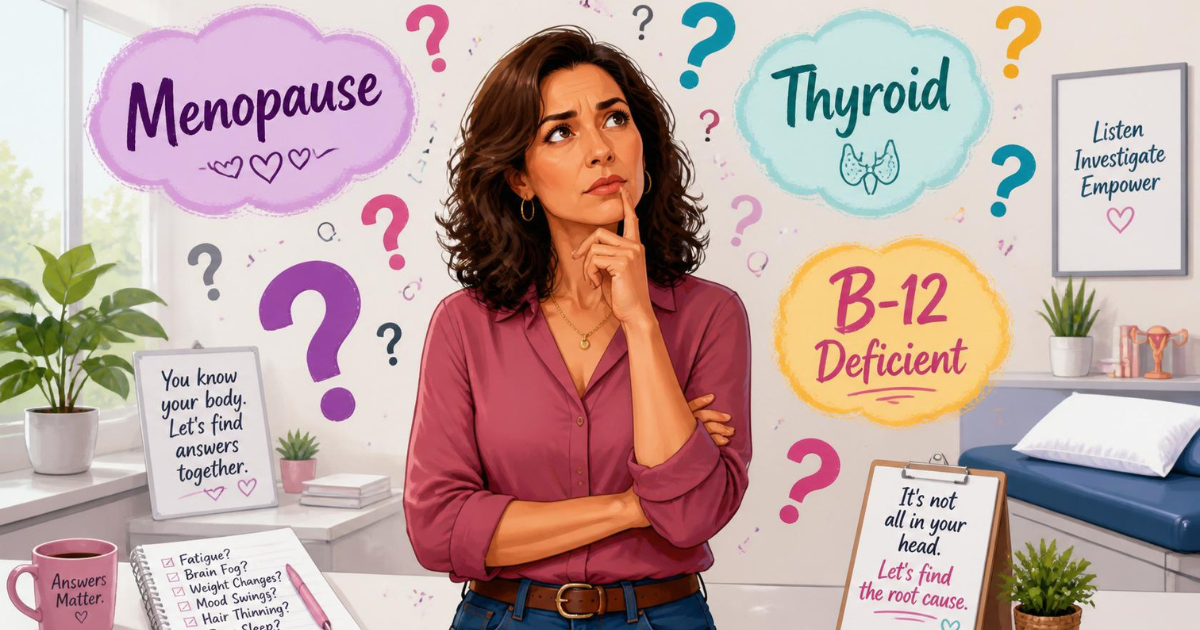
Is It Menopause or Something Else? Thyroid, Iron, and the Fatigue Look-Alikes
You've been told it's menopause. The exhaustion, the fog, the dragging-yourself-through-the-day feeling — someone waved a hand and said "it's your age." And maybe it is. But some of the most common causes of midlife fatigue aren't menopause at all — they just look exactly like it. And unlike menopause, they're simple to find with a blood test and very treatable once someone looks.
Educational Review: Her Midlife Wellness Help Editorial Team
Content Type: Research-Informed Menopause Education
Version in Spanish: ¿Es la menopausia o es otra cosa? La tiroides, el hierro y los imitadores de la fatiga
Introduction
You've been told it's menopause.
The exhaustion, the fog, the dragging-yourself-through-the-day feeling — someone waved a hand and said "it's your age, it's the change, welcome to midlife." And maybe it is. But maybe it isn't. Or maybe it's menopause and something else riding along underneath, quietly making everything worse.
Here's what almost nobody tells you: some of the most common causes of midlife fatigue are not menopause at all. They just look exactly like it. And unlike menopause, they're often simple to find with a blood test and very treatable once someone actually looks.
So this article is the one that says: don't just accept "it's menopause." Not because your doctor is wrong, but because "tired in midlife" has a short list of impostors worth ruling out — and you deserve to know what they are.
Nobody prepared us for this part. Let's make sure nothing's being missed.
Why these get mistaken for menopause
The trouble is that fatigue is what doctors call a nonspecific symptom. It doesn't point to one cause. And several conditions that spike in exactly your age range produce the same tired, foggy, not-myself feeling that menopause does.
When your symptoms could be three or four things at once, the honest move isn't to guess — it's to test. As one clinician put it plainly: fatigue and brain fog are symptoms, not diagnoses, and they can come from B12 deficiency, thyroid dysfunction, iron deficiency, insulin resistance, sleep disorders, or hormone imbalances — so testing should come first (via Newsweek, 2026).
That's the whole spirit of this article. Not "here's what's wrong with you" — but "here's what's worth checking, so you're treating the right thing."
Let's go through the big three.
1. Your thyroid
If there's one impostor to know about, it's this one — because it's common, it hits women in exactly your years, and it's endlessly mistaken for menopause.
The symptom overlap is almost comical in how complete it is. Fatigue, brain fog, mood swings, weight gain, sleep trouble, hair changes, temperature sensitivity — all of these happen in both perimenopause and an underactive thyroid, which is exactly why thyroid problems get waved off as "just menopause" (Dr. Christine Maren, 2026). The European Menopause and Andropause Society specifically flags that thyroid disorders and menopause overlap so much in symptoms that it makes diagnosis genuinely challenging (EMAS, via Medichecks, 2026).
There's one clue that helps you tell them apart, and it's worth knowing: hot flashes and feeling too hot lean toward menopause, while feeling unusually cold — cold when everyone else is comfortable — is a classic thyroid sign (Medichecks, 2026). Not a diagnosis, just a hint worth mentioning to your doctor.
Here's why it matters so much to catch: if your thyroid is off, no amount of estrogen or menopause treatment will fully fix your energy. As one menopause specialist puts it, if the thyroid isn't optimized, no amount of estrogen or progesterone will fully restore energy, metabolism, or mood (Dr. Christine Maren, 2026). You could do everything right for menopause and still feel awful, simply because the real driver was never checked.
The test: a simple TSH blood test is the high-value first step. Some providers stop at that one number — if your symptoms are strong and your TSH is "borderline," it's reasonable to ask about fuller thyroid testing (Ulta Lab Tests, 2025).
2. Your iron
This one is especially cruel in perimenopause, because perimenopause itself can cause it.
Here's the mechanism nobody explains: as your cycles become erratic in perimenopause, many women get heavier, longer periods — and heavy menstrual bleeding is a direct route to iron loss and iron-deficiency anemia (Hello Clue, 2024). (If heavy bleeding is part of your picture, that's its own subject: Heavy Bleeding During Menopause.) So the very hormonal chaos that says "menopause" can quietly be draining your iron at the same time. Doctors even have a name for it — perimenopause anemia, anemia triggered or worsened by the hormonal shifts of midlife (Women's Wellness of Mississippi, 2025).
And low iron feels exactly like menopause fatigue — the tiredness, the brain fog, the wiped-out feeling — with a few tells worth knowing: iron-deficiency anemia often adds shortness of breath after mild exertion, unusual paleness (check your inner eyelids and nail beds), and sometimes dizziness (Carrot, 2026; Hello Clue, 2024).
The frustrating part: many providers don't realize iron deficiency is a concern in perimenopause at all, so it often goes unchecked (Hello Clue, 2024). You may have to be the one to raise it.
The test: ask specifically for a ferritin level — that's the one that measures your iron stores and catches deficiency before it becomes full anemia — usually alongside a CBC (Elektra Health, 2026; Ulta Lab Tests, 2025).
3. Your B12
This is the quiet one, and it's genuinely common in your age group in a way most women don't know.
Vitamin B12 deficiency is estimated to affect 10–15% of people over 60 (PubMed, Andrès et al.), and studies in postmenopausal women specifically put it anywhere from 6% to 30% depending on the population (Sensorimotor study, NIH/PMC, 2024). That's not rare — that's common.
And the reason it climbs with age is sneaky: even if you're eating plenty of B12, your body absorbs less of it as you get older, because absorption of protein-bound B12 drops with age due to changes in the stomach lining (PubMed, Baik & Russell). So this isn't about a bad diet. A woman eating well can still run low.
The symptoms? The same familiar list — fatigue, brain fog, memory changes, weakness, low mood — plus a few that are more specifically B12: numbness or tingling in the hands and feet, and balance issues (Newsweek, 2026). B12 deficiency is so often written off as normal aging precisely because its symptoms overlap with what we expect midlife to feel like (Newsweek, 2026).
The test: a B12 blood test — and if it comes back low-normal but your symptoms are strong, ask about MMA (methylmalonic acid) testing, which can catch a deficiency a standard B12 test misses (Newsweek, 2026).
They also tangle together
One more thing worth knowing, because it shows why a single test sometimes isn't enough: these impostors feed each other.
Iron, for instance, is required to make thyroid hormone — the enzyme that builds thyroid hormone needs iron to work — so low iron can actually drag down your thyroid function even if the thyroid gland itself is fine (Thriving Proof, 2025). And B12 deficiency shows up more often in people with thyroid disease (PMC, 2023). It's not always one villain. Sometimes it's a couple of them, quietly reinforcing each other, all wearing a "menopause" costume.
That's not meant to overwhelm you. It's meant to make the case for one simple thing: a proper look, not a shrug.
What to actually do with this
Here's the honest, practical path — and notice what it is not. It's not "go buy iron and B12 supplements and hope." Please don't. Taking iron you don't need can genuinely harm you (iron overload is real), and guessing wastes months. The right order is test first, then treat what's actually low.
Confirm any deficiency with your provider before starting supplements, because targeted treatment based on your actual levels is what works (Carrot, 2026).
So:
Bring your symptoms in writing. If you've been tracking your fatigue and sleep — even a few days of it — that's real information your doctor can use, far better than "I'm always tired." (If you haven't started, my free 3-day tracker makes it easy.)
Getting answers starts with clear information.
Track your symptoms for 3 days and walk into your next appointment with real data — so you finally get the right answer.
Get the Free 3-Day Symptom TrackerAsk for the specific labs by name. A reasonable first panel for midlife fatigue is: TSH (thyroid), ferritin plus a CBC (iron), and B12 (Ulta Lab Tests, 2025). Writing those four down and bringing them to your appointment saves you a second visit. (For the full appointment playbook — every lab to request and exactly how to ask so you're not dismissed — here's the guide:What to Ask Your Doctor About Perimenopause.)
Don't accept "it's just menopause" if your gut says otherwise. You're allowed to ask "could we check my thyroid and iron before we assume?" A good provider won't mind. If yours brushes it off entirely, that's information too.
Treat what the tests find. If it's low iron, low B12, or a thyroid issue, these are among the most fixable causes of exhaustion there are. That's the hopeful part of this whole article: if one of these impostors is your real problem, you may be much closer to feeling better than you think.
A gentle reminder
Nothing is wrong with you for still feeling exhausted after you "did everything right" for menopause.
Sometimes the reason the menopause fixes aren't working is that menopause wasn't the whole story. And that's not a failure on your part — it's a gap in how often midlife women's fatigue gets properly investigated instead of waved away. For too long, "it's just your age" has been the end of the conversation when it should have been the start of a blood test.
You know better now. You know the impostors have names — thyroid, iron, B12 — and that they're findable and fixable. You know which labs to ask for. You know that testing comes before treating.
That knowledge is power in an exam room. It turns "I'm so tired" into "I'd like to rule out my thyroid, iron, and B12" — and that sentence gets a different kind of appointment.
You did not choose this exhaustion. But you are choosing to chase down the real cause instead of just enduring it. That's not being difficult. That's being your own advocate — and you're allowed to be.
You are not alone in this. And you may be closer to an answer — a real, treatable one — than anyone has led you to believe.
Frequently Asked Questions
How do I know if my fatigue is menopause or my thyroid?
You often can't tell from symptoms alone — they overlap almost completely (fatigue, fog, mood, weight, sleep). One hint: feeling too hot leans menopause, feeling unusually cold leans thyroid (Medichecks, 2026). But the only real way to know is a TSH blood test. Because thyroid problems and menopause coincide so often (EMAS), it's worth testing even when you're clearly in perimenopause.
Can perimenopause cause iron deficiency?
Yes, and it's underrecognized. Erratic, heavier perimenopausal periods can cause significant iron loss, leading to iron-deficiency anemia — sometimes called "perimenopause anemia" (Women's Wellness of Mississippi, 2025; Hello Clue, 2024). Ask for a ferritin test, which catches low iron stores before full anemia develops.
Why would I be low in B12 if I eat well?
Because absorption drops with age. Your body absorbs less protein-bound B12 as you get older due to changes in the stomach lining, so even a good diet can leave you low (PubMed). B12 deficiency affects an estimated 10–15% of people over 60 — it's common, not rare.
Should I just start taking iron and B12 supplements to be safe?
No — please test first. Taking iron you don't need can be harmful, and guessing delays finding the real cause. Confirm any deficiency with your provider before supplementing, so you treat what's actually low (Carrot, 2026).
What blood tests should I ask for if I'm exhausted in midlife?
A reasonable first panel: TSH (thyroid), ferritin plus a CBC (iron), and B12 (Ulta Lab Tests, 2025). Bring them written down. If a test is low-normal but your symptoms are strong, ask about follow-up testing (fuller thyroid panel, or MMA for B12).
If you want to walk into that appointment prepared, my free 3-day Symptom tracker gives you something concrete to show your doctor — real patterns beat "I'm always tired" every time.
Related Articles
Why Fatigue Happens During Menopause: Hormones, Cellular Energy, and Brain Function
Why Am I So Tired Even After Sleeping? The Menopause Sleep Problem Nobody Explains
Menopause Fatigue: What Actually Helps?
What to Ask Your Doctor When You Think You Are in Perimenopause or Menopause
Heavy Bleeding During Perimenopause: Causes, Treatment, and When to See a Doctor
Sources / References
Andrès, E., et al. Vitamin B12 deficiency in the elderly. (PubMed.) https://pubmed.ncbi.nlm.nih.gov/10448529/
Correlation of Vitamin B12 Deficiency with Sensorimotor Deficits in Postmenopausal Women. (NIH/PMC, 2024.) https://pmc.ncbi.nlm.nih.gov/articles/PMC12052276/
Newsweek. Vitamin B12 Deficiency Can Mimic Aging. 2026. https://www.newsweek.com/vitamin-b12-deficiency-mimic-aging-12126457
Medichecks. Thyroid vs Menopause — How to Spot the Difference. 2026. https://www.medichecks.com/blogs/thyroid/thyroid-vs-menopause-how-to-spot-the-difference
Maren, C. Thyroid vs. Perimenopause: Signs, Symptoms & Solutions. 2026. https://drchristinemaren.com/thyroid-vs-perimenopause-a-guide-to-signs-symptoms-solutions/
Hello Clue. Iron Deficiency and Perimenopause. 2024. https://helloclue.com/articles/menopause/iron-deficiency-and-perimenopause-what-are-the-signs
Elektra Health. Is It Iron Deficiency or Is It Menopause? 2026. https://elektrahealth.com/blog/iron-deficiency-or-menopause/
Carrot. Menopause and Fatigue. 2026. https://www.get-carrot.com/blog/menopause-and-fatigue
Ulta Lab Tests. Perimenopause Symptoms & Blood Tests. 2025. https://www.ultalabtests.com/blog/hormone/hormones-women/perimenopause-symptoms-blood-tests-your-next-steps/
Thriving Proof. Hypothyroidism, Iron Deficiency, and Perimenopause/Menopause. 2025. https://www.thrivingproof.com/hypothyroidism-iron-deficiency-and-perimenopause-menopause-when-fatigue-isn-t-just-getting-older/
A note, friend to friend: This article is for education and information — it's not medical advice, and it isn't a substitute for a conversation with your own doctor or a qualified health provider. Every woman's body and history are different, so what's right for someone else may not be right for you. Please bring any questions about your symptoms, treatments, or medications to a professional who knows you. You deserve care that's built around you.

Why Do I Crash Every Afternoon During Menopause? The 3 P.M. Wall, Explained
It's like clockwork. You're fine in the morning, you get through lunch, and then around 2 or 3 p.m. a wall comes down — heavy eyes, sludgy brain, desperate for a nap or something sweet. You didn't used to be like this, and you're not imagining that it's gotten worse in midlife. The afternoon crash is real, it has a specific mechanism, and menopause quietly makes it hit harder.
Educational Review: Her Midlife Wellness Help Editorial Team
Content Type: Research-Informed Menopause & Metabolic Health Education
Version in Spanish: ¿Por qué me desplomo cada tarde durante la menopausia? El muro de las 3 de la tarde, explicado
Introduction
It's like clockwork.
You're fine in the morning. You get through lunch. And then somewhere around 2 or 3 p.m., a wall comes down. Your eyes go heavy, your brain turns to sludge, and all you can think about is a nap, a coffee, or something sweet — anything to claw your way to five o'clock.
You didn't used to be like this. And you're not imagining that it's gotten worse in midlife.
The afternoon crash is real, it has a specific mechanism, and menopause quietly makes it hit harder. Once you understand what's actually happening between your lunch, your hormones, and your internal clock, you can stop white-knuckling through it — because it turns out this is one of the more fixable kinds of tired.
Nobody prepared us for this part. Let's take apart the 3 p.m. wall.
What's actually causing the crash
The afternoon slump isn't one thing. It's three things landing at the same time, and in midlife a fourth joins the pile-on.
One: your body clock naturally dips in the afternoon. This part is universal — it happens to everyone, menopause or not. There's a genuine circadian dip in alertness and energy in the early afternoon, long documented as the "post-lunch dip" (Monk, Clinics in Sports Medicine). Your internal clock schedules a low point in the early-to-mid afternoon. It's built in.
Two: your cortisol is on its way down. Cortisol isn't just a stress hormone — it's also your body's natural "get up and go" signal, and it runs on a daily curve: high in the morning to wake you, tapering across the day. By afternoon it's well into its decline. So the hormone that gave you morning drive is quietly leaving the room right when the clock-dip hits.
Three — and this is the big one you can control: your lunch. Here's the mechanism that turns a mild dip into a wall. When you eat a lunch heavy in refined carbs — the sandwich, the pasta, the pastry — your blood sugar spikes fast. Your body answers with a surge of insulin to clear it. And sometimes that insulin response overshoots, driving your blood sugar below where it started. That's called reactive hypoglycemia, and the timing is cruel: these post-meal blood sugar crashes typically hit 2 to 5 hours after eating (reactive hypoglycemia research, via Father Fuel) — which is to say, right in the middle of your afternoon. The spike buys you a brief lift, then the crash drops you into fatigue, shakiness, and fog.
Stack those three and you get the wall. Now here's what menopause adds.
Why menopause makes it worse
If your afternoon crashes have gotten deeper in midlife, it's not your imagination — the hormonal shift is changing how your body handles blood sugar.
As estrogen declines and fluctuates during the menopause transition, it can influence glucose regulation and insulin sensitivity (Scarfo, 2026). In plain terms: your body becomes a little less efficient at managing blood sugar than it used to be, so the same lunch that was fine at 35 now sends you on a bigger spike-and-crash at 50. Many women notice their energy, cravings, and metabolism shift during this time, and blood sugar is often part of that picture (Scarfo, 2026).
And there's a fascinating thread connecting this to the rest of your menopause symptoms. Research in Menopause: The Journal of the Menopause Society found that women with more hot flashes also showed greater swings in continuous glucose monitoring — suggesting the vasomotor instability of menopause and blood sugar instability may share common hormonal drivers (via Dr. Ruthie Harper, MD). Your hot flashes and your afternoon crashes might be cousins.
There's also a loop worth knowing about, because it explains why stressful, exhausting days feel the worst. When your blood sugar drops, your body releases cortisol to pull it back up — and chronically elevated cortisol worsens insulin resistance, which makes blood sugar swings bigger, which triggers more cortisol (Dr. Ruthie Harper, MD). Blood sugar and stress hormones feed each other. (The stress-hormone side of midlife has its own article, if that's your bigger struggle: Why Stress Can Feel Different During Menopause )
One honest correction to a myth you'll see everywhere: some articles claim afternoon is when your blood sugar control is naturally worst. The research actually shows the opposite — glucose tolerance is lower in the evening than midday (PNAS, 2015). So your afternoon crash isn't because 3 p.m. is your metabolic low point; it's the circadian energy dip plus a reactive crash from lunch, colliding. That distinction matters, because it tells you exactly where to aim: the fix is mostly about what and when you eat, not fighting the clock.
What actually stops the crash
Here's the good news I promised: this is one of the most responsive kinds of fatigue. Small changes to how you eat and move can flatten the wall dramatically. These target the one leg of the tripod you actually control — the blood sugar spike.
Rebuild lunch around protein and fiber, not refined carbs. This is the single biggest lever. A lunch anchored by protein and fiber-rich vegetables raises your blood sugar slowly and steadily instead of spiking it — no spike, no overshoot, no crash. You don't have to cut carbs; you have to anchor them. Put the protein and veggies first, let the bread or pasta be the side, not the center. The pasta-coma lunch is the crash's best friend.
Take a 10-minute walk after lunch. It sounds almost too simple, but movement after eating helps your muscles pull glucose out of your bloodstream, blunting the spike before it can become a crash. A short walk after your midday meal is one of the most effective, most underused tools there is. Even ten minutes around the block counts.
Don't skip breakfast, and put protein in it. Skipping breakfast sets up bigger blood sugar swings later in the day. A protein-forward morning meal steadies the whole day's glucose rhythm, so by afternoon you're working from a calmer baseline. (This ties into the bigger energy plan — the full toolkit is here: Menopause Fatigue: What Actually Helps? )
Watch the "fix" that makes it worse. When the wall hits, the instinct is coffee and something sweet. The sugar gives you fifteen minutes and then deepens the very crash you're trying to escape — another spike, another overshoot. And caffeine after about 2 p.m. can quietly sabotage that night's sleep, which sets up an even worse crash tomorrow. Reach for protein and a walk instead of sugar and a fourth coffee.
Protect your sleep — because tired amplifies everything. Poor sleep worsens insulin sensitivity the next day, making the crash deeper. So the nights and the afternoons are connected. (If your sleep is the weak link, start here: Why Am I So Tired Even After Sleeping?)
That afternoon crash isn't random.
Track it for 3 days and you'll start seeing exactly what's draining you — and when.
Get the Free 3-Day TrackerWhen it's worth a closer look
Most afternoon crashes are the ordinary collision we've described, and they respond beautifully to the food-and-movement fixes above. But blood sugar swings this noticeable can occasionally be an early signal worth checking.
Intense afternoon crashes, strong carb cravings, post-meal fog, and new weight gain around the middle can be your body's early warning that glucose metabolism is shifting (Respin Health) — and midlife is exactly when insulin resistance can start to creep in. It's reasonable, especially if this is pronounced, to ask your provider for a simple A1C or fasting glucose test at your next visit. Not to alarm you — just to catch any early shift while it's easy to address.
And if the crashes come with the deeper, all-day exhaustion we've talked about elsewhere, it's worth making sure nothing else is underneath it. (The fatigue impostors — thyroid, iron, B12 — are here: Is It Menopause or Something Else? )
A gentle reminder
Nothing is wrong with you for hitting a wall every afternoon.
You're not undisciplined for wanting the 3 p.m. cookie, and you're not weak for needing the coffee. Your body is running an ordinary daily rhythm through a hormonal season that made it more sensitive — the dip is real, the crash is real, and the cravings are your blood sugar talking, not your willpower failing.
And this is genuinely one of the good ones to get, because it moves so fast. Change what's on your lunch plate, take the little walk, and within days — not months — most women feel the afternoon wall soften into something manageable. You can get your afternoons back.
You did not choose this season. But you are choosing how to meet it — understanding the wall instead of just bracing against it every day at three. That's how you stop losing the back half of your day.
You are not alone in this. So many women are hitting the same wall at the same hour right now, reaching for the same coffee. The difference is, now you know what it is — and what actually makes it better.
We're in it together.
Frequently Asked Questions
Why do I crash every afternoon during menopause?
Three things collide: your body clock's natural early-afternoon energy dip, your cortisol tapering off from its morning high, and — the big controllable one — a blood sugar crash from a carb-heavy lunch, which typically hits 2–5 hours after eating (reactive hypoglycemia research). Menopause adds a fourth factor: shifting estrogen makes your body less efficient at managing blood sugar (Scarfo, 2026), so the crash hits harder than it used to.
Does menopause affect blood sugar?
Yes. As estrogen declines and fluctuates, it can influence glucose regulation and insulin sensitivity (Scarfo, 2026), meaning the same meals may cause bigger spikes and crashes than before. Interestingly, women with more hot flashes also show more blood sugar variability, suggesting shared hormonal drivers (Menopause journal, via Dr. Ruthie Harper, MD).
What should I eat for lunch to avoid the afternoon crash?
Anchor your lunch in protein and fiber-rich vegetables, and let refined carbs (bread, pasta) be a smaller side rather than the center. This raises blood sugar slowly instead of spiking it, preventing the insulin overshoot that causes the crash. A 10-minute walk after eating helps even more.
Is caffeine or sugar a good fix when I crash?
No — both backfire. Sugar gives a brief lift then deepens the crash with another spike-and-drop. And caffeine after about 2 p.m. can disrupt that night's sleep, worsening tomorrow's crash. Reach for protein and a short walk instead.
Could my afternoon crashes mean something more serious?
Usually they're the ordinary blood-sugar-and-circadian collision. But intense crashes, strong carb cravings, and new weight gain around the middle can be an early signal that glucose metabolism is shifting (Respin Health). It's reasonable to ask your provider for an A1C or fasting glucose test, especially if it's pronounced — early shifts are easy to address when caught.
If you want to spot your own crash pattern — what you ate, when the wall hits, how bad it is — my free 3-day tracker makes it easy to see, and gives you something concrete to bring to your doctor .
Related Articles
Menopause Fatigue: What Actually Helps?
Is It Menopause or Something Else? Thyroid, Iron, and the Fatigue Look-Alikes
Why Stress Can Feel Different During Menopause: Understanding the Brain's Stress Regulation System
Sources / References
Monk, T.H. The Post-Lunch Dip in Performance. Clinics in Sports Medicine, 2005. https://pubmed.ncbi.nlm.nih.gov/15892914/
Morris, C.J., et al. Endogenous circadian system and circadian misalignment impact glucose tolerance via separate mechanisms in humans. PNAS, 2015. https://www.pnas.org/doi/10.1073/pnas.1418955112
Singh, R., et al. Postprandial Reactive Hypoglycemia. Current Diabetes Reviews. https://www.ncbi.nlm.nih.gov/pmc/articles/PMC7192270/
Scarfo, L. Why You Crash at 3pm: Blood Sugar, Hormones & Fatigue After 40. 2026. https://www.lisascarfonaturopath.com/blog/why-you-crash-at-3pm-blood-sugar-hormones-amp-fatigue
Harper, R. (MD). The Menopause–Blood Sugar Connection (citing Menopause: The Journal of the Menopause Society). 2026. https://ruthieharper.com/menopause/travis-county-menopause-doctor/
Respin Health. Menopause & Metabolic Health: Your Blood Sugar Timeline.https://www.respin.health/blog/menopause-metabolic-health-blood-sugar-timeline
A note, friend to friend: This article is for education and information — it's not medical advice, and it isn't a substitute for a conversation with your own doctor or a qualified health provider. Every woman's body and history are different, so what's right for someone else may not be right for you. Please bring any questions about your symptoms, treatments, or medications to a professional who knows you. You deserve care that's built around you.

Menopause Fatigue: What Actually Helps? The Real Plan to Get Your Energy Back
You're tired of being tired. You've read why menopause drains you — and understanding helped. But at some point, knowing why stops being enough. You want to know what to actually do about it. This is that article: the real, ordered plan, from the foundation you can start this week to the medical options worth a conversation. Because you are not meant to spend the next decade exhausted.
Educational Review: Her Midlife Wellness Help Editorial Team
Content Type: Research-Informed Menopause Education
Version in Spanish: Fatiga en la menopausia: ¿qué ayuda de verdad? El plan real para recuperar tu energía
Introduction
You're tired of being tired.
You've read the articles that explain why menopause drains you — the hormones, the stolen deep sleep, the whole exhausting picture. And understanding it helped. But at some point, knowing why you're running on empty stops being enough. You want to know what to actually do about it.
This is that article.
I'm going to give you the real, ordered plan — from the foundation you can start this week, to the medical options worth a conversation with your doctor. Some of it is free. Some of it costs a little. All of it is grounded in what the research actually supports, and I'll be honest about what helps a lot versus what just gets hyped.
Because you are not meant to spend the next decade exhausted. There is a way back to feeling like yourself — and it's more within reach than anyone's told you.
Nobody prepared us for this part. Let's build your plan.
First — the one step that comes before everything
Before we talk protein or hormones or any of it, there's a step that matters more than all of them, and skipping it is the single most common reason women stay tired: make sure you're treating the right thing.
Menopause fatigue is real. But The Menopause Society itself points out that fatigue can also signal other medical conditions that need attention — which is why a proper evaluation is the essential first step in any safe plan (The Menopause Society, via ByWinona). Thyroid problems, low iron, and B12 deficiency all masquerade as menopause fatigue, and no amount of protein or hormones will fix them — they need their own treatment.
So step one isn't a supplement. It's a blood test. If you haven't ruled out the impostors yet, start there. (This is its own whole article, and it's worth the ten minutes: Is It Menopause or Something Else? Thyroid, Iron, and the Fatigue Look-Alikes .)
Everything below assumes you've either checked those boxes or are in the process. Now — the plan.
The foundation: what to do on your own
This is where most of your energy is won or lost, and none of it requires a prescription.
Protect your sleep quality (not just quantity)
Here's the thing about menopause fatigue: for most women, disrupted sleep is the biggest single driver (Meto, 2026). You can eat perfectly and exercise daily, but if night sweats and 3 a.m. wakeups are shredding your deep sleep, you'll stay exhausted.
So protecting sleep isn't one item on the list — it's the center of it. A cool bedroom, steady sleep and wake times, easing off evening alcohol, and treating the night sweats at their source do more for your energy than almost anything else. (The full sleep toolkit lives here: Menopause Insomnia: What Actually Helps? . And if you're sleeping the hours but still wrecked, that specific problem is here: Why Am I So Tired Even After Sleeping? .)
Eat to steady your energy — starting with protein
If there's one dietary change worth making, it's getting enough protein — and most midlife women don't.
Here's why it matters for energy specifically: as estrogen declines, women lose muscle faster, and after 50, muscle mass can drop 5–10% per decade (SWAN data, via The 'Pause Life). Less muscle means a slower metabolism, less strength, and less physical stamina — you get tired doing things that used to feel easy. Protein, paired with movement, is how you defend that muscle.
I'll be honest about the evidence, because you deserve it: research suggests postmenopausal women should get at least the RDA of protein and likely more, with the dose spread across meals — though the researchers note the overall evidence is still limited and not high quality (Aird et al., narrative review, 2024). So this isn't a magic macronutrient. But "eat more protein, spread through the day" is low-risk, well-founded advice with real upside for energy and strength.
If hitting your protein target through food is a struggle — and with midlife appetite changes it often is — a protein powder is a genuinely useful gap-filler. It's not a treatment, it's a tool to make the target reachable. A scoop in your morning coffee or a post-walk shake is often the difference between "meant to get enough protein" and actually doing it.
Two more food notes that steady energy: build meals around protein and fiber-rich vegetables to blunt the blood-sugar swings that cause energy crashes (the afternoon-crash problem has its own article ), and stay hydrated, since even mild dehydration worsens fatigue and night sweats make you lose more fluid than you think.
Move — the right amount, the right way
I know. When you're this tired, exercise sounds like a cruel joke. But movement is one of the most reliable energy creators there is — regular activity enhances energy, improves circulation, and supports mental clarity in menopausal women (University of Rochester Medicine, 2025).
The most valuable kind for midlife energy is strength training, because it directly fights the muscle loss draining your stamina. Resistance exercise counteracts muscle atrophy by stimulating protein synthesis, preserving the strength and functional independence that make daily life feel less exhausting (Princeton Sports Medicine). Two or three short sessions a week is enough to start.
One honest caution that surprises people: more isn't better here. Excessive high-intensity exercise elevates cortisol, which can actually worsen menopause fatigue (Raveco, 2026). So you don't need to punish yourself with daily HIIT — in fact that can backfire. Strength work a few times a week, daily walks, and real rest days beat grinding yourself down.
Manage your energy, not just your time
This one's less about biology and more about survival, and it matters enormously for the woman carrying work, kids, and aging parents at once.
When your energy is a limited resource, you have to spend it deliberately. That means protecting your best hours for what matters, saying no to what you can, building in real recovery, and stopping the self-blame that itself is exhausting. Pacing isn't giving up — it's how you stop crashing.
The supplement question (the honest version)
You want to know what to take. Here's the truthful answer, and it's the same principle as everything else: supplements help most when they fill an actual gap — not as a blanket fix.
There's no single supplement that cures menopause fatigue; but if you're genuinely deficient in something like iron, B12, or vitamin D, correcting that deficiency can help significantly (MIDI Health, 2025). That's the whole game — test, find the real gap, fill that.
A few worth knowing honestly:
Magnesium — a reasonable, low-risk one that supports sleep quality and nervous-system calm, and many midlife women run low. It won't transform your energy on its own, but as part of the foundation it earns its place, and the glycinate form is gentle on the stomach. It's the one I keep on hand.
B12 and vitamin D — genuinely worth checking, because deficiencies are common in midlife and both cause fatigue. B12 is water-soluble, so there's little risk from supplementing, but it's still best to confirm with your provider (Inflexxion Health). Vitamin D is worth a test, especially in darker months.
Iron — only if you're actually low. This is the one to not guess on: correcting real iron deficiency can resolve fatigue quickly, but too much iron is harmful, so levels should be monitored (Nore Health). Test first, always.
The pattern across all of them: don't self-prescribe a cabinet full of pills. Find your actual deficiencies and treat those.
Affiliate disclosure: If you buy through a link above, I may earn a small commission at no extra cost to you. I only point you toward things I'd recommend to a friend at my own kitchen table.
The medical options: when to bring in your doctor
If you've built the foundation and you're still dragging, it's time for a real conversation — and there are genuine medical tools worth knowing about.
Hormone therapy (HRT/MHT)
Here's the honest picture on hormones and energy, because it's often oversold in both directions.
HRT is not a direct "energy drug." But it can meaningfully improve fatigue indirectly, and powerfully — mainly by fixing what's stealing your sleep. Hormone therapy is the most effective treatment for hot flashes and night sweats, and by calming those, it can improve sleep quality and therefore daytime energy (via PubMed; ByWinona). Estrogen also supports the brain's energy pathways, which can ease the "wired-but-tired" feeling (ByWinona). Progesterone, for many women, promotes deeper, more restorative sleep.
So if your fatigue is being driven by night sweats wrecking your sleep, treating those with hormones can be genuinely transformative for your energy. One honest boundary, though: the Menopause Society does not recommend HRT specifically for cognitive complaints like brain fog, due to lack of evidence (NIH/PMC review) — so it's a sleep-and-symptom tool, not a fog cure. (The full HRT picture — benefits, risks, who it's for — is in our treatment guide: What Actually Helps Hot Flashes? .)
Treating the deficiencies properly
If your blood work turned up low iron, B12, or thyroid trouble, this is where your energy comes back — often dramatically. These aren't "manage forever" problems; they're fixable. Correcting iron deficiency can resolve fatigue rapidly; treating hypothyroidism restores the metabolic engine; B12 repletion brings back cellular energy. The plan is simple: treat what the test found, then retest in 3–6 months to confirm it worked (Women's Wellness of Mississippi, 2025).
Don't overlook mood and sleep disorders
Two more medical pieces worth naming: depression and anxiety can present largely as fatigue, and they're treatable. And sleep apnea — which rises sharply after menopause — is a common, very fixable cause of "I sleep but I'm exhausted." If your fatigue comes with loud snoring, low mood, or just won't lift, these deserve a look.
Your starting plan this week
If it's a lot, here's where to begin, in order:
Rule out the impostors first — if you haven't, get the blood tests (thyroid, ferritin, B12). Don't build on an unchecked foundation.
Attack sleep quality — it's the biggest lever. Cool room, steady schedule, treat the night sweats.
Add protein and a little strength work — defend the muscle that holds your stamina. Two sessions a week, protein at each meal.
Pace your energy — protect your best hours, build in recovery, drop the guilt.
If you're still struggling after a few weeks, book the appointment — and ask specifically about HRT for your sleep symptoms, and about anything your labs flagged.
That's not desperate flailing. That's a real plan, in the right order, with something that helps at every step.
Your energy can come back.
The plan that works is the one built on your patterns. Track 3 days and see what's really draining you — and where to start.
Get the Free 3-Day Symptom TrackerA gentle reminder
You are not lazy, and you have not "let yourself go."
You've been running your life on an energy system that menopause quietly rewired — less muscle, worse sleep, a metabolism finding new footing — and you kept showing up anyway. That's not weakness. That's someone doing hard things on far less fuel than she used to have, without even knowing why.
The exhaustion is real, but it is not permanent, and it is not your fault. And here's the part I most want you to hold: this is one of the most fixable seasons of midlife. Between protecting your sleep, defending your muscle, treating any real deficiencies, and the medical tools available now, most women can feel dramatically better than they do today. Some feel more energized than they have in years.
You did not choose this exhaustion. But you are choosing to do something about it — the right things, in the right order — instead of just enduring. That's not too much to want. Your energy was never too much to want.
You are not alone in this. And you are so much closer to feeling like yourself again than this tired moment is telling you.
We're in it together.
Frequently Asked Questions
What actually helps the most with menopause fatigue?
For most women, protecting sleep quality is the single biggest lever, since disrupted sleep is often the main driver (Meto, 2026). After that: enough protein plus strength training to defend your muscle and stamina, treating any real nutrient deficiencies (iron, B12, D), and — if night sweats are wrecking your sleep — hormone therapy. But step one is always ruling out non-menopause causes with a blood test.
Will hormone therapy fix my fatigue?
It can, mostly indirectly. HRT is the most effective treatment for night sweats and hot flashes, and by calming those it improves sleep and therefore daytime energy (PubMed; ByWinona). It's not a direct energy drug — and it's not recommended specifically for brain fog — but if disrupted sleep from night sweats is draining you, it can help a lot. Discuss it with a menopause-informed provider.
How much protein do I actually need in menopause?
Research suggests postmenopausal women should aim for at least the RDA and likely somewhat more, spread across meals — though the evidence base is still limited (Aird et al., 2024). The practical takeaway: include protein at each meal, and use a protein powder to fill the gap if food alone falls short. It protects the muscle that holds your energy and strength.
Should I take supplements for menopause fatigue?
Only to fill a real gap. There's no single supplement that cures fatigue, but correcting an actual deficiency in iron, B12, or vitamin D can help significantly (MIDI Health, 2025). Magnesium is a reasonable low-risk addition for sleep. Iron especially should only be taken if you've tested low, since too much is harmful.
Why am I still exhausted even on HRT / after doing everything right?
A few common reasons: an untreated deficiency (B12 and iron are frequently missed, even in women on HRT), undiagnosed sleep apnea, thyroid trouble, or depression. If you've optimized hormones and lifestyle and you're still wiped out, it's worth going back for blood work — the missing piece is often one of these treatable look-alikes. (See: Is It Menopause or Something Else? .)
If the day-to-day comfort side helps — the cooling bedding, the small things that protect your rest and energy — I keep my honest favorites on my Menopause Comfort Favorites page (link here).
And if you want to spot your own patterns before a doctor's visit, my free 3-day tracker gives you something concrete to work from.
Related Article
Is It Menopause or Something Else? Thyroid, Iron, and the Fatigue Look-Alikes
Why Fatigue Happens During Menopause: Hormones, Cellular Energy, and Brain Function
Menopause Insomnia: What Actually Helps?
Sources / References
The Menopause Society, via ByWinona. Menopause Fatigue: Why It Happens and How to Manage It.https://bywinona.com/journal/menopause-symptoms/fatigue
Meto. Menopause Fatigue: Why You're So Tired and How to Get Your Energy Back. 2026. https://meto.co/blog/why-menopause-makes-you-tired
Aird, T., et al. The Impact of Protein in Post-Menopausal Women on Muscle Mass and Strength: A Narrative Review. Journal of Ageing and Longevity, 2024. https://www.mdpi.com/2673-9488/4/3/16
University of Rochester Medical Center. Why Exercise is Essential During Menopause. 2025. https://www.urmc.rochester.edu/news/publications/health-matters/why-exercise-is-essential-during-menopause
Princeton Sports and Family Medicine. The Science Behind Strength Training for Postmenopausal Women.https://www.princetonmedicine.com/blog/the-science-behind-strength-training-for-postmenopausal-women-a-sports-medicine-perspective
MIDI Health. 8 Best Minerals, Supplements & Vitamins for Menopause Fatigue. 2025. https://www.joinmidi.com/post/vitamins-for-menopause-fatigue
Cognitive Function in Peri- and Postmenopausal Women: Implications for Iron Supplementation. (NIH/PMC.) https://www.ncbi.nlm.nih.gov/pmc/articles/PMC12157887/
Women's Wellness of Mississippi. Low Estrogen and Iron Deficiency. 2025. https://womenswellnessms.com/low-estrogen-and-iron-deficiency/
A note, friend to friend: This article is for education and information — it's not medical advice, and it isn't a substitute for a conversation with your own doctor or a qualified health provider. Every woman's body and history are different, so what's right for someone else may not be right for you. Please bring any questions about your symptoms, treatments, or medications to a professional who knows you. You deserve care that's built around you.