
Her Parents Help
Clear, calm support as you care for an aging parent
Practical guidance, simple tools, and calm direction to help you care for your parent with more confidence and less overwhelm.
Are you also navigating your own midlife changes? We have that covered too." → Visit Her Midlife Wellness Help
Welcome to Her Parents Help
For the woman who has cried in the car, laughed in the parking lot, and somehow done both on the same Tuesday.
You found this place for a reason.
Maybe your parent just got a diagnosis and you don't know where to start. Maybe you've been doing this for a while and you're running on empty. Maybe you're sitting in a waiting room right now, phone in hand, searching for someone who gets it.
We get it. You are in the right place.
Caring for an aging parent is one of the hardest things you will ever do. It is also — and nobody warns you about this part — sometimes really, really funny.
Not because it isn't hard. Because it is. And because sometimes the only thing left to do is look at your sister across the room and just lose it.
You know the laughter I'm talking about.
The midnight group chat with your siblings. The voice memo that starts with crying and ends with laughing. The moment in the parking lot after the hard appointment where one of you says something and suddenly you're both crying-laughing and a stranger walks by and you do not care even a little.
That laughter is not a failure of love. That is love — the deep, exhausted, in-it-together kind.
A few things I never thought I'd say to my mother:
"That is a beautiful outfit. Is that the one you wore yesterday? And the day before?" — I bought three identical ones. I rotate them in the dark. She has never noticed. Greatest victory of my adult life.
"The appointment is at 10. So we're leaving at 8:15." — Because getting out the door is now a full production and I treat Tuesday morning doctor appointments the way airports treat international flights.
"I'm not the nurse. I'm your daughter. Still your daughter. Yes, still." — Said with love. Every single time.
"I love you too. Go back to sleep." — 3am. Every few nights. And I would not trade it.
This is the peace we are building here. Not the quiet kind. The real kind — the kind that has been through something, that holds the laughter and the heartbreak in the same hand and keeps going.
Her Parents Help is your resource, your guide, and your community for every part of this journey. Practical help. Honest conversations. And yes — more moments like this one, because sometimes you need information and sometimes you just need to know someone gets it.
You don't have to carry this alone.
Join our community and get the free Caregiver Starter Checklist — the first practical step when you don't know where to begin and everything feels like too much.
No spam. Just real help, real talk, and a community that gets it.
Her Parents Help is part of Her Midlife Wellness Help — one woman, two of life's biggest challenges, one trusted resource.
Topics You Can Explore
Recognizing Changes in Aging Parents
Learn how to notice physical, emotional, and cognitive changes that may suggest your parent needs more support.
Recommended Articles:
Safety and Independent Living
Understand when living alone may still be appropriate—and when extra support may be worth considering.
Recommended Articles:
What to Do When Help Is Needed
If changes are becoming more noticeable, this section can help you think through next steps without panic or pressure.
Recommended Articles:
Difficult Conversations With Parents
Learn how to talk about support, safety, and changing needs without creating unnecessary conflict.
Recommended Articles:
Mental Load and Staying Organized
When you feel like you have to remember everything, this section offers calmer ways to manage information and reduce stress.
Recommended Articles:
How to Use This Page
You do not need to read everything at once.
Start with what feels most relevant right now.
Some people begin by looking for signs.
Others need help starting conversations.
Many simply need more clarity.
That is what this page is here for.
A Different Approach
You will not find pressure here to make fast decisions.
You will not be pushed into one-size-fits-all answers.
Every family situation is different, and caring for a parent can be emotional, personal, and complex.
So the approach here is simple:
👉 clarity
👉 practical guidance
👉 manageable next steps
Helpful Resources
If you need tools, guidance, or supportive resources beyond articles, you can also visit the resource page.
You do not have to do this perfectly.
You do not have to do it all today.
And you do not have to do it alone.
Sometimes the most important thing is simply having a place to begin.
Feeling overwhelmed? Visit our helpful resources for caregivers.
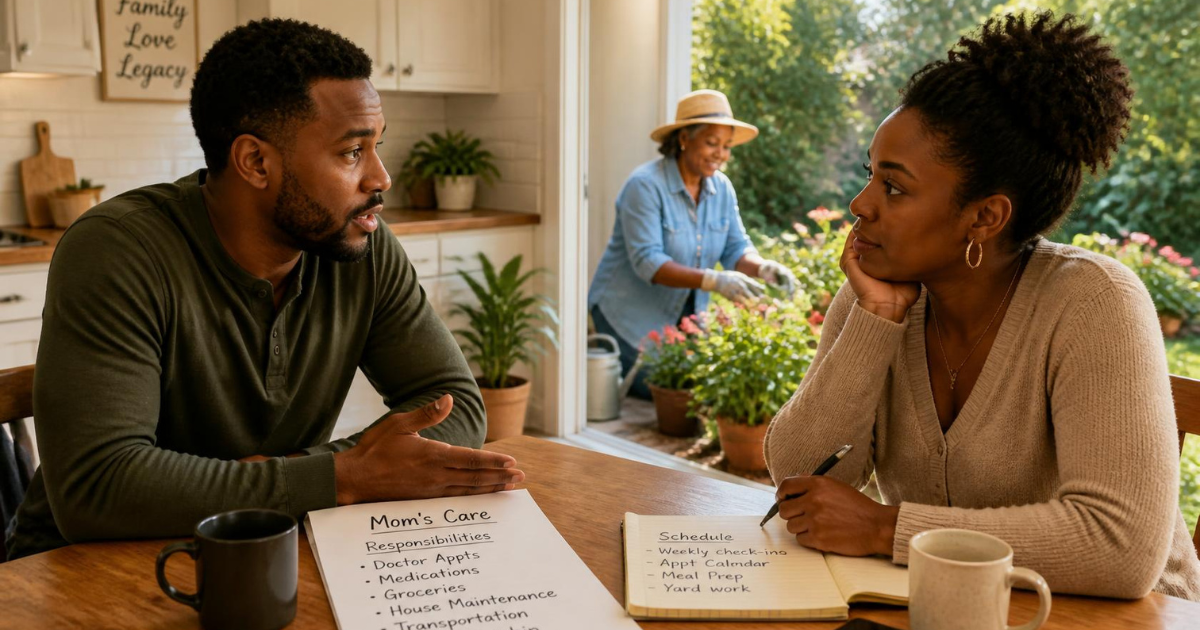
How to Divide Caregiving Responsibilities Between Siblings Without the Family Falling Apart
Caregiving almost always lands on one person — usually the one who lives closest, usually a woman. Here's the step-by-step framework for dividing a parent's care fairly between siblings: how to make the invisible work visible, split it by capacity instead of guilt, run the family meeting without a fight, and handle it when someone doesn't follow through.

Nobody Told Me It Would Be Like This
Nobody told me. I thought I knew what this would look like. I had seen it in movies. Read about it. Nodded like I understood. I did not understand. Not even close. Nobody told me what it actually feels like to watch the person who raised you slowly become someone you do not fully recognize anymore.

Burial Insurance for Aging Parents — A Simple Guide to What It Is and Whether Your Family Needs It
The names are different. The marketing is sometimes confusing. And underneath all of it is one simple question — is there an affordable way to make sure my parent's funeral does not fall on the family?

How Much Does a Funeral Actually Cost — The Complete Breakdown Most Families Never See
Most people have never planned a funeral. And most have no idea what one costs — until they are sitting across from a funeral director, in shock, trying to make decisions they have never made before.

What Is Final Expense Insurance — And Does Your Parent Need It?
A $10,000 policy. Around $30 a month. The decision that could save your family from a financial crisis at the worst possible moment. Here is everything you need to know about final expense insurance.

What Happens When There Is No Funeral Plan in Place — The Real Cost Nobody Talks About
You have seen it in your Facebook feed. A familiar face. A family in grief. A GoFundMe link. We share it, donate what we can, and scroll on. But nobody ever asks why this is still happening.

I Am Sandwiched Between Hot Flashes and My Mother's Dementia Appointments — This Is What a Week Looks Like
It is 5am on a Tuesday. Most people are asleep. I have been awake for an hour already — not because of insomnia — but because today is my mother's doctor appointment and I have learned that if I do not start preparing her three hours early we are not going to make it. This is what a week looks like now.

How to Find a Geriatric Care Manager — And Why This Person Might Be the Most Valuable Call You Make
What if there was a professional whose entire job was to help you navigate caregiving? There is. They are called geriatric care managers — and they may be the most underused resource in all of caregiving.

Nobody Told Me That Menopause Brain Fog and Caregiver Burnout Feel Exactly the Same — Here Is How to Tell Them Apart
You walked into the kitchen for something. You have no idea what. You forgot your neighbor's name — someone you have known for eleven years. Now you are wondering: is this menopause? Is this burnout? Is this the beginning of something worse? Here is the answer you have been afraid to ask for.

When It Is Too Late to Get a Power of Attorney — And What to Do If You Are Already There
It usually happens in a hospital room. A form needs to be signed. A decision needs to be made. And someone asks the question that stops you cold — who has power of attorney? Here is what to do.

Assisted Living vs. Nursing Home — What Is the Difference and How Do You Know Which One Your Parent Needs
Suddenly you are hearing terms you have never had to understand before — assisted living, skilled nursing, memory care. Here is exactly what they mean and how to choose.

The GLP-1 Side Effect List Your Doctor Skipped — Especially If You Are Over 45 and Caring for an Aging Parent
The clinical trials for GLP-1 medications were not conducted on women over 45 managing perimenopause, caregiver stress, and an appetite already suppressed by doing too much for everyone else. Here is the conversation your doctor probably did not have time for.

The Things Nobody Warned Us About — A Friday List for the Woman Who Shows Up
You found the remote in the refrigerator. You watched her un-swallow a pill like a magic trick. You sat through a doctor's appointment where she charmed everyone in the room while you held a symptom list nobody asked for. You negotiated a meal that she specifically requested and ate four bites of.
Nobody warned us about any of this.
And yet here you are — still showing up, still laughing, still figuring it out one impossible day at a time.

How to Keep Track of Your Aging Parent’s Health Without Feeling Overwhelmed
Appointments, medications, specialists, follow-ups — managing a parent's health can quickly become a second job. Here is a simple system for staying organized without letting it take over your life.

When Your Parent Has Dementia — What Families Need to Know
Whatever you are feeling right now — fear, grief, relief that you finally have an answer — all of it is valid. There is no wrong way to receive this news. But there are better ways to move through it.

The Sandwich Generation Survival Guide — For the Woman Doing It All in the Middle
Nobody named this experience until recently. The Sandwich Generation. Squeezed from both directions. Giving in both directions. This guide will not fix the sandwich. But it will help you survive it

Managing Your Hormones While Managing Their Health — The Sandwich Generation Guide to Not Losing Yourself
You research your mother's medications meticulously. You know every dosage, every specialist, every refill schedule. And your own hormone levels? Last checked sometime before the pandemic. Maybe. This article is about eventually being now.

The Ghost in the House — Why Things Go Missing When Mommy Is Around
I know I left it on the table. I watched myself put it there. I am a functioning adult with a working brain.
The charger is not on the table.
I searched every bag. Every cushion. Every surface in the room. I retraced every step. I started questioning my memory, my sanity, and whether the brain fog had finally won.
And then Xavier said four words that solved the whole mystery.
I was not ready for what I found.

Menopause and Caring for Aging Parents: Why You Feel So Exhausted (and It’s Not Just One Thing)
You are running on empty and you can not figure out why — because it is not just one thing. It is your hormones, your parent's needs, your household, and the invisible weight of doing it all. This article names what is happening and gives you permission to stop blaming yourself.

How to Talk to Parents About Money Without Causing Conflict
Money conversations with aging parents are loaded — with pride, fear, old family dynamics, and things nobody ever said out loud. Here is how to open the door without it turning into a fight.