Welcome
A space for women navigating the beautiful, complicated, science-informed reality of midlife health — with clarity, warmth and no judgment. It feels different. And so does having the right information.
Understanding Health Changes During Midlife
Articles on perimenopause, hormones, sleep, metabolism and the symptoms no one warned you about. Written clearly. Backed by research. Made for real life.
Because understanding what is happening in your body changes everything.
Are you also caring for an aging parent? You are in the right place for that too. → Visit Her Parents Help
Quick Reads
You Found The Right Place
Making sense of
midlife health changes
If your body has started doing things it has never done before — your cycle changing, your sleep shifting, your energy feeling different, your emotions surprising you — you are not imagining it. And you are not alone.
This is a science-informed space dedicated to helping women understand what is happening in their bodies during midlife — with clear explanations, honest information and the kind of warmth that has been missing from most conversations about women's health.
What you are feeling is real. It is documented. It makes complete sense. Now let's understand it together.
Whether you are just beginning to notice changes or you are deep in the transition — there is something here for you. Start wherever feels right.
Not sure where to begin?
Start right here.
The Her Midlife Primer is a free guide that walks you through what perimenopause actually is, what to expect, and how to start understanding the changes happening in your body. It is the perfect first step.
Her Midlife Wellness Help está disponible en español — con artículos, recursos y herramientas para las mujeres hispanohablantes que navegan la mediana edad. Porque cada mujer merece esta conversación en su propio idioma.
También estamos aquí
— en español.
Around here, we have a saying.
La abuela sabe...
Mija, escúchame. Hay cosas que necesitas saber.
La abuela — grandmother. Because some wisdom is timeless, in any language.
Take a breath. You’re not alone in this.
Your body is changing—and it’s trying to tell you something.
The symptoms, the shifts, the moments that feel unfamiliar… they have meaning.
You’re not meant to guess your way through this.
Here, you’ll find clarity, guidance, and tools to help you understand what’s happening—
and what to do next.
Start with what you need most today.
Track your cycle. Stop guessing.
Your body deserves to be understood.
When you track your cycle and patterns, things start to make sense.
Name what you’re feeling. Find clarity.
Tracking symptoms helps you connect the dots and feel more in control.
Understand before you decide.
Learn how GLP-1 medications work and what to expect before starting.
"It feels different. And now you have the tools to understand it".
Recent Educational Articles

You walked into the kitchen and forgot why. You lost a word mid-sentence — one you've known your whole life. By now you probably understand why it's happening. But understanding the fog doesn't clear it. At some point you want to know: what actually helps? So this is the honest toolkit — what the research really supports, ordered from the most proven to the most speculative, including one genuinely promising newer option worth knowing about.
You've read the explanations by now. You know the rage has a cause. You know the anxiety isn't weakness. Understanding helped — it genuinely did. But at some point, knowing why stops being enough. You want to stop white-knuckling through the days and feel like yourself again. So this is the article about what to actually do — the honest version, including the part a lot of menopause content is getting wrong.
You did everything right. You went to bed at a decent hour, got your eight hours — and woke up feeling like you'd been hit by a truck. If that's you, hear this first: you are not lazy, you are not imagining it, and you are not doing sleep wrong. There's a real, measurable reason a full night can leave you exhausted in midlife — and it has almost nothing to do with the hours.
You've tried the obvious things. The chamomile tea. Putting the phone down. Maybe a melatonin gummy that worked for three nights and then stopped. And you're still lying there at 1 a.m. So let's skip the recycled advice and get to what actually moves the needle — from the small changes you can make tonight to the single most effective insomnia treatment that exists, one most women have never even heard of.
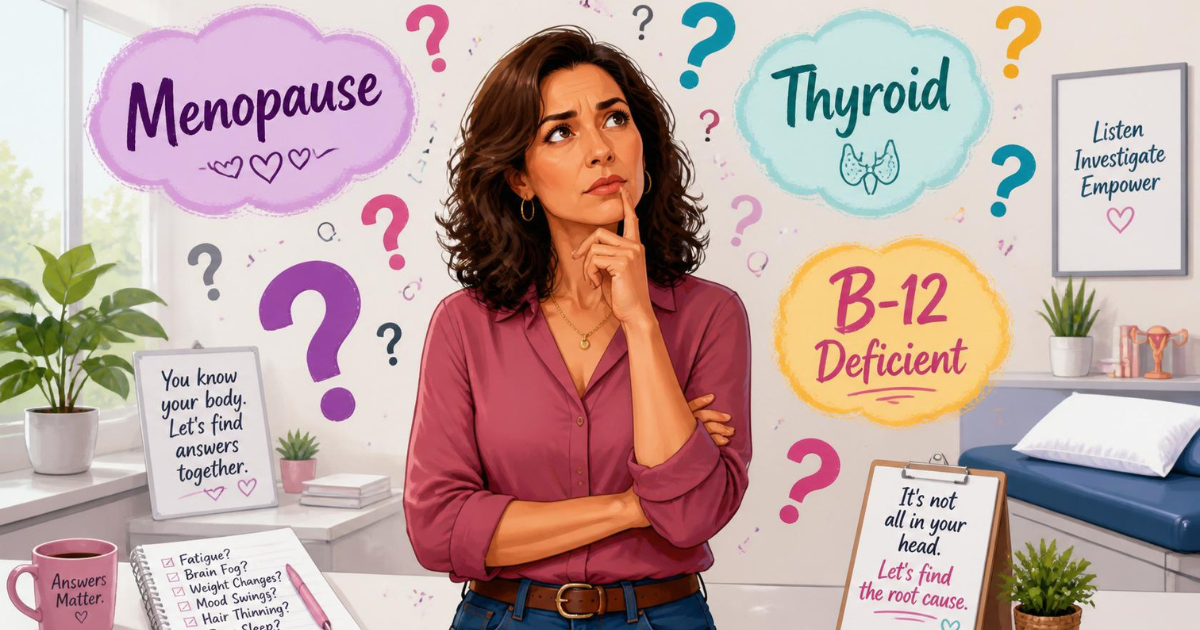
You've been told it's menopause. The exhaustion, the fog, the dragging-yourself-through-the-day feeling — someone waved a hand and said "it's your age." And maybe it is. But some of the most common causes of midlife fatigue aren't menopause at all — they just look exactly like it. And unlike menopause, they're simple to find with a blood test and very treatable once someone looks.
It's like clockwork. You're fine in the morning, you get through lunch, and then around 2 or 3 p.m. a wall comes down — heavy eyes, sludgy brain, desperate for a nap or something sweet. You didn't used to be like this, and you're not imagining that it's gotten worse in midlife. The afternoon crash is real, it has a specific mechanism, and menopause quietly makes it hit harder.
You're tired of being tired. You've read why menopause drains you — and understanding helped. But at some point, knowing why stops being enough. You want to know what to actually do about it. This is that article: the real, ordered plan, from the foundation you can start this week to the medical options worth a conversation. Because you are not meant to spend the next decade exhausted.
It's quiet now. The house is dark. Everyone's asleep. And your mind picks this exact moment to come roaring to life. Daytime you can manage — it's the nights that are undoing you. If this is you, there's a real reason anxiety saves its worst for the dark, and it's not that you're falling apart. Let's walk through it, and then through what actually breaks the spiral.
You finally got to sleep. And then you're awake — heart going, sheets damp, throwing the covers off, flipping the pillow to the cool side. If your hot flashes seem to save their worst for nighttime, you are not imagining it. There's a real, physical reason the nights hit harder than the days — and once you understand it, the 3 a.m. drench stops feeling like a personal failing.
Your sister breezed through menopause with a shrug. Your friend "barely had hot flashes." And you're changing your shirt twice a day, white-knuckling through meetings. Same season of life, wildly different experiences — and underneath it, a quiet question: why me? Here's the answer, up front, so you can breathe: you are not doing anything wrong.
You have probably been told a hundred things by now. Drink this tea. Try this supplement. Just breathe through it. And you are standing in the middle of all that noise, still sweating through your shirt, wondering what is actually true. So let's cut through it together — the honest version, including the parts nobody likes to say out loud.
When you typed "how long do hot flashes last," you probably weren't asking about the clock. You were asking: when does this end? When do I get to feel like myself again? So here's the real answer — both halves of it. The few minutes a single flash lasts, and the longer season the flashes themselves last. All of it true, even the parts you weren't told.
You are sitting through dinner, perfectly fine — and then the heat rolls up through your chest and into your face like someone opened an oven door behind you. That question — what set it off? — is one of the most useful ones you can ask. Because while you cannot stop your body from changing, you can often learn what tips it over the edge.
You have managed stress before. But something is different now. The anxiety is louder. The exhaustion is deeper. The belly weight appeared without explanation. This is what happens when cortisol and changing reproductive hormones collide — and nobody warned you they were on a collision course.
You snapped over a dish in the sink. You sat in your car and cried because you were so angry and did not even know why. And then you wondered — what is wrong with me? Nothing is wrong with you. Your hormones are changing and nobody told you this was part of it. Perimenopause rage is real, it has a biological cause, and you are not alone.
You have been feeling off for a while. The sleep. The mood. The brain fog. The heat at 3am. You are ready to talk to your doctor — but walking in without preparation is how you walk out with no answers. Here is exactly what to ask, what to test, and how to make sure you are heard.
He wrapped both hands around his mug, stared down at the table, and then looked up like a man who had been carrying something heavy for a long time. "I don't even know where to start. She's just… different. And I love her. I'm not going anywhere. I just don't always know what to do anymore." This is the conversation every married couple needs to hear.
She snapped at you over something small. Again. She cried over a commercial. You are walking on eggshells. Here is what is actually happening in her brain — and what to do about it.
If your marriage has felt different lately — strained, distant, unfamiliar — you are not imagining it. Menopause does things to a marriage. Here is the truth about what is happening and how couples come through this stronger.
You have two options. You can be the man who makes this harder — not out of cruelty, just out of not knowing. Or you can be the man who makes it a little easier. This article is for the second kind of man.
Did you notice? Right there at the beginning of the word. MEN-opause. You are more involved in this than you thought. Here is what you need to know.
Learn how menopause can affect bone density, heart health, and metabolism over time. Understand common risks after menopause and ways to support long-term wellness.
Postmenopause begins after 12 months without a period, but it does not always mean symptoms instantly disappear. Learn what changes may improve, what may continue, and how to support your body, bones, heart, sleep, and long-term wellness in this new phase of life.
This article explains postmenopausal bleeding: causes, cancer risk, endometrial thickness, and when to see your doctor and the underlying health changes that can occur during perimenopause and menopause. Learn the possible causes, what the symptoms may mean, and when medical evaluation may be appropriate.
This article explains why hair thinning happens during menopause: understanding hormones, hair growth, and midlife changes and the underlying health changes that can occur during perimenopause and menopause. Learn the possible causes, what the symptoms may mean, and when medical evaluation may be appropriate.
This article explains libido changes during menopause: why sex drive can shift in midlife and the underlying health changes that can occur during perimenopause and menopause. Learn the possible causes, what the symptoms may mean, and when medical evaluation may be appropriate.
This article explains glp-1 medications and menopause metabolism: why weight loss works differently after 40 and the underlying health changes that can occur during perimenopause and menopause. Learn the possible causes, what the symptoms may mean, and when medical evaluation may be appropriate.
This article explains why joint pain happens during menopause: understanding hormones, inflammation, and musculoskeletal health and the underlying health changes that can occur during perimenopause and menopause. Learn the possible causes, what the symptoms may mean, and when medical evaluation may be appropriate.
This article explains evidence-based supplements for menopause: what research actually shows and the underlying health changes that can occur during perimenopause and menopause. Learn the possible causes, what the symptoms may mean, and when medical evaluation may be appropriate.
This article explains hormone therapy for menopause: benefits, risks, and what women should know and the underlying health changes that can occur during perimenopause and menopause. Learn the possible causes, what the symptoms may mean, and when medical evaluation may be appropriate.
Are you also caring for an aging parent? You are in the right place for that too." → Visit Her Parents Help