
Menopause Brain Fog: What Actually Helps? The Honest Toolkit for Getting Your Sharpness Back
You walked into the kitchen and forgot why. You lost a word mid-sentence — one you've known your whole life. By now you probably understand why it's happening. But understanding the fog doesn't clear it. At some point you want to know: what actually helps? So this is the honest toolkit — what the research really supports, ordered from the most proven to the most speculative, including one genuinely promising newer option worth knowing about.
Educational Review: Her Midlife Wellness Help Editorial Team
Content Type: Research-Informed Menopause Education
Version in Spanish: Niebla mental en la menopausia: ¿qué ayuda de verdad? La guía honesta para recuperar tu claridad
Introduction
You walked into the kitchen and forgot why. You lost a word mid-sentence — a word you've known your whole life. You reread the same email three times and it still didn't land.
By now you probably understand why it's happening. You know it's your hormones, not your mind failing. You know it's usually temporary. That understanding helps — genuinely.
But understanding why the fog rolls in doesn't clear it. At some point you want to know: what actually helps?
So this is the honest toolkit. Not a list of miracle cures — a clear-eyed walk through what the research actually supports, ordered from the most proven to the most speculative. Some of it is free and you can start today. Some of it is worth a conversation with your doctor. And one option is genuinely promising newer research that's worth knowing about.
Nobody prepared us for this part. Let's get your clarity back.
First, the honest hierarchy
Here's what most "brain fog cure" content gets wrong: it leads with a supplement. The truth is that the most powerful levers for menopause brain fog are the unglamorous, free ones — sleep, stress, movement, blood sugar. A pill can't out-perform a week of broken sleep. So we start where the real leverage is, and work toward the newer options from there.
(If you want the full picture of the mechanism — how estrogen affects the hippocampus, memory, and neurotransmitters — that's covered in depth in the companion piece: Why Brain Fog Happens During Menopause. And if the fog has you genuinely frightened it might be something worse, please read Brain Fog vs. Dementia in Midlife: How to Tell the Difference — it will almost certainly set your mind at ease.)
Step 1: Fix the foundations (this is where the real power is)
These are the daily habits research most consistently links to cognitive clarity. They're free, they work, and they matter more than any supplement.
Protect your sleep — this is the single biggest lever. Poor sleep alone causes brain fog, in anyone, at any age. During sleep, your brain consolidates memories and literally clears metabolic waste. When menopause fragments your sleep — through night sweats, 3 a.m. wakeups, or anxiety — mental clarity is the first thing to suffer. If you fix one thing, fix this. (The full toolkit: Menopause Insomnia: What Actually Helps?)
Lower your cortisol. Chronic stress floods your brain with cortisol, which directly interferes with concentration and memory retrieval — in the exact regions (hippocampus, prefrontal cortex) menopause is already affecting. Stress and fog form a loop. Breaking it — through slow breathing, movement, time outdoors, or simply doing one thing at a time instead of five — measurably helps. (More: Why Stress Can Feel Different During Menopause)
Move your body. Exercise increases blood flow to the brain and stimulates BDNF, a protein that supports the growth of new neural connections. It's one of the most reliably brain-protective things you can do, and it doesn't have to be intense — brisk walking counts.
Steady your blood sugar. Blood sugar crashes feel exactly like brain fog — the mid-afternoon "I can't think" wall. Meals built on protein, fiber, and healthy fats keep your brain's fuel supply stable. (If afternoon crashes are your pattern: Why Do I Crash Every Afternoon During Menopause?)
If you do nothing else on this page, do these four. They're the foundation everything else builds on.
Not sure which of your symptoms are connecting to your brain fog? The free Menopause Symptom Quiz helps you see how your sleep, stress, mood, and energy are feeding into your mental clarity — in a couple of minutes — and points you to what's most relevant for you.
Step 2: Rule out the things that aren't menopause
Here's something important: not all "brain fog" is menopause. Several very treatable conditions cause identical symptoms — and if one of them is the real culprit, no amount of sleep hygiene will fix it. Worth asking your doctor to check:
Thyroid dysfunction, low B12, and iron deficiency all cause fog, forgetfulness, and mental fatigue that mimic menopause exactly. So can depression and sleep apnea. A simple blood panel can rule these in or out. (This is worth its own read: Is It Menopause or Something Else? Thyroid, Iron, and the Fatigue Look-Alikes — the same mimics that cause fatigue cause brain fog.)
Ruling these out is one of the highest-value steps you can take, because if the answer is "your thyroid," that's genuinely fixable.
Step 3: Hormone therapy — the honest picture
Since estrogen directly affects the brain regions involved in memory and focus, it's natural to ask whether hormone therapy (HRT) helps brain fog. The honest answer is nuanced:
Estrogen does influence cognition, and some women on HRT report clearer thinking — often because HRT improves the sleep and hot flashes that were fogging them up in the first place. But here's the important honesty: HRT is not FDA-approved as a treatment for cognitive symptoms, and the research on estrogen directly improving memory is mixed, with timing appearing to matter. It's not a guaranteed brain fog fix, and it shouldn't be started for cognition alone.
What this means practically: if you're a candidate for HRT for other reasons (hot flashes, night sweats, sleep disruption), improved mental clarity may come along with it. But it's a conversation to have with a menopause-informed provider about your whole picture — not a brain fog prescription. (The full HRT picture: Hormone Therapy for Menopause: Benefits, Risks, and What Women Should Know)
Step 4: Creatine — the promising newer option
This is the one genuinely exciting development in the brain fog space, and it surprised even me.
Most people think of creatine as a gym supplement. But it turns out the brain runs on creatine too — it's part of how brain cells produce energy. And in 2025, a randomized controlled trial studied creatine specifically in perimenopausal and menopausal women (the CONCRET-MENOPA trial) — which is rare and valuable, because most supplement research is never done in women our age.
What it found: compared to placebo, low-dose creatine improved alertness, executive function, and processing speed, and the medium-dose group reported significant reductions in fatigue and concentration difficulties — which is brain fog, described exactly. Brain imaging even showed creatine levels rising in the frontal brain regions tied to memory and focus. It was well-tolerated, with no adverse effects identified.
Now the honest calibration, because I won't oversell: it's one small trial (36 women). Promising is not the same as proven. This is early, encouraging research — not settled science. But unlike a lot of supplements marketed to menopausal women, creatine has actual menopause-specific evidence behind it, a plausible mechanism, and a strong long-term safety record.
On the form: the 2025 study used creatine hydrochloride (HCl) at low doses. But the most-studied form overall — with decades of safety research and the best value — is creatine monohydrate, typically 3–5g daily. Monohydrate is what most experts still recommend as the default; it's affordable, well-tolerated, and effective. The one I keep on hand is a plain creatine monohydrate — you can find it here.
Affiliate disclosure: If you buy through the link above, I may earn a small commission at no extra cost to you. I only point you toward things I'd recommend to a friend at my own kitchen table.
One safety note: creatine is very safe for most people, but if you have kidney disease or any renal condition, check with your doctor first. And as always, run any new supplement by your provider — especially if you're on other medications.
Step 5: Lion's mane — the honest footnote
You've probably seen lion's mane (a mushroom) marketed heavily for "brain health." I looked into it carefully, and I'll be straight with you: the evidence doesn't support it the way the marketing implies.
The human studies are small, short, and mixed — and critically, none were done in menopausal women. Some showed a mild cognitive benefit that vanished once supplementation stopped; others showed nothing beyond placebo. There's no standardized form, and some people get stomach upset or a skin rash from it.
So: it's not a proven brain fog treatment, and I'm not going to pretend it is. If you're curious and want to try it, that's your call — but talk to your doctor first, and don't expect it to do what the labels promise. I'd put your energy (and money) into the foundations and, if you want a supplement, the better-supported creatine.
Your plan, in order
If the fog has you overwhelmed, start here:
Fix your sleep first — it's the biggest lever, full stop.
Lower your stress load — even small reductions in cortisol help your memory.
Move daily and steady your blood sugar — free, proven, start today.
Ask your doctor to rule out thyroid, B12, and iron — because sometimes it isn't menopause at all.
Have the HRT conversation if you have other menopause symptoms too.
Consider creatine if you want an evidence-backed supplement — and skip the hyped ones that aren't.
Track your patterns so you can see what's actually helping. (My free 3-Day Menopause Symptom Tracker makes it easy, and gives you something concrete to bring to your doctor.)
A gentle reminder
Your brain is not broken. You are not "losing it." You are running a remarkable, adaptable organ through a major hormonal transition with almost no warning and everyone still needing things from you.
The fog is real — but it is, for the overwhelming majority of women, temporary and workable. You have real tools here: the free foundational ones that do the heavy lifting, the medical options worth discussing, and the newer research worth watching. You are not powerless, and you are not alone.
You did not choose this season. But you are choosing how to meet it — clearly, and with a plan.
We're in it together.
Frequently Asked Questions
What actually helps menopause brain fog the most?
The most powerful tools are the foundational ones: consistent, quality sleep; managing stress and cortisol; regular exercise; and stable blood sugar. These affect cognition more than any supplement, and they're free. Beyond that, it's worth ruling out treatable mimics (thyroid, B12, iron), discussing HRT with your doctor if you have other menopause symptoms, and — if you want an evidence-backed supplement — considering creatine, which has promising menopause-specific research. Start with sleep; it's the single biggest lever.
Does creatine really help brain fog in menopause?
The early evidence is genuinely promising. A 2025 randomized controlled trial in perimenopausal and menopausal women found low-dose creatine improved alertness, processing speed, and concentration, and reduced fatigue — with creatine levels rising in memory-related brain regions. That said, it's one small study (36 women), so it's promising rather than proven. Creatine has a strong safety record and, unlike many supplements marketed to women, actual menopause-specific research behind it. Creatine monohydrate (3–5g daily) is the most-studied, affordable form. Check with your doctor first if you have any kidney condition.
Can hormone therapy (HRT) fix brain fog?
Sometimes it helps, but it's not a guaranteed or approved brain fog treatment. Estrogen affects brain regions involved in memory, and some women think more clearly on HRT — often because it improves the sleep and hot flashes that were causing the fog. But HRT isn't FDA-approved for cognitive symptoms, and the research on estrogen directly improving memory is mixed. If you're a candidate for HRT for other reasons, clearer thinking may come with it — but it's a whole-picture conversation with a menopause-informed provider, not a brain fog prescription.
How do I know my brain fog isn't something more serious?
Menopause brain fog fluctuates day to day, you stay aware of your lapses, and daily functioning stays intact. It's very different from dementia, which progresses steadily and interferes with independence. Still, if your symptoms worsen steadily, involve confusion or disorientation, or interfere with daily life, see a doctor — partly to rule out treatable causes like thyroid or B12 issues. Our full guide walks through the differences: Brain Fog vs. Dementia in Midlife.
What about lion's mane and other "brain" supplements?
Be skeptical. Lion's mane, the most-hyped one, has only small, short, mixed studies — none in menopausal women — and benefits that faded when supplementation stopped. It's not a proven treatment, despite the marketing. If you want a supplement with real menopause-specific evidence, creatine is the better-supported choice. And no supplement outperforms fixing your sleep, stress, and blood sugar first.
Is menopause brain fog permanent?
For the large majority of women, no. It's most noticeable during perimenopause when hormones fluctuate most, and it typically improves as levels stabilize and as you support your sleep, stress, and overall health. It reflects your brain adapting to a new hormonal environment — not permanent decline.
Related Articles
Why Brain Fog Happens During Menopause: Understanding Memory and Brain Function
Brain Fog vs. Dementia in Midlife: How to Tell the Difference
Menopause Fatigue: What Actually Helps?
Menopause Insomnia: What Actually Helps?
Sources / References
Korovljev D, Ostojic J, Panic J, et al. The Effects of 8-Week Creatine Hydrochloride and Creatine Ethyl Ester Supplementation on Cognition, Clinical Outcomes, and Brain Creatine Levels in Perimenopausal and Menopausal Women (CONCRET-MENOPA): A Randomized Controlled Trial. Journal of the American Nutrition Association, 2025. https://pubmed.ncbi.nlm.nih.gov/40854087/
Alzheimer's Drug Discovery Foundation, Cognitive Vitality. Lion's Mane.https://www.alzdiscovery.org/cognitive-vitality/ratings/lions-mane
National Institutes of Health / National Library of Medicine — estrogen and cognitive function in menopause. https://www.ncbi.nlm.nih.gov/
The Menopause Society (NAMS) — cognitive changes during the menopause transition.
Harvard Health Publishing — sleep, hormonal fluctuation, and cognitive performance.
Medical and Educational Disclaimer: Educational information only. This article summarizes research from medical and scientific sources and is not medical advice. Always consult a qualified healthcare professional for diagnosis or treatment, and before starting any new supplement — especially if you take other medications or have a medical condition.

Menopause Mood: What Actually Helps? The Honest Guide to Getting Yourself Back
You've read the explanations by now. You know the rage has a cause. You know the anxiety isn't weakness. Understanding helped — it genuinely did. But at some point, knowing why stops being enough. You want to stop white-knuckling through the days and feel like yourself again. So this is the article about what to actually do — the honest version, including the part a lot of menopause content is getting wrong.
Educational Review: Her Midlife Wellness Help Editorial Team
Content Type: Research-Informed Menopause Education
Version in Spanish: Estado de ánimo en la menopausia: ¿qué ayuda de verdad? La guía honesta para recuperarte
Introduction
You've read the explanations by now.
You know the rage has a cause. You know the anxiety isn't weakness. You know your brain chemistry is doing something real, and that the woman who snapped at her husband over a dish in the sink isn't who you've become.
Understanding helped. It genuinely did.
But at some point, knowing why stops being enough. You want to stop white-knuckling through the days. You want to feel like yourself again — steady, recognizable, not braced for the next wave.
So this is the article about what to actually do.
I'm going to give you the honest version — what the research really supports, what gets oversold, and one thing that a lot of well-meaning menopause content is getting flat-out wrong. Some of what follows might surprise you. All of it is grounded in the first-ever expert guidelines on this exact problem, written by a panel convened by The Menopause Society itself.
Because you deserve better than "have you tried yoga?" And you deserve better than suffering quietly through a season that has real, effective treatments.
Nobody prepared us for this part. Let's build your way back.
First — a truth that changes how you approach all of this
There's something the research is clear about, and it reframes everything.
Perimenopause is what the experts call a window of vulnerability — a period of genuinely increased risk for both depressive symptoms and full major depressive episodes (Maki et al., NAMS/National Network of Depression Centers Guidelines, Menopause, 2018).
Sit with that. It's not that you're handling midlife badly. It's that this specific stretch of your life carries a real, measurable, biological elevation in risk — and almost nobody warned you.
Which means two things. First: whatever you're feeling isn't a character defect. And second — this is the important part — menopause mood symptoms are not something to just ride out. They're something to treat.
(If you want the mechanism — how estrogen, progesterone, GABA and cortisol create all this — that's covered in depth in the companion pieces: Why Anxiety Can Increase During Perimenopause, Why Am I So Angry? Perimenopause Rage Is Real, and Menopause Mood Swings: Why They Happen .)
Now, what works.
The front line: therapy and antidepressants
Here's where I have to correct something, because it matters enormously and a lot of menopause content gets it wrong.
You'll see it said all over the internet: "Doctors just hand women antidepressants when what they really need is hormones." And there's a grain of truth in that — women are too often dismissed and medicated without anyone asking about hormones.
But the expert guidelines say something more precise, and it's important you hear it: antidepressants and psychotherapy — particularly CBT — are the front-line treatments for perimenopausal depression (Maki et al., 2018; Psychiatric News, 2018). Not the fallback. Not the lazy option. The first-line, evidence-backed choice.
That's not a betrayal of women. That's the science.
Cognitive behavioral therapy (CBT). This is the one I most want you to know about. CBT is effective for reducing depression symptoms and preventing relapse, and remarkably, it appears to be as effective as continuing antidepressant medication — with better lasting benefit than medication alone (Maki et al., 2018). It's practical, structured, usually a matter of weeks, and it has no side effects. There's even a bonus: CBT has been shown to help with menopausal low mood and anxiety and with physical symptoms like hot flashes (The Menopause Charity, 2025).
If you take one action from this article, ask your provider about CBT by name.
Antidepressants. If your symptoms are moderate to severe, these work, and needing one is not a failure. A few specifics worth knowing so you can have a smarter conversation: desvenlafaxine is the one antidepressant studied in large placebo-controlled trials in peri- and postmenopausal women specifically, which makes it a strong frontline candidate (Kornstein, via Psychiatric News, 2018). Other SSRIs and SNRIs are well-tolerated and effective too — and some of them reduce hot flashes and night sweats as a bonus (Maki et al., 2018). If an antidepressant worked for you in the past, that one's often the smart first choice.
Hormone therapy: what it can and can't do for mood
This is where the honest answer is more complicated than either side of the internet will tell you — and where I'd rather give you the truth than what's popular.
Where hormones genuinely help: estrogen therapy has real antidepressant effects in perimenopausal women — particularly those who also have hot flashes and night sweats (Maki et al., 2018). If your mood is cratering and you're being tortured by vasomotor symptoms and broken sleep, treating those with hormones can lift your mood substantially. The guidelines are explicit that clinicians should consider treating co-occurring sleep disturbance and night sweats as part of treating menopause-related depression (Maki et al., 2018).
Where hormones don't: here's the part that surprises people. Estrogen therapy is ineffective as a treatment for depressive disorders in postmenopausal women (Maki et al., 2018). The window matters. And estrogen is not FDA-approved to treat mood disturbance at all — it's not a first-line treatment for depression or anxiety (MGH Center for Women's Mental Health, 2026).
So the honest summary: hormone therapy is a powerful tool if you're perimenopausal with hot flashes and disrupted sleep. It is not an antidepressant, and it is not a substitute for treating a real depression. Anyone selling it as a cure-all for midlife mood is overselling.
Two more nuances worth bringing to your doctor: hormonal contraceptives may improve depressive symptoms in women approaching menopause (UIC, 2018), and combining estrogen with an antidepressant should be done cautiously, mainly for women with strong physical symptoms (Maki et al., 2018).
(What about progesterone specifically — the calming, GABA-linked hormone? That's the piece most tied to rage and irritability, and it's covered in depth in the rage article. The honest research caveat: data on estrogen plus progestin for mood is still sparse and inconclusive (Maki et al., 2018). Worth discussing with a provider, not worth promising.)
(The full picture on HRT — benefits, risks, who it's for — lives in our treatment guide: What Actually Helps Hot Flashes? )
What actually helps on your own
The lifestyle side is real, but let me be careful here — because this is exactly where menopause content oversells, and I'd rather you know what's a genuine treatment versus what's genuine support.
Movement — the strongest of the self-directed tools. Regular physical activity — walking, swimming, yoga, tai chi — reduces anxiety, depression, and stress, working through the same serotonin and dopamine pathways your hormones are disrupting (Raveco, 2026). This isn't a consolation prize. Exercise is one of the more reliably effective things you can do for midlife mood, and it doesn't require a prescription or a therapist's schedule.
Mindfulness — helpful, with an honest caveat. Here's a nuance most articles skip. A recent meta-analysis found mindfulness-based interventions were effective at reducing stress in menopausal women — but did not significantly improve anxiety or depression (Liu et al., via Frontiers, 2025). Other reviews are more favorable, finding benefits across mood and sleep (systematic review, 2025), and one meta-analysis found mindfulness had a medium effect on anxiety while CBT had a small one (MGH, 2025). So: the evidence is genuinely mixed. Mindfulness is worth doing, it's low-risk, and it reliably helps stress. Just don't expect it to treat a depression, and don't blame yourself if it doesn't.
Sleep — treat it like the priority it is. Poor sleep amplifies every mood symptom you have; the guidelines literally direct clinicians to treat sleep disruption as part of treating menopause-related depression (Maki et al., 2018). Fixing your nights may be the single highest-leverage thing you do for your days. (The full toolkit: Menopause Insomnia: What Actually Helps? And if anxiety is what's keeping you up: Why Is My Anxiety Worse at Night? )
Magnesium — a modest, low-risk support for nervous-system calm and sleep, and many midlife women run low. It's not a treatment for depression or anxiety, and I won't pretend otherwise — but as part of the foundation it earns a place, and the glycinate form is gentle on the stomach. It's the one I keep on hand.
Affiliate disclosure: If you buy through the link above, I may earn a small commission at no extra cost to you. I only point you toward things I'd recommend to a friend at my own kitchen table.
The one I have to be honest about: the guidelines found the evidence is insufficient to recommend botanical or alternative approaches for treating perimenopause-related depression (UIC, 2018). St. John's wort, black cohosh, the supplement of the month — the research doesn't back them for this. Some may help you feel cared for, and that has value. But they are not treatment, and I won't sell them to you as if they were.
When it's more than menopause — please read this part
I need to say this plainly, because it matters more than anything else on this page.
Menopause mood symptoms and clinical depression overlap, and they can be hard to tell apart — that's exactly why the expert panel wrote guidelines about it. But depression is a serious condition, and it is treatable.
Please reach out to a healthcare professional — soon, not eventually — if you're experiencing persistent sadness or hopelessness most days, loss of interest in things you used to enjoy, symptoms that are interfering with your work or your relationships, panic attacks, or any thoughts of harming yourself.
That last one is not a "wait and see." If you're having thoughts of suicide or self-harm, please contact a crisis line right away — in the US, you can call or text 988 — or go to your nearest emergency room. You deserve immediate support, and it's available.
Asking for help here is not weakness, and it is not an overreaction. Perimenopause is a documented window of vulnerability for major depression (Maki et al., 2018). You are not being dramatic. You are being smart about a real medical risk.
Your plan, in order
If this feels like a lot, here's where to start:
Track what's happening — what you feel, when, how bad, what preceded it. Patterns are power in an exam room, and "I've had thirty days of documented rage and 3 a.m. anxiety" is a different conversation than "I've been moody." (My free tracker makes this easy )
Move your body, protect your sleep — the two highest-leverage things you can do without a prescription, starting today.
Ask about CBT by name — the most underused effective treatment in this whole picture, and most women are never told it exists.
Have the real conversation with a provider — about antidepressants if your symptoms are significant, and about hormone therapy if you're perimenopausal with hot flashes and broken sleep. Bring your tracker. (Here's the full appointment guide: What to Ask Your Doctor When You Think You Are in Perimenopause or Menopause .)
Don't wait it out if it's severe. This is the one thing I'd push you on. Suffering longer doesn't earn you anything.
A gentle reminder
Nothing is wrong with you.
You did not become a difficult person. You did not fail at gratitude or resilience or holding it together. You walked into a documented window of biological vulnerability with no warning, no map, and everyone still needing dinner on the table.
And you're still here — reading, looking for answers, trying to find your way back to yourself. That is not the behavior of someone who's broken. That's someone fighting for her life, quietly, the way women have always done.
But you don't have to fight it alone, and you don't have to fight it with nothing. There is real, effective help — therapy that works as well as medication, medication that works when you need it, hormones that can lift you if your symptoms are the right shape, and a body that responds to movement and sleep more than you'd think.
This is a season, not a sentence. Most women come out the other side of it and find themselves again.
You did not choose this. But you are choosing how to meet it — and choosing to get help instead of just enduring is one of the bravest, most loving things you can do for yourself and for the people who need you.
You are not alone in this. Not even close.
We're in it together.
Frequently Asked Questions
What is the most effective treatment for menopause mood symptoms and depression?
Antidepressants and psychotherapy — especially CBT — are the front-line treatments for perimenopausal depression (Maki et al., NAMS Guidelines, 2018). CBT is notable because it works about as well as continuing antidepressant medication, with no side effects and better lasting benefit. Hormone therapy can help too, but mainly for perimenopausal women who also have hot flashes and night sweats.
Will HRT fix my mood swings and anxiety?
Sometimes — with important limits. Estrogen has genuine antidepressant effects in perimenopausal women, particularly those with hot flashes and night sweats (Maki et al., 2018). But it's ineffective for depression in postmenopausal women, it isn't FDA-approved for mood, and it's not a first-line treatment for depression or anxiety (MGH, 2026). If your mood problems come with vasomotor symptoms and broken sleep, HRT may help a lot. It is not an antidepressant.
Do I really need antidepressants, or is my doctor just dismissing me?
Both can be true — but don't dismiss the medication itself. The expert guidelines name antidepressants and psychotherapy as the front-line treatments for perimenopausal depression (Maki et al., 2018). Being handed a prescription without anyone asking about your hormones is a failure of care. But an antidepressant, chosen thoughtfully, is legitimate, effective treatment — not a brush-off.
Do supplements or herbal remedies help menopause mood?
Honestly, the evidence isn't there. The expert panel found evidence insufficient to recommend botanical or alternative approaches for perimenopause-related depression (UIC, 2018). Magnesium is a reasonable, low-risk support for sleep and nervous-system calm, but it's not a treatment for depression or anxiety.
When should I worry that this is depression, not just menopause?
If you have persistent sadness or hopelessness most days, loss of interest in things you enjoyed, symptoms interfering with work or relationships, or panic attacks — talk to a provider. Perimenopause is a documented window of increased risk for major depression (Maki et al., 2018), so this deserves real attention. If you're having thoughts of harming yourself, contact a crisis line immediately — in the US, call or text 988 — or go to an emergency room.
If the day-to-day comfort side helps — the small things that make a hard season easier — I keep my honest favorites on my Menopause Comfort Favorites page .
And if you're still working out where you are in this transition, the quick quiz can help you get your bearings in a couple of minutes.
Your body is changing and it is trying to tell you something.
Pause and understand where you are.
Related Articles
Why Am I So Angry? Perimenopause Rage Is Real and Nobody Warned Us
Why Is My Anxiety Worse at Night During Menopause? The 3 A.M. Spiral, Explained
Menopause Mood Swings: Why They Happen and What Helps
Sources / References
Maki, P.M., Kornstein, S.G., Joffe, H., et al. Guidelines for the Evaluation and Treatment of Perimenopausal Depression: Summary and Recommendations. Menopause / Journal of Women's Health, 2018 (convened by The North American Menopause Society and the National Network of Depression Centers). https://pubmed.ncbi.nlm.nih.gov/30179986/
University of Illinois Chicago. First-ever guidelines for detecting, treating perimenopausal depression. 2018. https://today.uic.edu/first-ever-guidelines-for-detecting-treating-perimenopausal-depression/
Psychiatric News. Perimenopausal Depression Guidelines Released. 2018. https://psychiatryonline.org/doi/10.1176/appi.pn.2018.10a15
MGH Center for Women's Mental Health. A Primer on Menopausal Hormone Therapy for Mental Health Providers. 2026. https://womensmentalhealth.org/posts/menopausal-hormone-therapy-for-mental-health-providers/
MGH Center for Women's Mental Health. CBT and Mindfulness-Based Interventions for Anxiety and Depression in Perimenopausal Women. 2025. https://womensmentalhealth.org/posts/cbt-mindfulness-for-menopausal-depression-anxiety/
Liu, et al., via Menopausal hormone therapy and exercise on psychosocial well-being and stress in menopausal women. Frontiers in Reproductive Health, 2025. https://www.frontiersin.org/journals/reproductive-health/articles/10.3389/frph.2025.1582406/full
The Menopause Charity. Antidepressants and Menopause. 2025. https://themenopausecharity.org/information-and-support/what-can-help/treatment-options/hormone-replacement-therapy/antidepressants-and-menopause/
A note, friend to friend: This article is for education and information — it's not medical advice, and it isn't a substitute for a conversation with your own doctor or a qualified health provider. Every woman's body and history are different, so what's right for someone else may not be right for you. Please bring any questions about your symptoms, treatments, or medications to a professional who knows you. You deserve care that's built around you.
If you are struggling with thoughts of suicide or self-harm, please reach out for help right away. In the US, call or text 988 (Suicide & Crisis Lifeline). You deserve support, and it is available.

Why Am I So Tired Even After Sleeping? The Menopause Sleep Problem Nobody Explains
You did everything right. You went to bed at a decent hour, got your eight hours — and woke up feeling like you'd been hit by a truck. If that's you, hear this first: you are not lazy, you are not imagining it, and you are not doing sleep wrong. There's a real, measurable reason a full night can leave you exhausted in midlife — and it has almost nothing to do with the hours.
Educational Review: Her Midlife Wellness Help Editorial Team
Content Type: Research-Informed Menopause Education
Version in Spanish: ¿Por qué estoy tan cansada incluso después de dormir? El problema de sueño de la menopausia que nadie te explica
Introduction
You did everything right.
You went to bed at a decent hour. You got your seven, maybe eight hours. The clock says you slept.
And yet you woke up feeling like you'd been hit by a truck. By two in the afternoon you're running on fumes, reaching for coffee you know won't help, wondering why a full night in bed left you this empty.
If that's you, I want to say something clearly before we go one word further: you are not lazy, you are not imagining it, and you are not doing sleep "wrong."
There's a real, measurable reason — and it comes down to one distinction almost nobody explains: the difference between being tired and being sleepy. Once you see it, everything about why you're exhausted (and how to fix it) changes.
Nobody prepared us for this part. Let's walk through it together.
Quick thing before we dig in: if what you're really after is the big-picture "why does menopause drain my energy" — the hormones, the cellular-energy side of it — that has its own home. (Start there: Why Fatigue Happens During Menopause .) This article is about something narrower and sneakier: not why you're tired in general, but why the sleep you are getting isn't restoring you.
First, the distinction that explains everything: tired vs. sleepy
Here's something most women have never had named for them, and it's the key to this whole puzzle.
Being sleepy and being fatigued are two different things.
As Cleveland Clinic explains it, fatigue is different from just feeling sleepy. Sleepiness is usually a short-term thing you can fix with more sleep — fatigue can last a long time and leave you feeling drained to the point that it disrupts your everyday life (Cleveland Clinic; Mayo Clinic).
One sleep researcher put the difference beautifully: you can be tired without being sleepy, but you can't be sleepy without being tired — fatigue impairs your functioning, while sleepiness prevents it (Dr. Parker, University of Alabama at Birmingham, 2026).
In plain terms: sleepy is your eyelids drooping, your head nodding at your desk. Fatigue is the bone-deep drained feeling in your body and mind even when you're wide awake. Fatigue can feel like an overwhelming urge to sleep — but you don't feel refreshed even after you rest (Cleveland Clinic, 2026).
And this is the crucial part for midlife: if you feel exhausted during the day even after what seemed like a full night's sleep, that points to a sleep quality problem, not a quantity one (Comprehensive Sleep Medicine Associates, 2025).
You're not failing to get enough sleep. You're getting un-refreshing sleep. Those are different problems with different solutions — and menopause is quietly causing the second one.
Why menopause steals the quality of your sleep
So if the hours are there but the rest isn't, where is it going?
The answer is in something called sleep architecture — the structure of your night. You don't just "sleep" for eight hours; you cycle through stages, including light sleep, deep slow-wave sleep, and REM. The deep slow-wave stage is the one that does the heavy repair work. It's the stage that makes you wake up feeling restored rather than just finished.
And that's exactly the stage menopause comes for.
Studies show that because of the hormonal shifts that affect natural sleep rhythms, menopause is often characterized by fragmented, lighter sleep — and a lack of deep, restorative rest can leave you feeling sluggish the next day (National Council on Aging). Sleep architecture changes during menopause can involve elevated nighttime arousal — even when those brain-to-body wake signals stay unconscious — resulting in fragmented rest (Westside Women's Health, 2025).
Read that again, because it's the heart of it: you can be pulled up out of deep sleep without ever waking up enough to remember it. You think you slept straight through. Your brain knows you surfaced a dozen times. The hours counted; the restoration didn't.
There's hard science under this. In a study measuring sleep and next-day fatigue, the people who woke most fatigued showed a measurable drop in deep NREM (stage N3) sleep in their first sleep cycle (Lee et al., NIH/PMC, 2019). Less deep sleep, more morning exhaustion — even when the time in bed looks normal on paper.
So when you tell someone "but I slept eight hours!" and they look at you like you're making excuses — you're not. The eight hours were real. The deep, repairing portion of them was stolen.
What's doing the stealing
A few things gang up on your deep sleep in midlife, and they compound each other:
The hormonal shift itself — the estrogen and progesterone changes that pull support out from under your sleep. (That's the anchor's territory: Why Fatigue Happens During Menopause.)
The night sweats you half-remember. Even a flash that doesn't fully wake you can yank you out of deep sleep. (If nighttime heat is a big part of your picture, this one's for you: Why Are My Hot Flashes Worse at Night?)
The 3 a.m. wake-ups. The cortisol-driven, wide-awake-at-an-ungodly-hour pattern fragments the back half of your night — right when some of your most restorative sleep should be happening.
The mental load. Many women in midlife are carrying the most — work, kids, aging parents — and a racing mind doesn't power down on command, which keeps you in lighter sleep. And if part of that load is caring for an aging parent, it changes the fatigue equation entirely — the two exhaustions stack in a way that rest alone can't touch. If that's you, this was written for exactly where you are: Menopause and Caring for Aging Parents: Why You Feel So Exhausted.
None of these is a character flaw. They're a stack of biological and life realities landing on you at once — not weakness. That's a lot to carry.
How to know what's actually happening in your sleep
Here's the frustrating thing about non-restorative sleep: you can't feel the deep-sleep loss happening. You're asleep for it. All you feel is the wreckage the next day.
Which is exactly why writing it down helps so much. When you track your nights — when you went to bed, how often you remember stirring, the night sweats, the next-day energy — patterns surface that you'd never catch from inside the exhaustion. You start to see oh, my worst mornings follow the nights I had a glass of wine, or the drenching nights are wrecking me more than the early wakeups.
I made a free 3-day Sleep & Night Sweats tracker for exactly this — three nights is enough to start seeing your own pattern, and you can copy it to track longer. It's the cheapest, most clarifying first step there is, and it gives you something concrete to bring to a doctor instead of just "I'm always tired."
Waking up rested is possible again.
The first step is seeing what's quietly disrupting your nights. Track your sleep for 3 days and find your path back to deep rest.
Get the Free 3-Day Sleep TrackerWhat actually helps — and one honest note about supplements
The real fixes for non-restorative sleep are the ones that protect your deep sleep: keeping the bedroom cool so night sweats don't surface, steadying your sleep and wake times, calming the nervous system before bed, and treating the night sweats and 3 a.m. waking at their source. (The full toolkit lives in its own article — Menopause Insomnia:What Actually Helps?)
Two small things that genuinely help on the comfort side:
A weighted sleep mask does double duty — it blocks the early summer light that pulls you out of morning REM, and the gentle weight is calming to a wound-up nervous system. It's a tiny change that makes the back half of the night a little deeper.
And on magnesium: you've probably heard it's a sleep miracle. Let me give you the honest version, because that's what you deserve. The research is real but modest. A 2025 randomized, placebo-controlled trial found that magnesium bisglycinate produced small but statistically significant improvements in insomnia scores in adults with poor sleep (Schuster et al., Nature and Science of Sleep, 2025) — and notably, the biggest improvements showed up in people who were low in magnesium to begin with (Schuster et al., 2025). A meta-analysis in older adults similarly found magnesium modestly shortened the time it took to fall asleep, though the researchers were candid that the overall quality of evidence is still limited (Mah & Pitre, BMC Complementary Medicine and Therapies, 2021).
So here's my friend-to-friend take: magnesium glycinate is a reasonable, low-risk thing to try — especially if your diet is light on it — and the glycinate form is gentle on the stomach. It's the form I keep on hand. Just go in with realistic expectations: it's a modest helper, not a cure, and it works best alongside the deeper changes, not instead of them.
Affiliate disclosure: If you buy through a link above, I may earn a small commission at no extra cost to you. I only point you toward things I'd recommend to a friend at my own kitchen table.
When tiredness deserves a doctor's eyes
Most of what we've talked about traces back to menopause sleep changes. But here's something important: not all midlife fatigue is about sleep at all.
One sleep-related cause worth flagging specifically — if your exhaustion comes with loud snoring or gasping in your sleep, that can signal sleep apnea, which rises after menopause. Declining hormones may increase the risk of sleep-disordered breathing like sleep apnea (Westside Women's Health, 2025), and it's very treatable once it's found — but only if someone looks. So mention it to your provider.
Beyond sleep, though, fatigue is also how several other things announce themselves — thyroid issues, low iron, low B12, blood sugar swings. These can masquerade as "just menopause tired," and they're worth ruling in or out with a simple conversation and sometimes a blood test. That's a whole subject of its own. (Worth reading if the tiredness won't lift: Is It Menopause or Something Else? Thyroid, Iron, and the Fatigue Look-Alikes. )
If you've been overly tired for more than a few days to weeks — especially if it's severe, comes with low mood, or just won't lift no matter what you do — reach out to your provider (Cleveland Clinic, 2026). You're not being a hypochondriac by asking. You're being smart.
A gentle reminder
Nothing is wrong with you.
You have been getting up every day and carrying your life on a tank that menopause has been quietly draining each night — and you've kept going anyway. That's not the behavior of someone who's lazy or weak. That's the opposite. That's someone running a marathon while someone keeps letting the air out of her tires.
The exhaustion is real. It is not a mood, not an excuse, not a failure of willpower. It is the measurable result of losing the deepest, most restoring part of your sleep to a hormonal transition you didn't choose.
And naming it correctly is the beginning of fixing it. You don't need to "try harder" to sleep. You need to protect the quality of the sleep you're already getting — and that's something you can actually do.
You did not choose this season. But you are choosing how to show up for it — and refusing to just accept being exhausted as your new normal is exactly that.
You are not alone in this. So many women are dragging through this same afternoon, wondering the same thing, slowly discovering the same truth: it was never that I wasn't trying. My sleep just stopped restoring me — and that can be fixed.
We're in it together.
Frequently Asked Questions
Why am I exhausted even though I slept 8 hours?
Because the quality of those hours matters more than the count. Menopause fragments your sleep and steals deep, restorative slow-wave sleep, leaving you feeling sluggish even after adequate time in bed (National Council on Aging). Daytime exhaustion after a "full" night points to a sleep-quality issue, not a quantity one (CSMA, 2025).
What's the difference between being tired and being sleepy?
Sleepiness is usually short-term and improves with more sleep; fatigue lasts longer and leaves you drained even when you're not nodding off (Cleveland Clinic). As one researcher put it, fatigue impairs functioning while sleepiness prevents it (UAB, 2026). Knowing which you have points you toward the right fix.
Can menopause really make you this tired?
Yes. The hormonal shifts of the menopause transition change your sleep architecture and reduce deep sleep, and can raise nighttime arousals even when you don't fully wake (Westside Women's Health, 2025). The result is real, measurable, non-restorative sleep and next-day fatigue.
Does magnesium help menopause fatigue and sleep?
Modestly, and honestly the evidence is mixed. A 2025 trial found small but significant sleep improvements from magnesium bisglycinate, with the most benefit in people low in magnesium (Schuster et al., 2025). It's a reasonable low-risk thing to try, but it's a modest helper, not a cure — best used alongside deeper sleep changes.
When should I see a doctor about being tired all the time?
If fatigue lasts more than a few days to weeks, or is severe, check with your provider (Cleveland Clinic, 2026) — especially with loud snoring or gasping (possible sleep apnea), low mood, or exhaustion that won't lift. Thyroid issues, low iron, and low B12 can all mimic menopause fatigue — and they deserve their own check. (Worth reading if the tiredness won't lift: Is It Menopause or Something Else? )
If the daily drain is the hardest part, the comfort tools — cooling bedding, the sleep mask, the small things that protect your rest — live on my Menopause Comfort Favorites page.
And if you're trying to pin down what's disrupting your nights specifically, the quick quiz can help you spot your likely triggers in a couple of minutes.
Related Articles
Menopause Insomnia: What Actually Helps?
Why Are My Hot Flashes Worse at Night? The Reason Behind the 3 A.M. Drench
Sources / References
Cleveland Clinic. Fatigue: Causes & Treatment.https://my.clevelandclinic.org/health/symptoms/21206-fatigue
University of Alabama at Birmingham. Sleepy vs. tired: Knowing the difference matters. 2026. https://www.uab.edu/news/news-you-can-use/sleepy-vs-tired-knowing-the-difference-matters
Lee, S., et al. Non-restorative Sleep Caused by Autonomic and EEG Parameter Dysfunction Leads to Subjective Fatigue at Wake Time. (NIH/PMC), 2019. https://www.ncbi.nlm.nih.gov/pmc/articles/PMC6370690/
National Council on Aging. Menopause and Sleep: What Every Woman Should Know.https://www.ncoa.org/article/menopause-and-sleep-what-every-woman-should-know/
Schuster, J., Cycelskij, I., Lopresti, A., & Hahn, A. Magnesium Bisglycinate Supplementation in Healthy Adults Reporting Poor Sleep: A Randomized, Placebo-Controlled Trial. Nature and Science of Sleep, 2025. https://www.ncbi.nlm.nih.gov/pmc/articles/PMC12412596/
Mah, J., & Pitre, T. Oral magnesium supplementation for insomnia in older adults: a Systematic Review & Meta-Analysis. BMC Complementary Medicine and Therapies, 2021. https://www.ncbi.nlm.nih.gov/pmc/articles/PMC8053283/
Westside Women's Health. Sleep Disorders in the Menopausal Transition. 2025. https://www.westsidewomenshealth.com/blog/sleep-disorders-in-menopausal-transition
A note, friend to friend: This article is for education and information — it's not medical advice, and it isn't a substitute for a conversation with your own doctor or a qualified health provider. Every woman's body and history are different, so what's right for someone else may not be right for you. Please bring any questions about your symptoms, treatments, or medications to a professional who knows you. You deserve care that's built around you.
Menopause Insomnia: What Actually Helps? The Real Toolkit, From Gentle to Gold-Standard
You've tried the obvious things. The chamomile tea. Putting the phone down. Maybe a melatonin gummy that worked for three nights and then stopped. And you're still lying there at 1 a.m. So let's skip the recycled advice and get to what actually moves the needle — from the small changes you can make tonight to the single most effective insomnia treatment that exists, one most women have never even heard of.
Educational Review: Her Midlife Wellness Help Editorial Team
Content Type: Research-Informed Menopause Education
Version in Spanish: Insomnio en la menopausia: ¿qué ayuda de verdad? El kit de herramientas real, de lo suave a lo más comprobado
Introduction
You've tried the obvious things.
The chamomile tea. Putting the phone down. Maybe a melatonin gummy that worked for three nights and then stopped. And you're still lying there at 1 a.m., or wide awake at 4, watching the hours you need slip away.
So let's skip the recycled advice and get to what actually moves the needle.
I'm going to walk you through the real toolkit — everything from the small changes you can make tonight to the single most effective treatment for insomnia that exists, one most women have never even heard of. Some of it is free. Some of it is worth asking your doctor about. All of it is backed by research, and I'll be honest with you about what works well and what just gets hyped.
Because you deserve to sleep. Not someday. And not by white-knuckling through it alone.
Nobody prepared us for this part. Let's fix what we can.
First, why menopause insomnia is its own animal
Quick grounding, then we get to the help.
The reason your old tricks stopped working is that menopause insomnia isn't ordinary insomnia. It's driven by the hormonal shift underneath — fluctuating estrogen and progesterone pulling support out from the brain systems that run your sleep, plus night sweats and a more reactive stress response stacked on top.
I won't re-explain all of that here, because it has its own home. (If you want the full "why this is happening to me" picture, start here: Why Sleep Problems Increase During Perimenopause . And if you're sleeping the hours but still exhausted, that's a specific thing too: Why Am I So Tired Even After Sleeping? )
What matters for this article: because the cause is real and physical, the fixes that work are the ones that either calm those systems down or treat the symptoms keeping you awake. Here they are, from gentlest to strongest.
The foundation: sleep hygiene that's actually built for menopause
"Sleep hygiene" gets thrown around so much it's lost its meaning. But done right — and tailored to menopause — it's the ground everything else stands on. These aren't generic tips; they target the specific things waking you in midlife.
Keep your bedroom genuinely cool, dark, and quiet. This is non-negotiable in menopause because your thermostat is now hair-trigger. Keep the room cool and well-ventilated, layer your bedding so it's easy to adjust if you overheat, and consider a fan or cooling sheets (Healthline, 2025). A cool room gives your overheating body somewhere to dump heat instead of waking you.
This is also where a white noise machine earns its keep. Menopause makes you wake more easily to small disturbances — a creak, a snore, a car door. A steady wall of soft sound smooths those over so a tiny noise doesn't become a 3 a.m. wake-up you can't recover from.
Cut caffeine off earlier than you think. Here's a number that surprises people. A 2023 review found that to avoid cutting into your sleep, a cup of coffee should be consumed at least about 8.8 hours before bedtime (Healthline, 2025). If you go to bed at 10, that's a 1 p.m. cutoff. Your aging body clears caffeine more slowly than it used to — that 4 p.m. coffee really is keeping you up.
Time your exercise — and do get it in. Movement genuinely improves sleep, but timing matters. Avoid moderate-to-vigorous exercise within 2–3 hours of bedtime, since it stimulates your body and brain, but regular daytime exercise reliably improves sleep (sleep hygiene clinical guidance). A morning or afternoon walk does double duty — the daylight also helps set your body clock.
Get morning light. This one's quietly powerful. Sleep experts say a good night's sleep begins in the morning — getting outside for daylight soon after waking helps set your body clock (The Menopause Charity, 2025). Light in the morning, dark in the evening — that contrast is what your circadian rhythm runs on.
Watch the evening wine. It feels like it helps, and it betrays you. Alcohol may ease you into sleep but fragments the back half of the night and suppresses REM — and it triggers hot flashes on top of that. A nightcap is working against the exact sleep you're trying to protect.
Protect the last hour. Dim the lights, put the phone in another room, build a wind-down ritual. Limiting screen time and light before bed, avoiding heavy meals, and keeping a consistent schedule are core to maintaining good sleep in menopause (Mayo Clinic, Dr. Faubion).
Here's the honest caveat, though, and it's important: for many women in menopause, sleep hygiene alone isn't enough. It's necessary but often not sufficient. So if you're doing all of this and still awake — you haven't failed. You just need the next tier. Which brings us to the one that actually changes things.
Sleeping through the night is within reach.
Every good plan starts with your own pattern. Track 3 nights and see exactly where to begin.
Get the Free 3-Day Sleep TrackerThe gold standard most women have never heard of: CBT-I
If you take one thing from this entire article, take this.
There is a treatment for insomnia that works as well as sleeping pills, keeps working after you stop, and has essentially no side effects. It's called Cognitive Behavioral Therapy for Insomnia — CBT-I — and it is the first-line, recommended treatment for chronic insomnia. Not pills. This.
CBT-I is recognized as the first-line treatment for chronic insomnia by the NIH, the American Academy of Sleep Medicine, and others (NIH Consensus Statement; AASM). And it's not just for "regular" insomnia — it's been studied specifically in women like you. Research consistently shows CBT-I significantly improves sleep quality and reduces insomnia severity in menopausal women — and it outperformed sleep hygiene education alone (Ntikoudi et al., Life, 2024).
Here's the part that should make you sit up: the improvements lasted up to six months after treatment, which is why CBT-I is supported as a first-line option for menopausal insomnia — a lasting solution with fewer side effects than medication (Ntikoudi et al., 2024). A pill works only on the nights you take it. CBT-I retrains your sleep so the benefit stays. As researchers put it, sleeping medication masks the symptoms while CBT-I restores the body's natural sleep mechanisms (Ntikoudi et al., 2024).
So what is it? Not lying on a couch talking about your childhood. It's a short, practical, structured program — usually a handful of weeks — that retrains the way your brain and body do sleep. It has a few core pieces:
Stimulus control — rebuilding the link between your bed and sleep, instead of your bed and lying-awake-frustrated. (If you can't sleep, you get up; the bed gets reserved for sleep.)
Sleep restriction — temporarily tightening your time in bed to rebuild deep, consolidated sleep, then expanding it. Counterintuitive, and remarkably effective.
Cognitive work — defusing the racing, catastrophizing 2 a.m. thoughts ("if I don't sleep I'll ruin tomorrow") that pour fuel on the wakefulness.
Relaxation and hygiene — calming the nervous system and setting the conditions for rest.
You can access it a few ways: through a sleep psychologist or trained provider, or through well-validated digital CBT-I programs and apps that deliver it on your phone — studies have tested it delivered face-to-face, online, and even by telephone, all with good results (Ntikoudi et al., 2024). If your insomnia has lasted more than a few weeks, this is the thing to ask your provider about by name. Most women are never told it exists. Now you know.
Where supplements fit (the honest version)
You want to know about magnesium. Let me give it to you straight, because that's the deal we have.
The evidence is real but modest. Magnesium can modestly help sleep — especially if you're running low on it — but it's a gentle helper, not a cure, and it works best alongside the foundations above, not instead of them. The glycinate form is easy on the stomach, which is why it's the one I keep on hand. Realistic expectations are the key: a little help, not a fix.
Affiliate disclosure: If you buy through a link above, I may earn a small commission at no extra cost to you. I only point you toward things I'd recommend to a friend at my own kitchen table.
A word on melatonin and herbal remedies, since you'll see them everywhere: the evidence for most is thin and mixed, and "natural" doesn't mean "harmless" — some interact with medications or conditions. If you're going to try one, loop in your provider, especially if you have liver or hormonal issues.
When to bring in your doctor: HRT and medication
If you've worked the foundations and asked about CBT-I and you're still struggling, it's time for a real conversation with a provider who knows menopause. You're not "skipping ahead" — some menopause insomnia genuinely needs medical help, and wanting it is not weakness.
Two big options to know about going in:
Hormone therapy (HRT/MHT). For women whose sleep is being wrecked specifically by night sweats and hot flashes, treating those at the source can be transformative. Menopause hormone therapy may improve sleep, especially for those with hot flashes, by reducing night sweats and improving sleep quality, though effectiveness varies by hormone type and delivery (via Maki, Panay & Simon, Menopause, 2024). As one Mayo Clinic expert puts it, hormone therapy tends to help with a lot of these factors and does help improve sleep (Mayo Clinic, Dr. Faubion). (The full picture on HRT — benefits, risks, who it's for — is in our hot-flash treatment guide: What Actually Helps Hot Flashes?)
Non-hormonal medication. Certain antidepressants can help insomnia, particularly when it's linked to low mood, and can also reduce hot flashes, making them an option for women who can't use hormones (Hinge Health, 2026). Prescription sleep medications like zolpidem and eszopiclone can help short-term, but carry side effects like next-day drowsiness, fall risk, and dependence (Hinge Health, 2026) — which is exactly why experts steer toward CBT-I first and reserve these for short-term or specific use.
The point: you have a real menu, and a good provider will help you match it to your situation, your other symptoms, and your health history.
Your starting plan tonight
If this feels like a lot, here's where to begin, in order:
Start with the foundations tonight — cool dark room, caffeine cutoff by early afternoon, morning light, protect the last hour. Give them two to three weeks.
Track your nights while you do, so you can see what's actually moving. My free 3-day Sleep & Night Sweats tracker is built for exactly this — and it gives you something concrete to hand your doctor.
If you're still struggling after that, ask your provider about CBT-I by name, and about whether HRT or another option fits you.
That's not a desperate scramble. That's a real, ordered plan — and at every step, there's something that genuinely helps.
A gentle reminder
Nothing is wrong with you.
If pills and tea and willpower haven't fixed this, that is not a personal failure — it's because menopause insomnia is a real physiological problem that needs real tools, and most women were simply never handed them. You were trying to bail out a boat without knowing there was a pump.
Now you know about the pump. CBT-I exists. Hormone therapy exists. The foundations work. The tracker is free. There is a whole toolkit here, and not one piece of it requires you to just "be tougher" about being exhausted.
You did not choose these sleepless nights. But you are choosing how to meet them — informed, with a plan, refusing to accept lying awake as simply your lot now. That's not too much to want. Sleep was never too much to want.
You are not alone in this. So many women are awake right now in the dark, doing the same math on the hours they're losing. The difference is, now you have somewhere to start when the sun comes up.
We're in it together.
Frequently Asked Questions
What is the most effective treatment for menopause insomnia?
For chronic insomnia, the gold standard is CBT-I (Cognitive Behavioral Therapy for Insomnia). It's the recommended first-line treatment per the NIH and American Academy of Sleep Medicine (NIH; AASM), and it's been shown to significantly improve sleep in menopausal women specifically, with benefits lasting up to six months (Ntikoudi et al., 2024). For sleep wrecked by hot flashes, hormone therapy can also be very effective.
Does CBT-I really work better than sleeping pills?
For lasting results, yes. Medication masks insomnia symptoms, while CBT-I restores the body's natural sleep mechanisms (Ntikoudi et al., 2024). Pills work only while you take them and carry side effects; CBT-I retrains your sleep so improvements persist after treatment ends — which is why guidelines put it first.
What time should I stop drinking coffee?
Earlier than most people expect. Research suggests having your last coffee at least about 8.8 hours before bed to avoid losing sleep (Healthline, 2025) — roughly a 1 p.m. cutoff for a 10 p.m. bedtime. Your body clears caffeine more slowly with age, so afternoon caffeine hits harder than it used to.
Will hormone therapy help me sleep?
It can, especially if night sweats are what's waking you. HRT may improve sleep by reducing night sweats and hot flashes, though effectiveness varies by type and delivery method (Maki, Panay & Simon, Menopause, 2024). It's a personal decision based on your full health picture — one to weigh with a provider who knows menopause.
Is it safe to take melatonin or magnesium every night for menopause insomnia?
Magnesium is low-risk and modestly helpful for many women, especially if you're low in it — but it's a gentle aid, not a cure. Melatonin and herbal remedies have thinner, mixed evidence, and "natural" doesn't mean risk-free. Run any nightly supplement past your provider, particularly if you take medications or have liver or hormonal conditions.
If you want the comfort tools that make the nights easier — cooling bedding, the small things that protect your rest — they're on my Menopause Comfort Favorites page .
And if you're still pinning down what's disrupting your nights, the quick quiz can help you spot your likely triggers in a couple of minutes.
Related Articles
Why Am I So Tired Even After Sleeping? The Menopause Sleep Problem Nobody Explains
Why Are My Hot Flashes Worse at Night? The Reason Behind the 3 A.M. Drench
Hormone Therapy for Menopause: Benefits, Risks, and What Women Should Know
Sources / References
Ntikoudi, A., Owens, D.A., Spyrou, A., Evangelou, E., & Vlachou, E. The Effectiveness of Cognitive Behavioral Therapy on Insomnia Severity Among Menopausal Women: A Scoping Review. Life, 2024;14(11):1405. https://www.ncbi.nlm.nih.gov/pmc/articles/PMC11595697/
Maki, P.M., Panay, N., & Simon, J.A. Sleep disturbance associated with the menopause. Menopause: The Journal of The Menopause Society, 2024;31(8). https://pubmed.ncbi.nlm.nih.gov/
Mayo Clinic News Network. Mayo Clinic Minute: Managing sleep during menopause (Dr. Stephanie Faubion). https://newsnetwork.mayoclinic.org/discussion/mayo-clinic-minute-managing-sleep-during-menopause/
Healthline. Sleep Hygiene During Perimenopause and Menopause. 2025. https://www.healthline.com/health/menopause/sleep-hygiene-during-perimenopause-and-menopause
The Menopause Charity. Managing Sleep in Menopause. 2025. https://themenopausecharity.org/information-and-support/what-can-help/good-sleep/managing-sleep-in-menopause/
Hinge Health. How Menopause Affects Sleep: Tips for Better Rest. 2026. https://www.hingehealth.com/resources/articles/menopause-and-sleep/
A note, friend to friend: This article is for education and information — it's not medical advice, and it isn't a substitute for a conversation with your own doctor or a qualified health provider. Every woman's body and history are different, so what's right for someone else may not be right for you. Please bring any questions about your symptoms, treatments, or medications to a professional who knows you. You deserve care that's built around you.
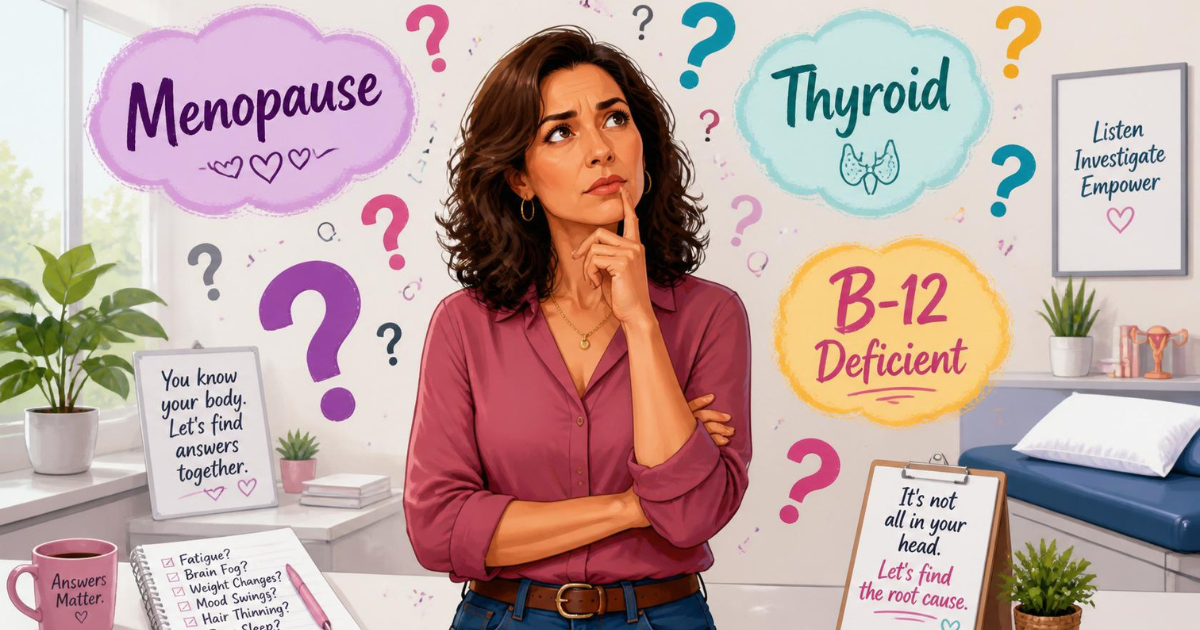
Is It Menopause or Something Else? Thyroid, Iron, and the Fatigue Look-Alikes
You've been told it's menopause. The exhaustion, the fog, the dragging-yourself-through-the-day feeling — someone waved a hand and said "it's your age." And maybe it is. But some of the most common causes of midlife fatigue aren't menopause at all — they just look exactly like it. And unlike menopause, they're simple to find with a blood test and very treatable once someone looks.
Educational Review: Her Midlife Wellness Help Editorial Team
Content Type: Research-Informed Menopause Education
Version in Spanish: ¿Es la menopausia o es otra cosa? La tiroides, el hierro y los imitadores de la fatiga
Introduction
You've been told it's menopause.
The exhaustion, the fog, the dragging-yourself-through-the-day feeling — someone waved a hand and said "it's your age, it's the change, welcome to midlife." And maybe it is. But maybe it isn't. Or maybe it's menopause and something else riding along underneath, quietly making everything worse.
Here's what almost nobody tells you: some of the most common causes of midlife fatigue are not menopause at all. They just look exactly like it. And unlike menopause, they're often simple to find with a blood test and very treatable once someone actually looks.
So this article is the one that says: don't just accept "it's menopause." Not because your doctor is wrong, but because "tired in midlife" has a short list of impostors worth ruling out — and you deserve to know what they are.
Nobody prepared us for this part. Let's make sure nothing's being missed.
Why these get mistaken for menopause
The trouble is that fatigue is what doctors call a nonspecific symptom. It doesn't point to one cause. And several conditions that spike in exactly your age range produce the same tired, foggy, not-myself feeling that menopause does.
When your symptoms could be three or four things at once, the honest move isn't to guess — it's to test. As one clinician put it plainly: fatigue and brain fog are symptoms, not diagnoses, and they can come from B12 deficiency, thyroid dysfunction, iron deficiency, insulin resistance, sleep disorders, or hormone imbalances — so testing should come first (via Newsweek, 2026).
That's the whole spirit of this article. Not "here's what's wrong with you" — but "here's what's worth checking, so you're treating the right thing."
Let's go through the big three.
1. Your thyroid
If there's one impostor to know about, it's this one — because it's common, it hits women in exactly your years, and it's endlessly mistaken for menopause.
The symptom overlap is almost comical in how complete it is. Fatigue, brain fog, mood swings, weight gain, sleep trouble, hair changes, temperature sensitivity — all of these happen in both perimenopause and an underactive thyroid, which is exactly why thyroid problems get waved off as "just menopause" (Dr. Christine Maren, 2026). The European Menopause and Andropause Society specifically flags that thyroid disorders and menopause overlap so much in symptoms that it makes diagnosis genuinely challenging (EMAS, via Medichecks, 2026).
There's one clue that helps you tell them apart, and it's worth knowing: hot flashes and feeling too hot lean toward menopause, while feeling unusually cold — cold when everyone else is comfortable — is a classic thyroid sign (Medichecks, 2026). Not a diagnosis, just a hint worth mentioning to your doctor.
Here's why it matters so much to catch: if your thyroid is off, no amount of estrogen or menopause treatment will fully fix your energy. As one menopause specialist puts it, if the thyroid isn't optimized, no amount of estrogen or progesterone will fully restore energy, metabolism, or mood (Dr. Christine Maren, 2026). You could do everything right for menopause and still feel awful, simply because the real driver was never checked.
The test: a simple TSH blood test is the high-value first step. Some providers stop at that one number — if your symptoms are strong and your TSH is "borderline," it's reasonable to ask about fuller thyroid testing (Ulta Lab Tests, 2025).
2. Your iron
This one is especially cruel in perimenopause, because perimenopause itself can cause it.
Here's the mechanism nobody explains: as your cycles become erratic in perimenopause, many women get heavier, longer periods — and heavy menstrual bleeding is a direct route to iron loss and iron-deficiency anemia (Hello Clue, 2024). (If heavy bleeding is part of your picture, that's its own subject: Heavy Bleeding During Menopause.) So the very hormonal chaos that says "menopause" can quietly be draining your iron at the same time. Doctors even have a name for it — perimenopause anemia, anemia triggered or worsened by the hormonal shifts of midlife (Women's Wellness of Mississippi, 2025).
And low iron feels exactly like menopause fatigue — the tiredness, the brain fog, the wiped-out feeling — with a few tells worth knowing: iron-deficiency anemia often adds shortness of breath after mild exertion, unusual paleness (check your inner eyelids and nail beds), and sometimes dizziness (Carrot, 2026; Hello Clue, 2024).
The frustrating part: many providers don't realize iron deficiency is a concern in perimenopause at all, so it often goes unchecked (Hello Clue, 2024). You may have to be the one to raise it.
The test: ask specifically for a ferritin level — that's the one that measures your iron stores and catches deficiency before it becomes full anemia — usually alongside a CBC (Elektra Health, 2026; Ulta Lab Tests, 2025).
3. Your B12
This is the quiet one, and it's genuinely common in your age group in a way most women don't know.
Vitamin B12 deficiency is estimated to affect 10–15% of people over 60 (PubMed, Andrès et al.), and studies in postmenopausal women specifically put it anywhere from 6% to 30% depending on the population (Sensorimotor study, NIH/PMC, 2024). That's not rare — that's common.
And the reason it climbs with age is sneaky: even if you're eating plenty of B12, your body absorbs less of it as you get older, because absorption of protein-bound B12 drops with age due to changes in the stomach lining (PubMed, Baik & Russell). So this isn't about a bad diet. A woman eating well can still run low.
The symptoms? The same familiar list — fatigue, brain fog, memory changes, weakness, low mood — plus a few that are more specifically B12: numbness or tingling in the hands and feet, and balance issues (Newsweek, 2026). B12 deficiency is so often written off as normal aging precisely because its symptoms overlap with what we expect midlife to feel like (Newsweek, 2026).
The test: a B12 blood test — and if it comes back low-normal but your symptoms are strong, ask about MMA (methylmalonic acid) testing, which can catch a deficiency a standard B12 test misses (Newsweek, 2026).
They also tangle together
One more thing worth knowing, because it shows why a single test sometimes isn't enough: these impostors feed each other.
Iron, for instance, is required to make thyroid hormone — the enzyme that builds thyroid hormone needs iron to work — so low iron can actually drag down your thyroid function even if the thyroid gland itself is fine (Thriving Proof, 2025). And B12 deficiency shows up more often in people with thyroid disease (PMC, 2023). It's not always one villain. Sometimes it's a couple of them, quietly reinforcing each other, all wearing a "menopause" costume.
That's not meant to overwhelm you. It's meant to make the case for one simple thing: a proper look, not a shrug.
What to actually do with this
Here's the honest, practical path — and notice what it is not. It's not "go buy iron and B12 supplements and hope." Please don't. Taking iron you don't need can genuinely harm you (iron overload is real), and guessing wastes months. The right order is test first, then treat what's actually low.
Confirm any deficiency with your provider before starting supplements, because targeted treatment based on your actual levels is what works (Carrot, 2026).
So:
Bring your symptoms in writing. If you've been tracking your fatigue and sleep — even a few days of it — that's real information your doctor can use, far better than "I'm always tired." (If you haven't started, my free 3-day tracker makes it easy.)
Getting answers starts with clear information.
Track your symptoms for 3 days and walk into your next appointment with real data — so you finally get the right answer.
Get the Free 3-Day Symptom TrackerAsk for the specific labs by name. A reasonable first panel for midlife fatigue is: TSH (thyroid), ferritin plus a CBC (iron), and B12 (Ulta Lab Tests, 2025). Writing those four down and bringing them to your appointment saves you a second visit. (For the full appointment playbook — every lab to request and exactly how to ask so you're not dismissed — here's the guide:What to Ask Your Doctor About Perimenopause.)
Don't accept "it's just menopause" if your gut says otherwise. You're allowed to ask "could we check my thyroid and iron before we assume?" A good provider won't mind. If yours brushes it off entirely, that's information too.
Treat what the tests find. If it's low iron, low B12, or a thyroid issue, these are among the most fixable causes of exhaustion there are. That's the hopeful part of this whole article: if one of these impostors is your real problem, you may be much closer to feeling better than you think.
A gentle reminder
Nothing is wrong with you for still feeling exhausted after you "did everything right" for menopause.
Sometimes the reason the menopause fixes aren't working is that menopause wasn't the whole story. And that's not a failure on your part — it's a gap in how often midlife women's fatigue gets properly investigated instead of waved away. For too long, "it's just your age" has been the end of the conversation when it should have been the start of a blood test.
You know better now. You know the impostors have names — thyroid, iron, B12 — and that they're findable and fixable. You know which labs to ask for. You know that testing comes before treating.
That knowledge is power in an exam room. It turns "I'm so tired" into "I'd like to rule out my thyroid, iron, and B12" — and that sentence gets a different kind of appointment.
You did not choose this exhaustion. But you are choosing to chase down the real cause instead of just enduring it. That's not being difficult. That's being your own advocate — and you're allowed to be.
You are not alone in this. And you may be closer to an answer — a real, treatable one — than anyone has led you to believe.
Frequently Asked Questions
How do I know if my fatigue is menopause or my thyroid?
You often can't tell from symptoms alone — they overlap almost completely (fatigue, fog, mood, weight, sleep). One hint: feeling too hot leans menopause, feeling unusually cold leans thyroid (Medichecks, 2026). But the only real way to know is a TSH blood test. Because thyroid problems and menopause coincide so often (EMAS), it's worth testing even when you're clearly in perimenopause.
Can perimenopause cause iron deficiency?
Yes, and it's underrecognized. Erratic, heavier perimenopausal periods can cause significant iron loss, leading to iron-deficiency anemia — sometimes called "perimenopause anemia" (Women's Wellness of Mississippi, 2025; Hello Clue, 2024). Ask for a ferritin test, which catches low iron stores before full anemia develops.
Why would I be low in B12 if I eat well?
Because absorption drops with age. Your body absorbs less protein-bound B12 as you get older due to changes in the stomach lining, so even a good diet can leave you low (PubMed). B12 deficiency affects an estimated 10–15% of people over 60 — it's common, not rare.
Should I just start taking iron and B12 supplements to be safe?
No — please test first. Taking iron you don't need can be harmful, and guessing delays finding the real cause. Confirm any deficiency with your provider before supplementing, so you treat what's actually low (Carrot, 2026).
What blood tests should I ask for if I'm exhausted in midlife?
A reasonable first panel: TSH (thyroid), ferritin plus a CBC (iron), and B12 (Ulta Lab Tests, 2025). Bring them written down. If a test is low-normal but your symptoms are strong, ask about follow-up testing (fuller thyroid panel, or MMA for B12).
If you want to walk into that appointment prepared, my free 3-day Symptom tracker gives you something concrete to show your doctor — real patterns beat "I'm always tired" every time.
Related Articles
Why Fatigue Happens During Menopause: Hormones, Cellular Energy, and Brain Function
Why Am I So Tired Even After Sleeping? The Menopause Sleep Problem Nobody Explains
Menopause Fatigue: What Actually Helps?
What to Ask Your Doctor When You Think You Are in Perimenopause or Menopause
Heavy Bleeding During Perimenopause: Causes, Treatment, and When to See a Doctor
Sources / References
Andrès, E., et al. Vitamin B12 deficiency in the elderly. (PubMed.) https://pubmed.ncbi.nlm.nih.gov/10448529/
Correlation of Vitamin B12 Deficiency with Sensorimotor Deficits in Postmenopausal Women. (NIH/PMC, 2024.) https://pmc.ncbi.nlm.nih.gov/articles/PMC12052276/
Newsweek. Vitamin B12 Deficiency Can Mimic Aging. 2026. https://www.newsweek.com/vitamin-b12-deficiency-mimic-aging-12126457
Medichecks. Thyroid vs Menopause — How to Spot the Difference. 2026. https://www.medichecks.com/blogs/thyroid/thyroid-vs-menopause-how-to-spot-the-difference
Maren, C. Thyroid vs. Perimenopause: Signs, Symptoms & Solutions. 2026. https://drchristinemaren.com/thyroid-vs-perimenopause-a-guide-to-signs-symptoms-solutions/
Hello Clue. Iron Deficiency and Perimenopause. 2024. https://helloclue.com/articles/menopause/iron-deficiency-and-perimenopause-what-are-the-signs
Elektra Health. Is It Iron Deficiency or Is It Menopause? 2026. https://elektrahealth.com/blog/iron-deficiency-or-menopause/
Carrot. Menopause and Fatigue. 2026. https://www.get-carrot.com/blog/menopause-and-fatigue
Ulta Lab Tests. Perimenopause Symptoms & Blood Tests. 2025. https://www.ultalabtests.com/blog/hormone/hormones-women/perimenopause-symptoms-blood-tests-your-next-steps/
Thriving Proof. Hypothyroidism, Iron Deficiency, and Perimenopause/Menopause. 2025. https://www.thrivingproof.com/hypothyroidism-iron-deficiency-and-perimenopause-menopause-when-fatigue-isn-t-just-getting-older/
A note, friend to friend: This article is for education and information — it's not medical advice, and it isn't a substitute for a conversation with your own doctor or a qualified health provider. Every woman's body and history are different, so what's right for someone else may not be right for you. Please bring any questions about your symptoms, treatments, or medications to a professional who knows you. You deserve care that's built around you.

Why Do I Crash Every Afternoon During Menopause? The 3 P.M. Wall, Explained
It's like clockwork. You're fine in the morning, you get through lunch, and then around 2 or 3 p.m. a wall comes down — heavy eyes, sludgy brain, desperate for a nap or something sweet. You didn't used to be like this, and you're not imagining that it's gotten worse in midlife. The afternoon crash is real, it has a specific mechanism, and menopause quietly makes it hit harder.
Educational Review: Her Midlife Wellness Help Editorial Team
Content Type: Research-Informed Menopause & Metabolic Health Education
Version in Spanish: ¿Por qué me desplomo cada tarde durante la menopausia? El muro de las 3 de la tarde, explicado
Introduction
It's like clockwork.
You're fine in the morning. You get through lunch. And then somewhere around 2 or 3 p.m., a wall comes down. Your eyes go heavy, your brain turns to sludge, and all you can think about is a nap, a coffee, or something sweet — anything to claw your way to five o'clock.
You didn't used to be like this. And you're not imagining that it's gotten worse in midlife.
The afternoon crash is real, it has a specific mechanism, and menopause quietly makes it hit harder. Once you understand what's actually happening between your lunch, your hormones, and your internal clock, you can stop white-knuckling through it — because it turns out this is one of the more fixable kinds of tired.
Nobody prepared us for this part. Let's take apart the 3 p.m. wall.
What's actually causing the crash
The afternoon slump isn't one thing. It's three things landing at the same time, and in midlife a fourth joins the pile-on.
One: your body clock naturally dips in the afternoon. This part is universal — it happens to everyone, menopause or not. There's a genuine circadian dip in alertness and energy in the early afternoon, long documented as the "post-lunch dip" (Monk, Clinics in Sports Medicine). Your internal clock schedules a low point in the early-to-mid afternoon. It's built in.
Two: your cortisol is on its way down. Cortisol isn't just a stress hormone — it's also your body's natural "get up and go" signal, and it runs on a daily curve: high in the morning to wake you, tapering across the day. By afternoon it's well into its decline. So the hormone that gave you morning drive is quietly leaving the room right when the clock-dip hits.
Three — and this is the big one you can control: your lunch. Here's the mechanism that turns a mild dip into a wall. When you eat a lunch heavy in refined carbs — the sandwich, the pasta, the pastry — your blood sugar spikes fast. Your body answers with a surge of insulin to clear it. And sometimes that insulin response overshoots, driving your blood sugar below where it started. That's called reactive hypoglycemia, and the timing is cruel: these post-meal blood sugar crashes typically hit 2 to 5 hours after eating (reactive hypoglycemia research, via Father Fuel) — which is to say, right in the middle of your afternoon. The spike buys you a brief lift, then the crash drops you into fatigue, shakiness, and fog.
Stack those three and you get the wall. Now here's what menopause adds.
Why menopause makes it worse
If your afternoon crashes have gotten deeper in midlife, it's not your imagination — the hormonal shift is changing how your body handles blood sugar.
As estrogen declines and fluctuates during the menopause transition, it can influence glucose regulation and insulin sensitivity (Scarfo, 2026). In plain terms: your body becomes a little less efficient at managing blood sugar than it used to be, so the same lunch that was fine at 35 now sends you on a bigger spike-and-crash at 50. Many women notice their energy, cravings, and metabolism shift during this time, and blood sugar is often part of that picture (Scarfo, 2026).
And there's a fascinating thread connecting this to the rest of your menopause symptoms. Research in Menopause: The Journal of the Menopause Society found that women with more hot flashes also showed greater swings in continuous glucose monitoring — suggesting the vasomotor instability of menopause and blood sugar instability may share common hormonal drivers (via Dr. Ruthie Harper, MD). Your hot flashes and your afternoon crashes might be cousins.
There's also a loop worth knowing about, because it explains why stressful, exhausting days feel the worst. When your blood sugar drops, your body releases cortisol to pull it back up — and chronically elevated cortisol worsens insulin resistance, which makes blood sugar swings bigger, which triggers more cortisol (Dr. Ruthie Harper, MD). Blood sugar and stress hormones feed each other. (The stress-hormone side of midlife has its own article, if that's your bigger struggle: Why Stress Can Feel Different During Menopause )
One honest correction to a myth you'll see everywhere: some articles claim afternoon is when your blood sugar control is naturally worst. The research actually shows the opposite — glucose tolerance is lower in the evening than midday (PNAS, 2015). So your afternoon crash isn't because 3 p.m. is your metabolic low point; it's the circadian energy dip plus a reactive crash from lunch, colliding. That distinction matters, because it tells you exactly where to aim: the fix is mostly about what and when you eat, not fighting the clock.
What actually stops the crash
Here's the good news I promised: this is one of the most responsive kinds of fatigue. Small changes to how you eat and move can flatten the wall dramatically. These target the one leg of the tripod you actually control — the blood sugar spike.
Rebuild lunch around protein and fiber, not refined carbs. This is the single biggest lever. A lunch anchored by protein and fiber-rich vegetables raises your blood sugar slowly and steadily instead of spiking it — no spike, no overshoot, no crash. You don't have to cut carbs; you have to anchor them. Put the protein and veggies first, let the bread or pasta be the side, not the center. The pasta-coma lunch is the crash's best friend.
Take a 10-minute walk after lunch. It sounds almost too simple, but movement after eating helps your muscles pull glucose out of your bloodstream, blunting the spike before it can become a crash. A short walk after your midday meal is one of the most effective, most underused tools there is. Even ten minutes around the block counts.
Don't skip breakfast, and put protein in it. Skipping breakfast sets up bigger blood sugar swings later in the day. A protein-forward morning meal steadies the whole day's glucose rhythm, so by afternoon you're working from a calmer baseline. (This ties into the bigger energy plan — the full toolkit is here: Menopause Fatigue: What Actually Helps? )
Watch the "fix" that makes it worse. When the wall hits, the instinct is coffee and something sweet. The sugar gives you fifteen minutes and then deepens the very crash you're trying to escape — another spike, another overshoot. And caffeine after about 2 p.m. can quietly sabotage that night's sleep, which sets up an even worse crash tomorrow. Reach for protein and a walk instead of sugar and a fourth coffee.
Protect your sleep — because tired amplifies everything. Poor sleep worsens insulin sensitivity the next day, making the crash deeper. So the nights and the afternoons are connected. (If your sleep is the weak link, start here: Why Am I So Tired Even After Sleeping?)
That afternoon crash isn't random.
Track it for 3 days and you'll start seeing exactly what's draining you — and when.
Get the Free 3-Day TrackerWhen it's worth a closer look
Most afternoon crashes are the ordinary collision we've described, and they respond beautifully to the food-and-movement fixes above. But blood sugar swings this noticeable can occasionally be an early signal worth checking.
Intense afternoon crashes, strong carb cravings, post-meal fog, and new weight gain around the middle can be your body's early warning that glucose metabolism is shifting (Respin Health) — and midlife is exactly when insulin resistance can start to creep in. It's reasonable, especially if this is pronounced, to ask your provider for a simple A1C or fasting glucose test at your next visit. Not to alarm you — just to catch any early shift while it's easy to address.
And if the crashes come with the deeper, all-day exhaustion we've talked about elsewhere, it's worth making sure nothing else is underneath it. (The fatigue impostors — thyroid, iron, B12 — are here: Is It Menopause or Something Else? )
A gentle reminder
Nothing is wrong with you for hitting a wall every afternoon.
You're not undisciplined for wanting the 3 p.m. cookie, and you're not weak for needing the coffee. Your body is running an ordinary daily rhythm through a hormonal season that made it more sensitive — the dip is real, the crash is real, and the cravings are your blood sugar talking, not your willpower failing.
And this is genuinely one of the good ones to get, because it moves so fast. Change what's on your lunch plate, take the little walk, and within days — not months — most women feel the afternoon wall soften into something manageable. You can get your afternoons back.
You did not choose this season. But you are choosing how to meet it — understanding the wall instead of just bracing against it every day at three. That's how you stop losing the back half of your day.
You are not alone in this. So many women are hitting the same wall at the same hour right now, reaching for the same coffee. The difference is, now you know what it is — and what actually makes it better.
We're in it together.
Frequently Asked Questions
Why do I crash every afternoon during menopause?
Three things collide: your body clock's natural early-afternoon energy dip, your cortisol tapering off from its morning high, and — the big controllable one — a blood sugar crash from a carb-heavy lunch, which typically hits 2–5 hours after eating (reactive hypoglycemia research). Menopause adds a fourth factor: shifting estrogen makes your body less efficient at managing blood sugar (Scarfo, 2026), so the crash hits harder than it used to.
Does menopause affect blood sugar?
Yes. As estrogen declines and fluctuates, it can influence glucose regulation and insulin sensitivity (Scarfo, 2026), meaning the same meals may cause bigger spikes and crashes than before. Interestingly, women with more hot flashes also show more blood sugar variability, suggesting shared hormonal drivers (Menopause journal, via Dr. Ruthie Harper, MD).
What should I eat for lunch to avoid the afternoon crash?
Anchor your lunch in protein and fiber-rich vegetables, and let refined carbs (bread, pasta) be a smaller side rather than the center. This raises blood sugar slowly instead of spiking it, preventing the insulin overshoot that causes the crash. A 10-minute walk after eating helps even more.
Is caffeine or sugar a good fix when I crash?
No — both backfire. Sugar gives a brief lift then deepens the crash with another spike-and-drop. And caffeine after about 2 p.m. can disrupt that night's sleep, worsening tomorrow's crash. Reach for protein and a short walk instead.
Could my afternoon crashes mean something more serious?
Usually they're the ordinary blood-sugar-and-circadian collision. But intense crashes, strong carb cravings, and new weight gain around the middle can be an early signal that glucose metabolism is shifting (Respin Health). It's reasonable to ask your provider for an A1C or fasting glucose test, especially if it's pronounced — early shifts are easy to address when caught.
If you want to spot your own crash pattern — what you ate, when the wall hits, how bad it is — my free 3-day tracker makes it easy to see, and gives you something concrete to bring to your doctor .
Related Articles
Menopause Fatigue: What Actually Helps?
Is It Menopause or Something Else? Thyroid, Iron, and the Fatigue Look-Alikes
Why Stress Can Feel Different During Menopause: Understanding the Brain's Stress Regulation System
Sources / References
Monk, T.H. The Post-Lunch Dip in Performance. Clinics in Sports Medicine, 2005. https://pubmed.ncbi.nlm.nih.gov/15892914/
Morris, C.J., et al. Endogenous circadian system and circadian misalignment impact glucose tolerance via separate mechanisms in humans. PNAS, 2015. https://www.pnas.org/doi/10.1073/pnas.1418955112
Singh, R., et al. Postprandial Reactive Hypoglycemia. Current Diabetes Reviews. https://www.ncbi.nlm.nih.gov/pmc/articles/PMC7192270/
Scarfo, L. Why You Crash at 3pm: Blood Sugar, Hormones & Fatigue After 40. 2026. https://www.lisascarfonaturopath.com/blog/why-you-crash-at-3pm-blood-sugar-hormones-amp-fatigue
Harper, R. (MD). The Menopause–Blood Sugar Connection (citing Menopause: The Journal of the Menopause Society). 2026. https://ruthieharper.com/menopause/travis-county-menopause-doctor/
Respin Health. Menopause & Metabolic Health: Your Blood Sugar Timeline.https://www.respin.health/blog/menopause-metabolic-health-blood-sugar-timeline
A note, friend to friend: This article is for education and information — it's not medical advice, and it isn't a substitute for a conversation with your own doctor or a qualified health provider. Every woman's body and history are different, so what's right for someone else may not be right for you. Please bring any questions about your symptoms, treatments, or medications to a professional who knows you. You deserve care that's built around you.
Menopause Fatigue: What Actually Helps? The Real Plan to Get Your Energy Back
You're tired of being tired. You've read why menopause drains you — and understanding helped. But at some point, knowing why stops being enough. You want to know what to actually do about it. This is that article: the real, ordered plan, from the foundation you can start this week to the medical options worth a conversation. Because you are not meant to spend the next decade exhausted.
Educational Review: Her Midlife Wellness Help Editorial Team
Content Type: Research-Informed Menopause Education
Version in Spanish: Fatiga en la menopausia: ¿qué ayuda de verdad? El plan real para recuperar tu energía
Introduction
You're tired of being tired.
You've read the articles that explain why menopause drains you — the hormones, the stolen deep sleep, the whole exhausting picture. And understanding it helped. But at some point, knowing why you're running on empty stops being enough. You want to know what to actually do about it.
This is that article.
I'm going to give you the real, ordered plan — from the foundation you can start this week, to the medical options worth a conversation with your doctor. Some of it is free. Some of it costs a little. All of it is grounded in what the research actually supports, and I'll be honest about what helps a lot versus what just gets hyped.
Because you are not meant to spend the next decade exhausted. There is a way back to feeling like yourself — and it's more within reach than anyone's told you.
Nobody prepared us for this part. Let's build your plan.
First — the one step that comes before everything
Before we talk protein or hormones or any of it, there's a step that matters more than all of them, and skipping it is the single most common reason women stay tired: make sure you're treating the right thing.
Menopause fatigue is real. But The Menopause Society itself points out that fatigue can also signal other medical conditions that need attention — which is why a proper evaluation is the essential first step in any safe plan (The Menopause Society, via ByWinona). Thyroid problems, low iron, and B12 deficiency all masquerade as menopause fatigue, and no amount of protein or hormones will fix them — they need their own treatment.
So step one isn't a supplement. It's a blood test. If you haven't ruled out the impostors yet, start there. (This is its own whole article, and it's worth the ten minutes: Is It Menopause or Something Else? Thyroid, Iron, and the Fatigue Look-Alikes .)
Everything below assumes you've either checked those boxes or are in the process. Now — the plan.
The foundation: what to do on your own
This is where most of your energy is won or lost, and none of it requires a prescription.
Protect your sleep quality (not just quantity)
Here's the thing about menopause fatigue: for most women, disrupted sleep is the biggest single driver (Meto, 2026). You can eat perfectly and exercise daily, but if night sweats and 3 a.m. wakeups are shredding your deep sleep, you'll stay exhausted.
So protecting sleep isn't one item on the list — it's the center of it. A cool bedroom, steady sleep and wake times, easing off evening alcohol, and treating the night sweats at their source do more for your energy than almost anything else. (The full sleep toolkit lives here: Menopause Insomnia: What Actually Helps? . And if you're sleeping the hours but still wrecked, that specific problem is here: Why Am I So Tired Even After Sleeping? .)
Eat to steady your energy — starting with protein
If there's one dietary change worth making, it's getting enough protein — and most midlife women don't.
Here's why it matters for energy specifically: as estrogen declines, women lose muscle faster, and after 50, muscle mass can drop 5–10% per decade (SWAN data, via The 'Pause Life). Less muscle means a slower metabolism, less strength, and less physical stamina — you get tired doing things that used to feel easy. Protein, paired with movement, is how you defend that muscle.
I'll be honest about the evidence, because you deserve it: research suggests postmenopausal women should get at least the RDA of protein and likely more, with the dose spread across meals — though the researchers note the overall evidence is still limited and not high quality (Aird et al., narrative review, 2024). So this isn't a magic macronutrient. But "eat more protein, spread through the day" is low-risk, well-founded advice with real upside for energy and strength.
If hitting your protein target through food is a struggle — and with midlife appetite changes it often is — a protein powder is a genuinely useful gap-filler. It's not a treatment, it's a tool to make the target reachable. A scoop in your morning coffee or a post-walk shake is often the difference between "meant to get enough protein" and actually doing it.
Two more food notes that steady energy: build meals around protein and fiber-rich vegetables to blunt the blood-sugar swings that cause energy crashes (the afternoon-crash problem has its own article ), and stay hydrated, since even mild dehydration worsens fatigue and night sweats make you lose more fluid than you think.
Move — the right amount, the right way
I know. When you're this tired, exercise sounds like a cruel joke. But movement is one of the most reliable energy creators there is — regular activity enhances energy, improves circulation, and supports mental clarity in menopausal women (University of Rochester Medicine, 2025).
The most valuable kind for midlife energy is strength training, because it directly fights the muscle loss draining your stamina. Resistance exercise counteracts muscle atrophy by stimulating protein synthesis, preserving the strength and functional independence that make daily life feel less exhausting (Princeton Sports Medicine). Two or three short sessions a week is enough to start.
One honest caution that surprises people: more isn't better here. Excessive high-intensity exercise elevates cortisol, which can actually worsen menopause fatigue (Raveco, 2026). So you don't need to punish yourself with daily HIIT — in fact that can backfire. Strength work a few times a week, daily walks, and real rest days beat grinding yourself down.
Manage your energy, not just your time
This one's less about biology and more about survival, and it matters enormously for the woman carrying work, kids, and aging parents at once.
When your energy is a limited resource, you have to spend it deliberately. That means protecting your best hours for what matters, saying no to what you can, building in real recovery, and stopping the self-blame that itself is exhausting. Pacing isn't giving up — it's how you stop crashing.
The supplement question (the honest version)
You want to know what to take. Here's the truthful answer, and it's the same principle as everything else: supplements help most when they fill an actual gap — not as a blanket fix.
There's no single supplement that cures menopause fatigue; but if you're genuinely deficient in something like iron, B12, or vitamin D, correcting that deficiency can help significantly (MIDI Health, 2025). That's the whole game — test, find the real gap, fill that.
A few worth knowing honestly:
Magnesium — a reasonable, low-risk one that supports sleep quality and nervous-system calm, and many midlife women run low. It won't transform your energy on its own, but as part of the foundation it earns its place, and the glycinate form is gentle on the stomach. It's the one I keep on hand.
B12 and vitamin D — genuinely worth checking, because deficiencies are common in midlife and both cause fatigue. B12 is water-soluble, so there's little risk from supplementing, but it's still best to confirm with your provider (Inflexxion Health). Vitamin D is worth a test, especially in darker months.
Iron — only if you're actually low. This is the one to not guess on: correcting real iron deficiency can resolve fatigue quickly, but too much iron is harmful, so levels should be monitored (Nore Health). Test first, always.
The pattern across all of them: don't self-prescribe a cabinet full of pills. Find your actual deficiencies and treat those.
Affiliate disclosure: If you buy through a link above, I may earn a small commission at no extra cost to you. I only point you toward things I'd recommend to a friend at my own kitchen table.
The medical options: when to bring in your doctor
If you've built the foundation and you're still dragging, it's time for a real conversation — and there are genuine medical tools worth knowing about.
Hormone therapy (HRT/MHT)
Here's the honest picture on hormones and energy, because it's often oversold in both directions.
HRT is not a direct "energy drug." But it can meaningfully improve fatigue indirectly, and powerfully — mainly by fixing what's stealing your sleep. Hormone therapy is the most effective treatment for hot flashes and night sweats, and by calming those, it can improve sleep quality and therefore daytime energy (via PubMed; ByWinona). Estrogen also supports the brain's energy pathways, which can ease the "wired-but-tired" feeling (ByWinona). Progesterone, for many women, promotes deeper, more restorative sleep.
So if your fatigue is being driven by night sweats wrecking your sleep, treating those with hormones can be genuinely transformative for your energy. One honest boundary, though: the Menopause Society does not recommend HRT specifically for cognitive complaints like brain fog, due to lack of evidence (NIH/PMC review) — so it's a sleep-and-symptom tool, not a fog cure. (The full HRT picture — benefits, risks, who it's for — is in our treatment guide: What Actually Helps Hot Flashes? .)
Treating the deficiencies properly
If your blood work turned up low iron, B12, or thyroid trouble, this is where your energy comes back — often dramatically. These aren't "manage forever" problems; they're fixable. Correcting iron deficiency can resolve fatigue rapidly; treating hypothyroidism restores the metabolic engine; B12 repletion brings back cellular energy. The plan is simple: treat what the test found, then retest in 3–6 months to confirm it worked (Women's Wellness of Mississippi, 2025).
Don't overlook mood and sleep disorders
Two more medical pieces worth naming: depression and anxiety can present largely as fatigue, and they're treatable. And sleep apnea — which rises sharply after menopause — is a common, very fixable cause of "I sleep but I'm exhausted." If your fatigue comes with loud snoring, low mood, or just won't lift, these deserve a look.
Your starting plan this week
If it's a lot, here's where to begin, in order:
Rule out the impostors first — if you haven't, get the blood tests (thyroid, ferritin, B12). Don't build on an unchecked foundation.
Attack sleep quality — it's the biggest lever. Cool room, steady schedule, treat the night sweats.
Add protein and a little strength work — defend the muscle that holds your stamina. Two sessions a week, protein at each meal.
Pace your energy — protect your best hours, build in recovery, drop the guilt.
If you're still struggling after a few weeks, book the appointment — and ask specifically about HRT for your sleep symptoms, and about anything your labs flagged.
That's not desperate flailing. That's a real plan, in the right order, with something that helps at every step.
Your energy can come back.
The plan that works is the one built on your patterns. Track 3 days and see what's really draining you — and where to start.
Get the Free 3-Day Symptom TrackerA gentle reminder
You are not lazy, and you have not "let yourself go."
You've been running your life on an energy system that menopause quietly rewired — less muscle, worse sleep, a metabolism finding new footing — and you kept showing up anyway. That's not weakness. That's someone doing hard things on far less fuel than she used to have, without even knowing why.
The exhaustion is real, but it is not permanent, and it is not your fault. And here's the part I most want you to hold: this is one of the most fixable seasons of midlife. Between protecting your sleep, defending your muscle, treating any real deficiencies, and the medical tools available now, most women can feel dramatically better than they do today. Some feel more energized than they have in years.
You did not choose this exhaustion. But you are choosing to do something about it — the right things, in the right order — instead of just enduring. That's not too much to want. Your energy was never too much to want.
You are not alone in this. And you are so much closer to feeling like yourself again than this tired moment is telling you.
We're in it together.
Frequently Asked Questions
What actually helps the most with menopause fatigue?
For most women, protecting sleep quality is the single biggest lever, since disrupted sleep is often the main driver (Meto, 2026). After that: enough protein plus strength training to defend your muscle and stamina, treating any real nutrient deficiencies (iron, B12, D), and — if night sweats are wrecking your sleep — hormone therapy. But step one is always ruling out non-menopause causes with a blood test.
Will hormone therapy fix my fatigue?
It can, mostly indirectly. HRT is the most effective treatment for night sweats and hot flashes, and by calming those it improves sleep and therefore daytime energy (PubMed; ByWinona). It's not a direct energy drug — and it's not recommended specifically for brain fog — but if disrupted sleep from night sweats is draining you, it can help a lot. Discuss it with a menopause-informed provider.
How much protein do I actually need in menopause?
Research suggests postmenopausal women should aim for at least the RDA and likely somewhat more, spread across meals — though the evidence base is still limited (Aird et al., 2024). The practical takeaway: include protein at each meal, and use a protein powder to fill the gap if food alone falls short. It protects the muscle that holds your energy and strength.
Should I take supplements for menopause fatigue?
Only to fill a real gap. There's no single supplement that cures fatigue, but correcting an actual deficiency in iron, B12, or vitamin D can help significantly (MIDI Health, 2025). Magnesium is a reasonable low-risk addition for sleep. Iron especially should only be taken if you've tested low, since too much is harmful.
Why am I still exhausted even on HRT / after doing everything right?
A few common reasons: an untreated deficiency (B12 and iron are frequently missed, even in women on HRT), undiagnosed sleep apnea, thyroid trouble, or depression. If you've optimized hormones and lifestyle and you're still wiped out, it's worth going back for blood work — the missing piece is often one of these treatable look-alikes. (See: Is It Menopause or Something Else? .)
If the day-to-day comfort side helps — the cooling bedding, the small things that protect your rest and energy — I keep my honest favorites on my Menopause Comfort Favorites page (link here).
And if you want to spot your own patterns before a doctor's visit, my free 3-day tracker gives you something concrete to work from.
Related Article
Is It Menopause or Something Else? Thyroid, Iron, and the Fatigue Look-Alikes
Why Fatigue Happens During Menopause: Hormones, Cellular Energy, and Brain Function
Menopause Insomnia: What Actually Helps?
Sources / References
The Menopause Society, via ByWinona. Menopause Fatigue: Why It Happens and How to Manage It.https://bywinona.com/journal/menopause-symptoms/fatigue
Meto. Menopause Fatigue: Why You're So Tired and How to Get Your Energy Back. 2026. https://meto.co/blog/why-menopause-makes-you-tired
Aird, T., et al. The Impact of Protein in Post-Menopausal Women on Muscle Mass and Strength: A Narrative Review. Journal of Ageing and Longevity, 2024. https://www.mdpi.com/2673-9488/4/3/16
University of Rochester Medical Center. Why Exercise is Essential During Menopause. 2025. https://www.urmc.rochester.edu/news/publications/health-matters/why-exercise-is-essential-during-menopause
Princeton Sports and Family Medicine. The Science Behind Strength Training for Postmenopausal Women.https://www.princetonmedicine.com/blog/the-science-behind-strength-training-for-postmenopausal-women-a-sports-medicine-perspective
MIDI Health. 8 Best Minerals, Supplements & Vitamins for Menopause Fatigue. 2025. https://www.joinmidi.com/post/vitamins-for-menopause-fatigue
Cognitive Function in Peri- and Postmenopausal Women: Implications for Iron Supplementation. (NIH/PMC.) https://www.ncbi.nlm.nih.gov/pmc/articles/PMC12157887/
Women's Wellness of Mississippi. Low Estrogen and Iron Deficiency. 2025. https://womenswellnessms.com/low-estrogen-and-iron-deficiency/
A note, friend to friend: This article is for education and information — it's not medical advice, and it isn't a substitute for a conversation with your own doctor or a qualified health provider. Every woman's body and history are different, so what's right for someone else may not be right for you. Please bring any questions about your symptoms, treatments, or medications to a professional who knows you. You deserve care that's built around you.
Why Is My Anxiety Worse at Night During Menopause? The 3 A.M. Spiral, Explained
It's quiet now. The house is dark. Everyone's asleep. And your mind picks this exact moment to come roaring to life. Daytime you can manage — it's the nights that are undoing you. If this is you, there's a real reason anxiety saves its worst for the dark, and it's not that you're falling apart. Let's walk through it, and then through what actually breaks the spiral.
Educational Review: Midlife Wellness Help Editorial Team
Content Type: Research-Informed Menopause & Metabolic Health Education
Version in Spanish: ¿Por qué mi ansiedad empeora de noche durante la menopausia? El espiral de las 3 de la mañana, explicado
Introduction
It's quiet now. The house is dark. Everyone's asleep.
And your mind picks this exact moment to come roaring to life.
The worry about your kid. The thing you said in that meeting. The money. Your aging parents. Your own body. It all arrives at once, louder in the dark than it ever was in daylight — and the harder you try to shut it off and sleep, the wider awake and more wound-up you get.
Daytime you can manage. It's the nights that are undoing you.
If this is your experience, there's a real reason anxiety saves its worst for the dark — and it's not that you're falling apart. It's a specific collision of biology, timing, and the particular way menopause has turned up your nervous system. Let's walk through it, and then through what actually helps you break the spiral.
Nobody prepared us for this part. Let's understand the nights.
Why anxiety gets louder at night (it's not in your head)
The anxiety itself isn't new information — if you want the full picture of why menopause ramps up anxiety in general (the estrogen, the GABA, the HPA axis), that's its own article and it's worth reading. (Start here: Why Anxiety Can Increase During Perimenopause.)
What we're after here is narrower and sneakier: why the nighttime specifically is when it pounces. A few things stack up.
The distractions are gone. All day, your busy mind has somewhere to point — work, people, tasks, noise. At night, all of that falls away. When distractions stop and the nervous system loses its visual safety cues, the anxious thoughts that ran quietly in the background all day suddenly have uninterrupted access (Inner Heart Therapy, 2026). Nothing is competing for the microphone anymore. So worry takes the stage.
Your already-sensitized nervous system has no buffer left. This is the menopause piece. Your stress-regulation system is already running hotter and more reactive in midlife — that's the HPA-axis sensitivity your other articles explain. By night, after a full day of demands, whatever calming reserve you had is spent. The same worry that you'd have shrugged off at 10 a.m. lands like a crisis at midnight.
Sleep loss makes the anxiety worse — which is the cruel hinge of the whole thing. UC Berkeley sleep researchers found that the anxiety caused by sleep loss is driven by impaired activity in the medial prefrontal cortex — the region that normally keeps your emotional centers in check — and that even modest night-to-night reductions in sleep predict measurable jumps in next-day anxiety (Ben Simon et al., Nature Human Behaviour, 2020). Translation: the very sleeplessness menopause is causing makes your brain more anxious, not less. Which keeps you awake. Which makes you more anxious. Which brings us to the loop.
The anxiety-insomnia loop: awake because anxious, anxious because awake
Here's the trap so many women in midlife are caught in without anyone naming it for them.
As the lead researcher put it: when we're anxious our sleep is disturbed, and when our sleep is disturbed we become anxious — a vicious cycle that can start from poor sleep alone (Ben Simon, UC Berkeley / Nature Human Behaviour, 2020). People who sleep poorly are far more likely to develop an anxiety disorder than those who sleep well. And each night reinforces the pattern, until the bed itself can start to feel like the most anxiety-producing place in the house.
Think about what that means. Sleep requires your nervous system to downshift — heart rate slowing, muscles releasing, the body handing over to rest. But anxiety at bedtime is the nervous system refusing to make that shift, because its threat-detection system is still running — and your body won't sleep while it believes something dangerous is happening (Inner Heart Therapy, 2026).
And after enough nights of lying there anxious and awake, your brain learns the association: bed equals dread. Now the very act of getting under the covers triggers the alarm. That's not a weakness or a bad habit. That's conditioning — your nervous system did exactly what nervous systems do. The good news is that conditioning can be undone.
About that 3 a.m. wake-up — the honest version
So many women jolt awake at 3 or 4 a.m., hearts going, minds switching on instantly. There's a popular story that a "cortisol spike" is ambushing you. The truth is a little different — and actually more reassuring.
Cortisol does rise in the early morning hours — but it's supposed to. In a healthy rhythm, cortisol is lowest overnight and naturally begins climbing around 2–3 a.m. to gently prepare you to wake (PTSD UK). Here's the part that surprised even me: recent 2025 research found the act of waking isn't what triggers a cortisol surge — the rise is circadian, on a schedule, and you simply happened to wake during its normal climb (via Declutter the Mind, citing Proceedings of the Royal Society B).
So cortisol isn't lurking to pounce on you. It's on its scheduled climb, sleep is naturally lighter in the second half of the night, and you surfaced during that window. Under stress, your cortisol system can become more sensitive, so even that normal early rise can feel like a jolt — heart racing, thoughts switching on at once (Ovrcome, 2025). That's the menopause amplification at work.
But here's the line I most want you to hold onto, because it changes everything about what to do: what keeps you stuck at 3 a.m. usually isn't the wake itself — it's the anxious effort to fall back asleep, which spikes mental arousal and makes it worse (Declutter the Mind, 2026).
You're not broken for waking. You're getting trapped by the fight to get back down. And that — the fight — is the thing you can actually change.
What actually helps — breaking the spiral
The big sleep toolkit lives in its own article, and if insomnia is your main battle, that's where to go for the full plan. (Read: Menopause Insomnia: What Actually Helps? ) What follows is aimed specifically at the nighttime anxiety spiral — the in-the-moment and wind-down tools that target the nervous system, not the thoughts.
Don't fight for sleep in the bed. Leave it. This is the counterintuitive one that works. If you're awake and anxious for about 20 minutes, get out of bed — staying put, tossing and turning, only deepens the bed-equals-anxiety association (Inner Heart Therapy, 2026; Declutter the Mind, 2026). Go to another dim room, do something calm and boring, and return only when sleepy. You're teaching your brain that the bed is for sleep, not for spiraling.
Breathe in a way that flips the switch. Slow breathing like the 4-7-8 pattern — and deep breathing generally — activates the parasympathetic "rest" side of your nervous system and has been shown to lower the stress response (Inner Heart Therapy, 2026; Rise Science). A few rounds tells your threat-detection system, physically, that there's no emergency. This is targeting the body, which is faster than arguing with the thoughts.
Stop clock-watching. Research has found that watching the clock makes it harder for people to fall back asleep (Oura, citing sleep research). Every glance ("only four hours left…") is a fresh hit of arousal. Turn the clock around. You don't need the math.
Build a real wind-down before bed. A 60-minute buffer to downshift, plus a consistent wake time and morning light, helps reset the nervous system out of the loop (Inner Heart Therapy, 2026). The hour before bed isn't a luxury — for an anxious midlife nervous system, it's the runway you need to land.
Protect the magnesium-and-nervous-system basics.Magnesium plays a genuine role in nervous-system regulation, and many women in midlife run low. It's a modest, low-risk support — not a cure for anxiety, but a reasonable part of the foundation, and the glycinate form is gentle. It's the one I keep on hand.
Affiliate disclosure: If you buy through the link above, I may earn a small commission at no extra cost to you. I only point you toward things I'd recommend to a friend at my own kitchen table.
And the deeper tool: CBT. The same cognitive-behavioral approach that's gold-standard for insomnia is also one of the most effective tools for anxiety — it works directly on that 2 a.m. catastrophizing. If the night spiral is a regular visitor, this is worth raising with a provider. (The hormonal side of treatment matters here too — including how progesterone and hormone therapy factor in. That's covered here: Why Am I So Angry? Perimenopause Rage Is Real )
When nighttime anxiety needs a doctor
Most midlife night-anxiety is the collision we've described, and it eases with the tools above and as hormones settle. But some of it deserves real medical attention, and you're not overreacting to ask.
Reach out to a provider if the anxiety is frequent and overwhelming, if it interferes with your daily functioning, if it comes with panic attacks, or if it's tangled up with persistent low mood. Those are signals worth a conversation, not a "tough it out." And if loud snoring or gasping is part of your nights, mention that too — sleep apnea can masquerade as 3 a.m. anxiety and is very treatable once found.
Wanting help here isn't weakness. It's the same instinct that made you read this far: you care about feeling like yourself again, and that's reason enough.
A gentle reminder
Nothing is wrong with you.
The fact that your worst hours are the dark, quiet ones — when you're supposed to be resting — is not a sign that you're fragile or failing. It's the predictable result of a sensitized nervous system, the day's distractions falling away, and a sleep-anxiety loop that feeds itself, all landing in a season nobody warned you about.
You are not the problem. The 3 a.m. spiral has a mechanism, and mechanisms can be interrupted. You don't have to out-tough it or lie there losing the fight night after night. You can get up, breathe, turn the clock around, and stop feeding the loop — and you can ask for real help with the parts that are bigger than a breathing exercise.
You did not choose these nights. But you are choosing how to meet them — learning what's actually happening, refusing to just suffer in the dark and call it your lot. That's not too much to want. Peace at night was never too much to want.
You are not alone in this. Right now, in the dark, other women are lying awake with the same racing minds, doing the same desperate math on the hours left. The difference is, now you know why — and you know what to do when it happens again tonight.
We're in it together.
Frequently Asked Questions
Why is my anxiety so much worse at night during menopause?
A few things collide. Daytime distractions fall away, so worry has your full attention; your already-sensitized midlife nervous system has used up its calming reserve by night; and poor sleep itself increases amygdala reactivity and reduces your brain's ability to regulate emotion — amplifying the anxiety (Inner Heart Therapy, 2026).
Why do I wake up at 3 a.m. anxious with my heart racing?
Partly normal biology. Cortisol naturally begins rising around 2–3 a.m. to prepare you to wake (PTSD UK), and recent research shows the wake itself doesn't cause a cortisol spike — the rise is circadian, and you woke during its normal climb (Proceedings of the Royal Society B, 2025). Under stress that rise can feel like a jolt — but what keeps you stuck is the anxious effort to fall back asleep, not the wake itself.
What is the anxiety-insomnia loop?
A bidirectional cycle: anxiety disrupts sleep, poor sleep intensifies anxiety, and each night reinforces it until the bed itself feels anxiety-producing (Inner Heart Therapy, 2026). Breaking it means targeting the nervous system — getting out of bed when wakeful, slow breathing, a consistent wind-down — rather than fighting the thoughts head-on.
What should I do when I wake up anxious in the middle of the night?
Don't lie there fighting it. After about 20 minutes awake, get out of bed (Declutter the Mind, 2026), go somewhere dim and do something calm, and use slow 4-7-8 breathing to settle your nervous system. Turn the clock away — clock-watching makes it harder to fall back asleep (Oura). Return to bed only when sleepy.
Will menopause night anxiety go away?
For many women it eases as hormones stabilize and as the loop is interrupted with the right tools. But persistent, overwhelming, or panic-level anxiety deserves a provider's help — it's treatable, and asking is smart, not weak.
If the comfort side of your nights needs help — cooling bedding, the small things that make rest easier — they're on my Menopause Comfort Favorites page .
And if you're still pinning down what's disrupting your nights, the quick quiz can help you spot your likely triggers in a couple of minutes.
Your body is changing and it is trying to tell you something.
Pause and understand where you are.
Related Articles
Menopause Insomnia: What Actually Helps?
Why Am I So Tired Even After Sleeping? The Menopause Sleep Problem Nobody Explains
Sources / References
Ben Simon, E., Rossi, A., Harvey, A.G., & Walker, M.P. Overanxious and underslept. Nature Human Behaviour, 2020;4(1):100–110. https://www.nature.com/articles/s41562-019-0754-8
Inner Heart Therapy. The Anxiety Insomnia Loop: Awake Because Anxious, Anxious Because Awake. 2026. https://www.innerhearttherapy.org/blog/anxiety-insomnia-loop
PTSD UK. Sleep and Cortisol.https://www.ptsduk.org/sleep-and-cortisol-in-ptsd/
Law, K., et al. Cortisol awakening response and waking (analysis in Proceedings of the Royal Society B, 2025), via Declutter the Mind. https://declutterthemind.com/blog/why-do-i-wake-up-at-3am
Ovrcome. Why Do I Wake Up at 3am? The Science of Cortisol and Sleep. 2025. https://www.ovrcome.io/post/why-do-i-wake-up-at-3am-the-surprising-science-of-cortisol-and-sleep
Oura. Why Do I Always Wake Up at 3am? (citing R. Robbins, PhD). https://ouraring.com/blog/why-do-i-wake-up-at-3-am/
Rise Science. How to Fix Your Cortisol and Sleep.https://www.risescience.com/blog/cortisol-and-sleep
A note, friend to friend: This article is for education and information — it's not medical advice, and it isn't a substitute for a conversation with your own doctor or a qualified health provider. Every woman's body and history are different, so what's right for someone else may not be right for you. Please bring any questions about your symptoms, treatments, or medications to a professional who knows you. You deserve care that's built around you.

Why Are My Hot Flashes Worse at Night? The Reason Behind the 3 A.M. Drench
You finally got to sleep. And then you're awake — heart going, sheets damp, throwing the covers off, flipping the pillow to the cool side. If your hot flashes seem to save their worst for nighttime, you are not imagining it. There's a real, physical reason the nights hit harder than the days — and once you understand it, the 3 a.m. drench stops feeling like a personal failing.
Educational Review: Her Midlife Wellness Help Editorial Team
Content Type: Research-Informed Menopause & Metabolic Health Education
Version in Spanish: ¿Por qué mis sofocos son peores de noche? La razón detrás del empapado de las 3 de la mañana
Introduction
You finally got to sleep.
And then you're awake — heart going, sheets damp, throwing the covers off, flipping the pillow to the cool side. Maybe you peel off your shirt. Maybe you lie there in the dark waiting to cool down enough to drift off again.
If your hot flashes seem to save their worst for nighttime, you are not imagining it. And you are not doing anything wrong.
There's a real, physical reason the nights hit harder than the days. Once you understand it, the 3 a.m. drench stops feeling like a personal failing and starts making sense — which is the first step to doing something about it.
Nobody prepared us for this part. Let's walk through it.
First — night flashes really are their own thing
A hot flash that happens while you're asleep has a name: a night sweat. Same underlying event as a daytime flash, but the timing changes everything about how it lands.
And here's something most women never hear: hot flashes don't spread evenly across the night. In research presented by The Menopause Society, when hot flashes were objectively measured during sleep, 59% of them occurred in the second half of the night — compared with 41% in the first half (The Menopause Society, 2024).
That's why so many women describe waking drenched in the small hours, around 3 or 4 a.m., then struggling to get back down. It's not random. There's a rhythm to it.
To understand why, we have to talk about what your body does with its temperature at night.
Why the night makes flashes worse
Your body runs on a daily temperature cycle. Your core temperature naturally falls slightly in the evening, and that lower temperature is actually what helps you fall asleep (Mohamed et al., Journal of the American Board of Family Medicine, 2012). Cooling down is the body's signal that it's time to rest.
Now layer menopause on top of that.
You may remember from your daytime flashes that estrogen's decline narrows your body's "comfort zone" for temperature — the range it can drift through before it panics and tries to cool you down. (If that mechanism is new to you, it's the heart of a related piece — What Triggers Hot Flashes? )
At night, that narrowed comfort zone collides with your body's natural temperature rhythm. Your core temperature is meant to fall to its lowest point in the early-morning hours — the body's lowest temperature typically lands around 4 a.m., right when your deepest sleep should be happening (Sleep Advisor, citing thermoregulation research). But for a body whose thermostat is already hair-trigger, the smallest upward nudge in that delicate window can cross the line — and the cooling alarm goes off. Blood vessels open, you flush, you sweat. You wake up.
So the nighttime isn't incidental. The very temperature changes that are supposed to help you sleep are the ones tipping an oversensitive system into a flash.
The cruel loop: flash wakes you, then you can't cool down
Here's the part that makes night flashes so much more punishing than daytime ones.
During the day, a flash comes, you fan yourself, it passes, you move on. At night, it doesn't just pass — it fragments your sleep.
When your body can't cool down properly at night, your sleep pays for it. Heat exposure leads to more frequent waking and less deep sleep and REM — and REM is the stage overheating cuts short most (Harding et al., 2019). When core temperature can't make its normal drop, deep slow-wave sleep decreases and you surface awake more often (Okamoto-Mizuno & Mizuno, NIH). Women who have night sweats often report waking up drenched.
So the flash wakes you. The dampness keeps you up. And even once you drift back, your sleep is lighter and more easily broken — which is why you can spend eight hours in bed and still feel hollowed out by noon.
It's not that you're not sleeping enough. It's that the sleep you're getting keeps getting interrupted at the deepest, most restoring layer. That is exhausting in a way that "tired" doesn't quite capture.
And this is exactly where night flashes stop being only about temperature and start being about sleep itself. The two are tangled together — which is why, if the sleep disruption is the part wearing you down most, it's worth understanding the fuller picture of how menopause reshapes sleep. (Related, and worth your time: Why Sleep Changes During Menopause )
Those 3 a.m. wake-ups don't have to be your normal.
There's almost always a pattern behind night sweats. Track 3 nights and start seeing what sets yours off.
Get the Free 3-Day Sleep TrackerWhat actually helps you sleep through them
You can't switch off the hormonal shift underneath. But night flashes respond genuinely well to a handful of changes — because so much of what feeds them is temperature, and temperature is something you can work with.
Make your bedroom a cooler place than feels normal. Managing room temperature, wearing breathable fabrics, and using cooling bedding can help reduce the night awakenings that come with menopausal temperature swings (thermoregulation and sleep research, 2025). Set the thermostat lower than you think you need. Your body is trying to shed heat — give it a cool room to shed it into.
Choose bedding and sleepwear that move heat away from you. Mayo Clinic specifically suggests cooling products for night sweats — wicking sheets and sleepwear, fans, and cooling pillows (Mayo Clinic, 2026). Breathable layers you can kick off mid-night beat one heavy comforter every time. A moisture-wicking sleep setis a small change that pays you back at 3 a.m.
Affiliate disclosure: If you buy through the link above, I may earn a small commission at no extra cost to you. I only point you toward things I'd recommend to a friend at my own kitchen table.
Watch your evening intake. Alcohol and caffeine both stir up flashes, and alcohol especially fragments the deep sleep you're already fighting for. A glass of wine with dinner is one thing; a nightcap is working against you. (More on this in What Triggers Hot Flashes?)
Keep your sleep and wake times steady. A consistent rhythm helps your body's internal clock keep your temperature cycle predictable — one less thing throwing your oversensitive thermostat off.
On magnesium and sleep support. Magnesium comes up constantly in midlife sleep conversations, and it does have a real role in the nervous system and sleep regulation — though it's a whole-body sleep support, not a hot-flash treatment. If you're curious which supplements actually have evidence behind them for midlife (and which don't), I went through the research honestly here. (Related: Evidence-Based Supplements for Menopause)
If the flashes themselves are the problem, there's a medication built for nights. Remember that gabapentin — one of the proven non-hormonal options — is taken at night and can help with sleep, which makes it a particularly good fit for women whose flashes are mostly nocturnal. That's a conversation for your provider. (The full menu of options is in What Actually Helps Hot Flashes? )
When night sweats deserve a closer look
Most night sweats in midlife are menopause doing exactly what menopause does. But not all of them.
Occasional night sweats can come from a warm room or heavy blankets, but chronic night sweats can sometimes point to other things — like thyroid issues or other medical conditions (thermoregulation and sleep research). It's worth checking with your provider if your night sweats are drenching and relentless, if they come with loud snoring or pauses in breathing (a sign of possible sleep apnea), or if you're losing weight or running fevers you can't explain.
You're not being dramatic by asking. You're being thorough. There's a difference, and you're allowed to want the second one.
A gentle reminder
Nothing is wrong with you.
Your body is not betraying you in the middle of the night — it's running an old, ordinary cooling system through a season it was always going to reach. The system is just oversensitive right now. That's not a flaw in you. That's biology doing a normal, if maddening, thing.
You did not choose these nights. But you are choosing how to meet them — cooling the room, changing the sheets, asking the right questions, refusing to just lie there and suffer because someone once told you this is simply what midlife feels like.
It isn't. And there is real help.
Tomorrow night might still be hard. But you understand it now. And understanding is where you stop bracing against your own body and start working with it.
You are not alone in this. All over, women are flipping their pillows to the cool side tonight, throwing off a damp shirt, taking a breath in the dark. Figuring out the same thing you are.
We're in it together.
Frequently Asked Questions
Why are my hot flashes worse at night than during the day?
Your core body temperature naturally dips in the evening to help you sleep, and shifts during sleep stages can nudge it back up. Because lower core temperature facilitates sleep and the body's temperature is in flux through the night (JABFM, 2012), an already-oversensitive menopausal thermostat is more easily triggered. Research has found that most hot flashes during sleep actually occur in the second half of the night (The Menopause Society, 2024).
Why do I wake up drenched in sweat around 3 or 4 a.m.?
That timing lines up with the research. When measured objectively, 59% of nighttime hot flashes happened in the second half of the night versus 41% in the first half (The Menopause Society, 2024). The deep early-night sleep gives way to lighter, more temperature-variable sleep later — prime conditions for a flash to break through and wake you.
Why am I exhausted even after a full night in bed?
Because night sweats interrupt your sleep at its most restorative layer. Overheating causes more frequent awakenings and less deep and REM sleep (Harding et al., 2019), and when your core temperature can't drop normally, deep slow-wave sleep decreases (NIH). Hours in bed aren't the same as quality sleep — and night flashes steal the quality.
What's the single most effective thing I can do for night sweats?
Get cool and stay cool. A colder bedroom, breathable wicking bedding and sleepwear, and easing off alcohol before bed target the temperature side directly. Room temperature, breathable fabrics, and cooling bedding can all help reduce menopausal night awakenings (Harding et al., 2019; NIH). If the flashes themselves remain disruptive, ask your provider about options like gabapentin, which is taken at night.
If you want the comfort tools that make the nights easier — the cooling bedding, the breathable layers, the small things that help — I keep my honest favorites, organized by symptom, on my Menopause Comfort Favorites page.
And if you haven't pinned down what sets your flashes off in the first place, the quick quiz can point you toward your likely triggers in a couple of minutes.
Your body is changing abd it is trying to tell you something. Pause and understand where you are. Take the quiz and understand where you are.
Related Articles
Why Sleep Changes During Menopause: Understanding Hormones, Brain Regulation, and Circadian Rhythm
What Triggers Hot Flashes? The Real Reasons Behind the Heat
What Actually Helps Hot Flashes? An Honest Look at What Works
Medical and Educational Disclaimer
Educational information only. This article summarizes research from medical and scientific sources and is not medical advice. Always consult a qualified healthcare professional for diagnosis or treatment.
Sources / References
The Menopause Society. Timing of Nocturnal Hot Flashes May Affect Risk of Heart Disease for Perimenopausal Women. 2024. https://menopause.org/press-releases/timing-of-nocturnal-hot-flashes-may-affect-risk-of-heart-disease-for-perimenopausal-women
Mold, J.W., et al. Night Sweats: A Systematic Review of the Literature. Journal of the American Board of Family Medicine, 2012. https://www.jabfm.org/content/25/6/878
Mishra, N., et al. Effects of menopause on temperature regulation. (NIH/PMC review.) https://pmc.ncbi.nlm.nih.gov/articles/PMC12051537/
Mayo Clinic News Network. Mayo Clinic Study Suggests Caffeine Intake May Worsen Menopausal Hot Flashes, Night Sweats. 2026. https://newsnetwork.mayoclinic.org/discussion/mayo-clinic-study-suggests-caffeine-intake-may-worsen-menopausal-hot-flashes-night-sweats/
Okamoto-Mizuno, K., & Mizuno, K. Effects of thermal environment on sleep and circadian rhythm. (NIH/PMC.) https://pmc.ncbi.nlm.nih.gov/articles/PMC1978351/
Harding, E.C., et al. The Temperature Dependence of Sleep / thermoregulation and sleep review, 2019. (Summarized at empowersleep.com/articles)

Why Are Some Women's Hot Flashes Worse Than Others? What the Research Reveals
Your sister breezed through menopause with a shrug. Your friend "barely had hot flashes." And you're changing your shirt twice a day, white-knuckling through meetings. Same season of life, wildly different experiences — and underneath it, a quiet question: why me? Here's the answer, up front, so you can breathe: you are not doing anything wrong.
Educational Review: Midlife Wellness Help Editorial Team
Content Type: Research-Informed Menopause & Metabolic Health Education
Version in Spanish: ¿Por qué los sofocos de algunas mujeres son peores que los de otras? Lo que revela la investigación
Introduction
Maybe you've noticed it.
Your sister breezed through menopause with a few warm moments and a shrug. Your friend says she "barely had hot flashes." And you? You're changing your shirt twice a day, waking up drenched, white-knuckling through meetings.
Same season of life. Wildly different experiences. And underneath it, a quiet, nagging question: why me? What am I doing wrong?
Here's the answer, up front, so you can breathe: you are not doing anything wrong. The difference between an easy menopause and a brutal one is mostly not about willpower, attitude, or how "well" you're handling it. It's about biology — and the research can actually name a lot of the factors now.
Let's walk through them. Not to label you, but to help it make sense. Because "it makes sense" is a kinder place to stand than "what's wrong with me."
Nobody prepared us for this part. Let's understand it together.
First — how much do women really differ?
A lot. This isn't in your head.
Hot flashes are nearly universal — up to 80% of women get them during the menopause transition (The Menopause Society). But the intensity runs an enormous range, from the occasional flush to dozens of drenching episodes a day. Some women have frequent, intense flashes; a significant minority barely have them at all (University of California–Los Angeles / Women's Health Initiative study, Menopause journal).
So when you compare yourself to the woman who "barely noticed," you're not comparing two attitudes. You're comparing two very different biological situations. Here's what shapes them.
The factors research has actually identified
Your weight
This is one of the more consistent findings, even if it's not a perfect rule.
A meta-analysis pulling together the available studies found that obesity is associated with an increased risk of hot flashes (Choi et al., Journal of Menopausal Medicine, 2016). Longitudinal research has backed this up — higher body mass index is linked to hot flashes over time, and gains in body fat during midlife are associated with a higher likelihood of menopausal symptoms, even after accounting for hormones, smoking, and race (Midlife Women's Health Study).
The leading explanation is that body fat affects how your body holds and releases heat — extra insulation makes it harder to shed the heat a flash is trying to dump.
I want to be careful here, the same way I always am about this. This is not a reason to feel bad about your body, and it is not the whole story — plenty of slim women have terrible flashes and plenty of larger women have mild ones. It's one factor among many. But because it's one of the few that's somewhat within reach, it's worth knowing.
Whether you smoke — or used to
This one is strong and consistent.
Cigarette smoking has repeatedly been linked to an increased risk of hot flashes (Midlife Women's Health Study). And it's not only current smoking — both current and past cigarette smoking raise the risk (The Menopause Society). So even if you quit years ago, it may still be part of your picture, which can feel unfair. The flip side: if you currently smoke, this is one more real reason quitting could ease what you're living with. (More on triggers you can influence: What Triggers Hot Flashes? )
Your race and ethnicity
The research is clear that hot flash experience differs across racial and ethnic groups — in how long they last and, in some studies, how intensely they hit.
Research has found that white women tend to have shorter hot flash durations than non-white women (Whiteley et al., PLOS One, 2016), and the large SWAN study found African American women reported the longest-lasting symptoms of any group. Ethnicity is among the factors researchers have linked to a higher risk of frequent hot flashes and night sweats (Crandall et al., Menopause: The Journal of The North American Menopause Society, 2016).
The honest caveat, and it matters: researchers don't fully understand why these differences exist — it may involve genetics, diet, body composition, stress, reproductive history, and access to care, all tangled together. So this is observed difference, not a verdict about any individual woman. (I covered the duration side of this in detail here: How Long Do Hot Flashes Last?
How your menopause happened — natural vs. surgical
This is a big one, and it's one many women are never warned about.
When menopause happens naturally, your hormones decline gradually over years. Your body has time to adjust. But when both ovaries are surgically removed — a bilateral oophorectomy, sometimes during a hysterectomy or to reduce inherited cancer risk — estrogen doesn't taper. It drops off a cliff.
Surgical menopause brings a sudden onset of severe menopause symptoms (Australasian Menopause Society). Women who have surgical menopause experience more severe symptoms (Shuster et al., American Journal of Medicine). As one breast cancer resource puts it, the symptoms can be intense because menopause "literally happens overnight" (Breastcancer.org, 2026).
If your flashes arrived suddenly and savagely after surgery, that is not you being dramatic or coping badly. That is the predictable result of losing your hormones all at once instead of gradually. You were handed a much steeper version of this — and you deserve to have that named, and to know that hormone therapy is often specifically recommended for women who go through menopause surgically before the natural age. That's a conversation worth having with your provider.
Your genes
Here's the one that may explain the sister who sailed through while you struggled.
In a study of more than 17,000 women, UCLA researchers identified 14 common genetic variants strongly linked to menopausal hot flashes — all located in a region of chromosome 4 that encodes a receptor involved in estrogen signaling (Crandall et al., Menopause: The Journal of The North American Menopause Society, 2016).
In plain terms: part of how intensely you experience hot flashes may be written into your DNA. It's not about toughness. Two women can do everything the same and have completely different flashes because their brains' temperature-control wiring is genetically a little different.
There's real relief in this for a lot of women. If you've been comparing yourself to someone who barely suffered and wondering what's wrong with you — possibly nothing. You may simply have drawn a different genetic hand.
What this all means for you
Notice something about that list. Some of those factors you can influence — weight, smoking. Some you cannot — your genes, your race, the fact that your menopause came by surgery.
That mix is actually freeing, if you let it be.
The parts you can't change are not your fault and never were. You didn't choose your genes or how your body is wired. Carrying guilt for a hard menopause is like blaming yourself for your height.
And the parts you can influence give you somewhere to put your energy — not as a punishment, but as a bit of leverage in a situation that can otherwise feel like it has none.
But here's the most important thing, and it's true no matter which factors are yours: the severity of your hot flashes does not have to dictate the quality of your life. Even the most stubborn, genetic, surgical-menopause, drenching flashes respond to real treatment. The woman with the worst hand at the table still has every option available to her — comfort measures, proven non-hormonal options, hormone therapy.
Worse flashes don't mean fewer answers. They just mean the answers matter more.
For the small, daily comfort side of that, I keep my honest favorites — cooling tools, layering pieces, the things that take the edge off — organized by symptom on my Menopause Comfort Favorites page . And if your nights are the hardest part, a cooling mattress topper or wicking sleep set can change a drenched 3 a.m. into something far more bearable.
Affiliate disclosure: If you buy through a link above, I may earn a small commission at no extra cost to you. I only point you toward things I'd recommend to a friend at my own kitchen table.
(And when you're ready to actually treat them, start here: What Actually Helps Hot Flashes? )
A gentle reminder
If you've been quietly carrying the sense that your hard menopause is somehow a personal failing — a sign you're weak, or dramatic, or not handling things as gracefully as the women around you — I hope you can set that down now.
Your flashes are worse than your sister's for reasons written in your biology, your history, and sometimes your DNA. None of that is a character flaw. It's just the particular hand you were dealt in a transition every woman walks differently.
Nothing is wrong with you. You are not failing. You are moving through a harder version of a normal passage, and you are doing it while still showing up for your life and the people in it. That's not weakness. That's the opposite.
You did not choose how your body would meet this season. But you are choosing how to show up for it — learning, understanding, refusing to suffer in silence the way the women before us so often had to.
You deserve relief regardless of why your flashes are bad. The "why" helps it make sense. But you don't have to earn help by having a good enough reason. You qualify simply because you're struggling, and you want to feel better.
You are not alone in this. Somewhere right now, another woman is peeling off a layer, wondering the same thing you wondered, finding the same relief in the same answer: oh — it's not me. It was never that I was doing it wrong.
We're in it together.
Frequently Asked Questions
Why are my hot flashes so much worse than my friend's?
Likely a combination of factors outside your control and a few within it. Genetics, ethnicity, higher BMI, and smoking have all been linked to more frequent or intense hot flashes (UCLA / Women's Health Initiative), and how your menopause happened matters too. Two women in the same life stage can have very different experiences for real biological reasons — it's not about how well you're coping.
Does being overweight make hot flashes worse?
Research suggests it can play a role. A meta-analysis found obesity is associated with an increased risk of hot flashes (Journal of Menopausal Medicine, 2016), likely because body fat affects how the body holds and releases heat. That said, it's one factor among many — slim women can have severe flashes too — so it's information, not blame.
Why are my hot flashes so severe after my hysterectomy/ovary removal?
Because surgical menopause removes your estrogen suddenly rather than gradually. It brings a sudden onset of severe symptoms (Australasian Menopause Society), and women who have surgical menopause experience more severe symptoms overall (American Journal of Medicine). This is expected, not a sign you're handling it poorly — and hormone therapy is often specifically recommended in this situation. Talk with your provider.
Can hot flashes really be genetic?
Yes. A study of over 17,000 women found 14 genetic variants linked to hot flashes, all in a chromosome region tied to estrogen signaling (UCLA / Women's Health Initiative). So part of your experience may simply be in your DNA — which means an easier or harder menopause isn't about willpower.
If my hot flashes are worse for reasons I can't change, is there any point in trying to treat them?
Absolutely — this is the most important part. The cause of your flashes doesn't limit your options for relief. Even severe, genetic, or surgical-menopause flashes respond to comfort measures, non-hormonal treatments, and hormone therapy. (See: What Actually Helps Hot Flashes? )
If you're trying to understand your own pattern — what sets yours off and how they show up — the quick quiz can help you spot your likely triggers in a couple of minutes.
Related Articles
How Long Do Hot Flashes Last? The Honest Answer
What Actually Helps Hot Flashes? An Honest Look at What Works
What Triggers Hot Flashes? The Real Reasons Behind the Heat
Medical and Educational Disclaimer
Educational information only. This article summarizes research from medical and scientific sources and is not medical advice. Always consult a qualified healthcare professional for diagnosis or treatment.
Sources / References
Crandall, C.J., Manson, J.E., Hohensee, C., et al. Association of genetic variation in the tachykinin receptor 3 (TACR3) locus with hot flashes and night sweats in the Women's Health Initiative Study. Menopause, 2016. https://www.ncbi.nlm.nih.gov/pmc/articles/PMC5327841/
Choi, H.G., et al. The Association between Body Mass Index and Hot Flash in Midlife Women: A Meta-analysis. Journal of Menopausal Medicine, 2016. https://pmc.ncbi.nlm.nih.gov/articles/PMC4854655/
Smith, R.L., et al. Risk factors for hot flashes among women undergoing the menopausal transition (Midlife Women's Health Study). https://pmc.ncbi.nlm.nih.gov/articles/PMC4573383/
Whiteley, J., et al. Risk Factors for Extended Duration and Timing of Peak Severity of Hot Flashes. PLOS One, 2016. https://journals.plos.org/plosone/article?id=10.1371/journal.pone.0155079
Shuster, L.T., et al. Bilateral oophorectomy and premature menopause. American Journal of Medicine. https://www.amjmed.com/article/S0002-9343(05)00915-0/fulltext
Australasian Menopause Society. Surgical Menopause (information sheet). https://www.menopause.org.au/hp/information-sheets/surgical-menopause
The Menopause Society. Hot Flashes (patient education). https://menopause.org/patient-education/menopause-topics/hot-flashes
What Actually Helps Hot Flashes? An Honest Look at What Works (and What Doesn't)
You have probably been told a hundred things by now. Drink this tea. Try this supplement. Just breathe through it. And you are standing in the middle of all that noise, still sweating through your shirt, wondering what is actually true. So let's cut through it together — the honest version, including the parts nobody likes to say out loud.
Educational Review: Her Midlife Wellness Help Editorial Team
Content Type: Research-Informed Menopause Education
Version in Spanish: ¿Qué ayuda de verdad con los sofocos? Una mirada honesta a lo que funciona (y lo que no)
Introduction
You have probably been told a hundred things by now.
Drink this tea. Try this supplement. Just breathe through it. Have you tried yoga? Black cohosh? A colder bedroom?
Some of it came from people who love you. Some from a magazine. Some from a stranger in a comment section who swears something cured her overnight.
And you are standing in the middle of all that noise, still sweating through your shirt, wondering what is actually true.
So let's cut through it together. Not what might help. Not what someone is selling. What the real research — the kind from doctors and menopause specialists — actually shows. The honest version, including the parts nobody likes to say out loud.
Because you deserve the truth, not just hope. And the truth is, there is more real help available now than there has ever been.
First, the most honest thing I can tell you
There is no single fix that works for every woman.
What melts one woman's hot flashes does nothing for the next. That is not a failure on your part or anyone else's — it is just how this works. So think of what follows as a menu, not a ladder. You and your healthcare provider get to find your combination.
I am going to walk you through three groups: the everyday changes you can make on your own, the proven non-hormonal options, and hormone therapy. From gentlest to strongest, roughly.
Let's start where you already have power — at home.
What you can do on your own
Let me be straight with you here, because this is where most articles oversell.
The lifestyle steps below help many women cope — they make you more comfortable, they help you sleep, they give you back a sense of control. That is real and it matters. But when researchers put some of these to the test specifically for reducing the flashes themselves, the evidence was thinner than the internet would have you believe. I would rather you know that than feel like you failed when keeping a cooler bedroom didn't cure you.
So here is what is genuinely worth doing.
Keep your cool — literally. Dress in layers you can peel off. Keep a fan within reach. Lighten your bedding. Mayo Clinic specifically suggests cooling products for the night — wicking sheets and sleepwear, fans, and cooling pillows (Mayo Clinic, 2026). None of this stops the hormonal shift underneath, but it can make the moment far more bearable — and a more comfortable night is not a small thing when you have been losing sleep for months.
This is exactly where the right bedding earns its place. If night sweats are soaking your pillow and flipping it to the cool side has become your 3 a.m. ritual, a cooling pillow is one of those small comforts that genuinely changes the night. A set of cooling bamboo memory foam pillows is what I'd point a friend toward — they stay cool without you having to think about it.
Affiliate disclosure: If you buy through the link above, I may earn a small commission at no extra cost to you. I only recommend things I'd genuinely tell a friend about at my own kitchen table.
Watch your known triggers. Caffeine, alcohol, spicy and hot foods, getting overheated — for many women, easing off these reduces how often the flashes hit. (If you haven't pinned down yours yet, that's a whole article of its own — related: What Triggers Hot Flashes?) Worth knowing: in formal trials, "avoiding triggers" as a strategy didn't reliably reduce flashes across the board (NAMS, 2023) — but women are individuals, and if your log shows wine sets you off every time, that pattern is real and worth respecting. (free tracker)
If you carry extra weight, losing some may help.
This one does have research behind it. The Menopause Society lists weight loss among its recommended non-hormonal approaches for hot flashes (NAMS, 2023). I say it gently, because your body has been through enough scrutiny — this is information to use if it helps you, not one more stick to beat yourself with. (PubMed)
Wondering which of these actually works for you?
That's the honest answer: it's personal. Track your hot flashes for 3 days and see what truly helps — and what sets them off.
Get the Free 3-Day TrackerThe proven non-hormonal options (for when "on your own" isn't enough)
Here is news that too few women hear: if you can't take hormones, or simply don't want to, you are not out of options. Real ones. Doctor-backed ones.
In 2023, the Menopause Society reviewed every non-hormonal approach and named which ones actually hold up. The ones with good, consistent evidence include cognitive behavioral therapy, clinical hypnosis, certain antidepressants (SSRIs and SNRIs), gabapentin, and a newer drug called fezolinetant (NAMS, 2023). (PubMed + 2)
Let me translate those into plain language.
Cognitive behavioral therapy (CBT). Not just "talk therapy." A structured, practical approach that has been shown to ease how much hot flashes bother you. The research as a whole supports that CBT helps with bothersome hot flashes and night sweats — for both menopausal women and breast cancer survivors (NAMS, 2023). No drugs, no side effects, and it tends to help sleep and mood too.
Clinical hypnosis. It sounds fringe until you see the data. In the trials studied, clinical hypnosis was significantly better at reducing hot flashes than no treatment (NAMS, 2023). A trained practitioner, not a stage act.
Antidepressants — even if you're not depressed. Low doses of certain SSRIs and SNRIs reduce hot flashes directly. These were tested in women who did not have depression, so it's fine to use them even if you're not depressed (The Menopause Society). One — paroxetine at a low 7.5 mg dose — is actually FDA-approved specifically for hot flashes (NAMS, 2023). They're often a good fit for women who've had breast cancer and can't use hormones.
Gabapentin. A medication that can be especially helpful for nighttime flashes, since it's taken at night and can help with sleep (NAMS, 2023).
Fezolinetant (brand name Veozah). This is the genuinely new one. Approved by the FDA in May 2023, it's the first drug specifically designed to reduce the frequency and severity of hot flashes (Harvard Health, 2023). It works in a completely different way from hormones — by targeting a receptor in the brain's temperature-control center (FDA). One honest caution: the FDA has added a warning about a rare risk of serious liver injury, so women taking it need their liver monitored (FDA). That's a real conversation to have with your doctor — but for women who can't take hormones, it's a meaningful new door.
A note on the popular stuff that didn't make the list: the same review did not find good evidence for paced breathing, yoga, mindfulness, soy supplements, black cohosh and other herbal remedies, or acupuncture as reliable ways to reduce hot flashes (NAMS, 2023). They may still help you relax or sleep, and that has its own value. But I won't tell you they'll stop the flashes when the research doesn't back it. You deserve straight talk. PubMed
Hormone therapy: still the most effective treatment there is
Let's name the elephant, because so many women are quietly afraid of it.
After everything you may have heard over the years, here is where the science stands today: hormone therapy remains the most effective treatment for hot flashes and night sweats (The Menopause Society, 2022 Hormone Therapy Position Statement). It can cut the number of hot flashes by around 70 percent (The Menopause Society, 2022).
Nothing else works quite as well. That's not an opinion — it's the consensus of the leading menopause experts.
The fear most of us absorbed came from older headlines. The picture is clearer now.
Today the experts are direct about it: for healthy women who are still in their fifties, or whose last period was within the past decade, and who don't have a specific medical reason to avoid it, hormone therapy's benefits generally outweigh its risks (The Menopause Society, 2022). It's even approved by the FDA as a first-choice treatment when hot flashes are bothersome (The Menopause Society).
This does not mean it's right for everyone — it isn't, and that's what the conversation with your provider is for. The guidance now is all about tailoring it to you — the dose, the form, the timing — and checking in over time rather than setting it and forgetting it (The Menopause Society, 2022). And the form matters: some options, like patches and lower doses, may carry less risk of certain complications (The Menopause Society, 2022).
The point I want you to walk away with: you're allowed to ask about it. You're allowed to want it. And a doctor who understands menopause won't make you feel foolish for asking.
So what should you do?
If I were sitting across the table from you, here's how I'd lay it out.
Start with the comfort measures tonight — the layers, the fan, the cooling pillow, easing off your worst triggers. They cost little and help you breathe.
If that's not enough, know that you have two strong paths: the proven non-hormonal options, and hormone therapy itself. Which one fits depends on your health history, your other symptoms, and what you're comfortable with — and that's exactly what the conversation with a knowledgeable provider is for. You don't have to sort it out alone, and you don't have to land on the answer tonight.
And then — this is the part that changes everything — find a provider who actually knows menopause. Not every doctor stays current on this, and that is not your fault. If yours brushes off what you're going through, you are allowed to look for someone who won't. The Menopause Society keeps a free directory of certified menopause practitioners — clinicians who've done the extra training in exactly this.
You should not have to white-knuckle your way through this. Not when there's this much real help.
A gentle reminder
Here is something worth saying plainly: nothing is wrong with you.
Menopause is not a disease or a malfunction. It is a normal passage every woman who lives long enough moves through — as natural as every other season your body has carried you through. Your body is not broken. It is doing exactly what it was always going to do.
You did not choose this season. But you are choosing how to show up for it — and looking for real answers, instead of just gritting your teeth, is exactly that.
For so long, women were told to just endure this. To be quiet about it. To accept that this is simply what midlife feels like.
That was never true, and it's less true now than ever. This is a natural transition — and how you move through it is yours to decide. Some women want every tool available. Some want to ride it out gently. Some land somewhere in between. There is no right way, only your way, and no one gets to make you feel small for the path you choose.
The options on this page are real. The relief is real. And wanting to feel like yourself again is not vanity or weakness — it's reason enough.
You are not asking for too much. You never were.
You are not alone in this.
Frequently Asked Questions
What is the most effective treatment for hot flashes?
According to the leading experts, hormone therapy remains the most effective treatment for hot flashes and night sweats (The Menopause Society, 2022). That said, "most effective overall" doesn't mean "right for you" — non-hormonal options work well for many women, and the best choice depends on your health history and preferences.
What can I take for hot flashes if I can't use hormones?
You have several evidence-backed options. The Menopause Society recommends cognitive behavioral therapy, clinical hypnosis, certain antidepressants (SSRIs/SNRIs), gabapentin, and the newer drug fezolinetant (NAMS, 2023). This is especially important for women who've had breast cancer. Talk with your provider about which fits you.
Do natural remedies like black cohosh or soy work for hot flashes?
Honestly, the strong evidence isn't there. The Menopause Society's 2023 review did not find good, consistent evidence to recommend herbal remedies, soy supplements, or acupuncture for reducing hot flashes (NAMS, 2023). Some women still find them soothing, and that has value — but they shouldn't be sold as a reliable cure.
Is hormone therapy safe?
For many women, yes. For most healthy women under 60 or within 10 years of their last period, without contraindications, the benefits outweigh the risks (The Menopause Society, 2022). It's a personal decision based on your health history, best made with a provider who knows menopause well.
What helps hot flashes at night specifically?
Cooling bedding, a cool room, and avoiding alcohol and caffeine close to bedtime all help with comfort. Some medications, like gabapentin, are taken at night and may be a fit. Nighttime flashes have their own dynamics, though. (Related: Why Are My Hot Flashes Worse at Night? )
If you want to go deeper on the comfort side — the cooling tools, the bedding, the small things that make the days and nights easier — I keep my honest favorites, organized by symptom, on my Menopause Comfort Favorites page .
And if you're still trying to figure out what sets yours off in the first place, the quick quiz can point you toward your likely triggers in a couple of minutes.
If you found this article helpful, here are some articles that are related that may also help
Hormone Therapy for Menopause: Benefits, Risks, and What Women Should Know
Best Diet for Menopause Metabolism: Supporting Energy, Hormones, and Body Composition After 40
Medical and Educational Disclaimer
Educational information only. This article summarizes research from medical and scientific sources and is not medical advice. Always consult a qualified healthcare professional for diagnosis or treatment.
Sources / References
The Menopause Society (NAMS). The 2022 Hormone Therapy Position Statement of The North American Menopause Society. Menopause, 2022;29(7):767–794. https://journals.lww.com/menopausejournal/abstract/2022/07000/the_2022_hormone_therapy_position_statement_of_the.4.aspx
The Menopause Society (NAMS). The 2023 Nonhormone Therapy Position Statement of The North American Menopause Society. Menopause, 2023;30(6):573–590. https://pubmed.ncbi.nlm.nih.gov/37252752/
The Menopause Society. Hot Flashes (patient education). https://menopause.org/patient-education/menopause-topics/hot-flashes
The Menopause Society. Hormone Therapy (patient education). https://menopause.org/patient-education/menopause-topics/hormone-therapy
U.S. Food and Drug Administration. FDA adds warning about rare occurrence of serious liver injury with use of Veozah (fezolinetant).https://www.fda.gov/drugs/drug-safety-communications/fda-adds-warning-about-rare-occurrence-serious-liver-injury-use-veozah-fezolinetant-hot-flashes-due
Harvard Health Publishing. FDA approves first drug designed to treat hot flashes. 2023. https://www.health.harvard.edu/womens-health/fda-approves-first-drug-designed-to-treat-hot-flashes
Mayo Clinic News Network. Mayo Clinic Study Suggests Caffeine Intake May Worsen Menopausal Hot Flashes, Night Sweats. 2026. https://newsnetwork.mayoclinic.org/discussion/mayo-clinic-study-suggests-caffeine-intake-may-worsen-menopausal-hot-flashes-night-sweats/
How Long Do Hot Flashes Last? The Honest Answer (Backed by the Research)
When you typed "how long do hot flashes last," you probably weren't asking about the clock. You were asking: when does this end? When do I get to feel like myself again? So here's the real answer — both halves of it. The few minutes a single flash lasts, and the longer season the flashes themselves last. All of it true, even the parts you weren't told.
Educational Review: Midlife Wellness Help Editorial Team
Content Type: Research-Informed Menopause & Metabolic Health Education
Version in Spanish: ¿Cuánto duran los sofocos? La respuesta honesta (con respaldo de la investigación)
Introduction
Let's start with the question underneath your question.
When you typed "how long do hot flashes last," you probably weren't asking about the clock. You were asking: when does this end? When do I get to feel like myself again?
So I'm going to give you the real answer — both halves of it. The few minutes a single flash lasts, and the longer season the flashes themselves last. Some of it is reassuring. Some of it is harder than what you may have been told. But all of it is true, and knowing the truth is better than being blindsided by it.
Because here's the thing nobody said out loud: for a lot of women, this lasts longer than anyone warned. And if that's been your experience, you are not broken, and you are not imagining it. The research is finally on your side.
Nobody prepared us for this part. Let's get you the real numbers.
The short answer: a single hot flash
One hot flash, start to finish, is brief.
Each episode typically lasts between 1 and 5 minutes (The Menopause Society). It comes on fast — that rising heat, the flush, the sweat — peaks, and then fades as your body finishes its cooling routine. Sometimes there's a chill afterward as you come back down.
So in the moment, there's a small mercy: it will pass, and usually within a few minutes. When you're in the middle of one, that's worth holding onto. This will pass. It always passes.
But that's the single flash. The bigger question — the one that actually keeps women up at night — is how long the whole season of having them lasts.
That answer is bigger than most of us were led to believe.
The longer answer: the whole season of hot flashes
For a long time, women were told hot flashes last a few years. Maybe six months to two years. Annoying, but short.
The best research we have now tells a different story.
The landmark source here is the SWAN study — the Study of Women's Health Across the Nation — which followed a large, racially and ethnically diverse group of women through their menopause transition. It's the strongest data we have on this question. And here's what it found: among women with frequent hot flashes and night sweats, the symptoms lasted a median of 7.4 years (Avis et al., SWAN, JAMA Internal Medicine, 2015).
Sit with that number for a second. Median means half of women had them even longer than 7.4 years.
And it gets more specific. The flashes persisted a median of 4.5 years even after a woman's final menstrual period (Avis et al., 2015). So the idea that flashes neatly stop once your periods do? That's not what the data shows for many women.
For some women, hot flashes continued as long as 14 years (SWAN Study, 2015).
If you've been quietly wondering whether something is wrong with you because yours have gone on and on — please hear this. Nothing is wrong with you. You are squarely inside what the research describes. You were just never told the real range.
Wondering if what you're feeling is really menopause?
Two minutes of questions can help you understand where you are — and what's next.
Understand Where You AreWhy the wide range? The single biggest factor
You might be wondering why one woman's flashes wrap up in three years and another's stretch past ten.
The SWAN study found one factor that mattered more than almost any other: when they start.
In general, the earlier hot flashes begin, the longer they tend to last (Avis et al., 2015). Women whose flashes started early — back in perimenopause, while they were still having periods — had the longest road. For women whose symptoms began before the menopause transition really got going, the midpoint was about 11.8 years (Avis et al., 2015).
There's a hard irony in that. The women who start earliest — who've been dealing with this the longest already — are also the ones likely to deal with it longest overall. If that's you, you deserve extra grace, not less.
What the research found about different women
Here's something the SWAN study made clear, and it's worth saying plainly: hot flashes don't last the same length of time for everyone, and some of that difference falls along racial and ethnic lines.
African American women reported the longest-lasting symptoms — a median of 10.1 years. For Hispanic women it was 8.9 years; for non-Hispanic white women, 6.5 years; and for Asian women, around 5 years (SWAN Study, 2015).
That's a real and significant spread — the longest group's median was roughly double the shortest's.
Now, the honest part: researchers don't fully know why these differences exist. As Dr. Avis, the study's lead author, put it, the reasons are unclear — it could be genetics, diet, reproductive factors, or other influences (SWAN Study, 2015). So this is data, not destiny. Your own experience won't be decided by a category — but if your flashes have lasted longer than your friends', this may be part of why, and it doesn't mean you're doing anything wrong.
(Why some women have it harder than others — in intensity, not just duration — is a whole subject of its own. I dug into it here: Why Are Some Women's Hot Flashes Worse Than Others?)
So when will yours end?
Here's the honest truth: no one can give you a date.
What the research can give you is a realistic range and a few signals. If your flashes started early, plan for a longer season. If they started later, closer to your final period, the total stretch tends to be shorter. As Dr. Avis noted, start later and it's a shorter total duration, and shorter from the last period on (SWAN Study, 2015).
But "long" does not have to mean "unmanaged." This is the part I most want you to take away.
A 7-year median was measured in women largely living with their symptoms. It is not a sentence you have to simply serve. There is more real, effective help available now than at any point in history — from comfort measures to proven non-hormonal options to hormone therapy. The length of your season and the misery of your season are two different things, and the second one you have real power over.
(If you haven't yet, this is the article to read next: What Actually Helps Hot Flashes? )
A gentle reminder
You came here asking how long this lasts, and I gave you bigger numbers than you may have wanted. I'm sorry if that lands hard. But there's something freeing in the truth, too.
If you've been white-knuckling through year five or six, wondering why this isn't over yet, the answer is not that you're failing at menopause. The answer is that you were handed a fairy tale about "a couple of years" that the science never actually supported. Your experience is normal. It was the expectation that was wrong.
And knowing the real timeline changes things. You can stop waiting for an ending that may be further off than you hoped, and start actually treating what you're living with now. You don't have to earn relief by enduring long enough. You can reach for it today.
This is a natural passage, not a malfunction. Your body is moving through something every generation of women before you moved through too — usually in silence, usually without the information you now have in front of you.
You have the information. You have the options. And you have my word that you are not alone in this.
We're in it together — however long it takes.
Frequently Asked Questions
How long does a single hot flash last?
Most last between 1 and 5 minutes from start to finish (The Menopause Society). They come on quickly, peak, and fade as your body completes its cooling response — sometimes leaving a brief chill afterward.
How many years do hot flashes last overall?
Longer than women were traditionally told. The SWAN study found a median total duration of 7.4 years for women with frequent symptoms (Avis et al., JAMA Internal Medicine, 2015) — meaning half of women experienced them even longer, and some for as long as 14 years (SWAN Study, 2015).
Do hot flashes stop after your periods end?
Not necessarily, and this surprises a lot of women. SWAN found that hot flashes persisted a median of 4.5 years after the final menstrual period (Avis et al., 2015). So they often continue well into postmenopause.
Why have mine lasted so much longer than my friend's?
A few reasons. The earlier your flashes started, the longer they tend to last overall (Avis et al., 2015). Duration also varied by race and ethnicity in the SWAN data, though researchers note the reasons for those differences aren't fully understood (SWAN Study, 2015). Individual experience varies widely.
Will my hot flashes ever completely stop?
For the large majority of women, yes — they do eventually end as the body settles into its postmenopausal baseline. The frustrating part is that the timeline varies so much from woman to woman. The good news is you don't have to wait it out unmanaged; effective treatments exist now. (See: What Actually Helps Hot Flashes? )
If the season is feeling long, the comfort tools can make the day-to-day genuinely easier. I keep my honest favorites, organized by symptom, on my Menopause Comfort Favorites page.
And if you're trying to get a handle on what sets yours off, the quick quiz can point you toward your likely triggers in a couple of minutes.
Related Articles
Why Are Some Women's Hot Flashes Worse Than Others?
What Actually Helps Hot Flashes? An Honest Look at What Works
What Triggers Hot Flashes? The Real Reasons Behind the Heat
Medical and Educational Disclaimer
Educational information only. This article summarizes research from medical and scientific sources and is not medical advice. Always consult a qualified healthcare professional for diagnosis or treatment.
Sources / References
Avis, N.E., Crawford, S.L., Greendale, G., et al. Duration of Menopausal Vasomotor Symptoms Over the Menopause Transition. JAMA Internal Medicine, 2015;175(4):531–539. https://jamanetwork.com/journals/jamainternalmedicine/fullarticle/2110996
Study of Women's Health Across the Nation (SWAN). Up to 14 Years of Hot Flashes Found in Menopause Study.https://www.swanstudy.org/up-to-14-years-of-hot-flashes-found-in-menopause-study/
The Menopause Society. Hot Flashes (patient education). https://menopause.org/patient-education/menopause-topics/hot-flashes

What Triggers Hot Flashes? The Real Reasons Behind the Heat (and What You Can Actually Control)
You are sitting through dinner, perfectly fine — and then the heat rolls up through your chest and into your face like someone opened an oven door behind you. That question — what set it off? — is one of the most useful ones you can ask. Because while you cannot stop your body from changing, you can often learn what tips it over the edge.
Educational Review: Her Midlife Wellness Help Editorial Team
Content Type: Research-Informed Menopause Education
Version in Spanish: ¿Qué provoca los sofocos? Las verdaderas razones detrás del calor (y lo que sí puedes controlar)
Introduction
You are sitting through dinner, perfectly fine — and then the heat rolls up through your chest and into your face like someone opened an oven door behind you.
A few minutes later it passes. You are left damp, a little rattled, wondering what set it off this time.
That question — what set it off? — is one of the most useful ones you can ask. Because while you cannot stop your body from changing, you can often learn what tips it over the edge. And that knowledge gives you something back.
A little control.
A little peace.
Nobody prepared us for this part. So let's walk through it together.
First, what is actually happening inside your body
A hot flash is not random, even when it feels that way.
Deep in your brain sits a small control center called the hypothalamus — think of it as your internal thermostat. Its job is to keep your core body temperature inside a comfortable range. For most of your life, that range is fairly wide. Your body has room to drift a little warmer or cooler before it reacts.
Then estrogen starts to decline. And researchers believe that drop narrows that comfortable range dramatically — so much so that even a tiny rise in your core temperature now crosses the line your body reads as "too hot" (Freedman, 2014, Menopausal Hot Flashes: Mechanisms, Endocrinology, Treatment, Journal of Steroid Biochemistry and Molecular Biology).
When that line is crossed, your body slams the emergency cooling button. Blood vessels near your skin open up. You flush. You sweat. Your heart might race. All of it is your body trying to dump heat fast — an exaggerated version of the same cooling system you have always had.
So a "trigger" is simply anything that nudges your core temperature up, or narrows that comfort zone even further. Once you understand that, the list of triggers stops feeling like a mystery and starts making sense.
Here is what the research points to.
The triggers you can often control
Caffeine
That morning coffee may be doing more than waking you up.
A Mayo Clinic study found a link between caffeine intake and more bothersome hot flashes and night sweats in menopausal women (Mayo Clinic, 2026). The thinking is that caffeine can raise your heart rate and widen your blood vessels — the very things your body does during a flash anyway.
You do not necessarily have to give it up entirely. But if your flashes are frequent, it is worth paying attention to whether your worst days follow your biggest coffee days.
One gentle note from that same research: in perimenopause specifically, some women found caffeine helped their mood and focus (Mayo Clinic, 2026). So this is not about rules. It is about noticing your own pattern.
Alcohol
Ever had a glass of wine and felt your face go warm almost immediately?
That flush is alcohol widening your blood vessels — and for many women in menopause, that is enough to set off a full flash. The Mayo Clinic lists alcohol, along with caffeine, among the things that can bring on hot flashes (Mayo Clinic, 2025; Cleveland Clinic, 2026).
There is a second reason to watch it, especially at night. Alcohol makes it harder to stay in deep sleep — so if night sweats are already waking you, a drink before bed can stack the odds against you.
You don't necessarily have to avoid alcohol completely. Some women notice that limiting it—or avoiding it close to bedtime—reduces night sweats.
Spicy and hot foods and drinks
This one is almost poetic in how direct it is. Eat something that literally heats you up, and your already-narrow comfort zone gets crossed.
Spicy foods, warm beverages, and piping-hot meals are among the most common triggers (Cleveland Clinic, 2026). The fix is not to give up flavor forever. It is to notice whether that bowl of soup or that spicy dish tends to be followed by a flash — and maybe let it cool to warm instead of hot.
Stress and big emotions
When you feel overwhelmed, anxious, or wound tight, your body releases stress hormones that can tip you straight into a flash.
This is why mind-body practices — slow, deep breathing, meditation, stress management — show up again and again in the guidance (Mayo Clinic, 2025). Not because they are magic, but because calming your nervous system can genuinely lower the temperature, so to speak.
And let's be honest about who tends to be carrying the most stress in midlife. The woman managing her own changing body while caring for aging parents, raising kids, holding down work. If that is you — the stress trigger is not a personal failing. It is a load.
A warm room, heavy clothes, hot weather
Sometimes the trigger is just the temperature around you. Hot weather, warm environments, heavy blankets, and getting overheated during exercise can all set off a flash (Cleveland Clinic, 2026). This is the easiest category to work with — dress in layers you can peel off, keep a fan close—in your purse, swap heavy bedding for lighter sheets.
The triggers that work a little differently
Some things do not set off a single flash so much as they make your hot flashes worse overall. These matter just as much.
Smoking
Smoking has consistently been associated with more frequent and more severe hot flashes. Both current and past cigarette smoking raise the risk (The Menopause Society). Quitting is hard, and this is not a lecture. But if you have been looking for one more reason, easing your flashes — and lowering your risk of heart disease and stroke — is a real one.
Extra weight around the middle
A higher level of abdominal fat has been shown to increase the likelihood of hot flashes, especially in women earlier in the transition (The Menopause Society). Mayo Clinic notes that for women who are overweight, losing some weight might help ease hot flashes (Mayo Clinic, 2025).
I want to say this carefully, because the last thing you need in midlife is one more way to feel bad about your body. This is information, not judgment. Your body is doing something hard right now. You get to decide what, if anything, you do with this.
Not sure which triggers are actually yours?
Three days of tracking shows you the ones hiding in your own routine.
Get the Free 3-Day Symptom TrackerHow to find your triggers (because they are personal)
Here is the truth underneath all of this: there is no single list that fits every woman.
What sets off a flash for you may do nothing to the woman sitting next to you. Caffeine might wreck your afternoons and barely touch hers. Wine might be your match while spicy food leaves you fine. Your body keeps its own rules — which is exactly why the guidance can only take you so far, and your own attention takes you the rest of the way.
So the most useful thing you can do is simple, and it costs nothing.
Keep a little log for two or three weeks — here's a free one you can copy and extend as many days as you need. When a flash hits, jot down the time and what came just before it — what you ate, drank, felt, where you were. After a couple of weeks, your own patterns start to rise off the page. Patterns no article could ever guess for you.
That log is how you stop reacting and start anticipating. It is how you take back a piece of the day.
Not sure where to even start? Take the quick quiz — a few questions to help you spot your most likely triggers in a couple of minutes.
A small thing that helps here: keeping that fan or cooling tool within reach when you know a trigger is unavoidable — a warm meeting room, a hot kitchen, a restless night. A bedside or purse-sized cooling fan is one of those little comforts that earns its keep.
Affiliate disclosure: If you buy through the link above, I may earn a small commission at no extra cost to you. I only ever point you toward things I'd recommend to a friend at my own kitchen table.
If you want, I keep a running list of the little comforts that have actually helped — cooling tools, layering pieces, the small stuff that makes a hard day easier — over on my Menopause Comfort Favorites . Browse it when you have a minute.
A gentle reminder
You did not choose this season. But you are choosing how to show up for it — and learning your triggers is exactly that kind of showing up.
You will not control every flash. Some will still ambush you at the worst moment, and that is not a failure on your part. Your body is changing, not betraying you.
But the more you understand what is happening, the less power it has to frighten you. Knowledge turns the unknown into something you can work with. And working with it — instead of bracing against it — is where a little peace lives.
You are not alone in this. So many women are sitting at their own kitchen tables tonight, peeling off a layer, taking a breath, figuring out the same thing.
We are all in it together.
Frequently Asked Questions
Can hot flashes be triggered by something other than menopause?
Yes. While menopause is the most common cause, thyroid disorders are also a common cause of hot flashes (Cleveland Clinic, 2026). Certain medications and some medical treatments can trigger them too. If your flashes feel unusual, started outside the typical age range, or come with other symptoms, it is worth checking with your healthcare provider.
If I avoid all my triggers, will my hot flashes stop completely?
Probably not entirely — and that is important to know so you do not feel like you failed. Avoiding triggers can reduce how often and how intensely flashes hit, but the underlying cause is the hormonal shift itself. You cannot fully prevent hot flashes, but you can avoid the things you know set yours off (Cleveland Clinic, 2026).
How common are hot flashes, really?
Very. Hot flashes and night sweats occur in up to 80% of women during menopause (The Menopause Society). If you are having them, you are in the large majority — not the exception.
Nighttime hot flashes are common, but they're influenced by more than just hormones. We take a closer look in Why Are My Hot Flashes Worse at Night?"
Related Articles
Why Are My Hot Flashes Worse at Night?
Hot Flashes During Menopause: Why They Happen and What Helps
Perimenopause vs Menopause: What’s the Difference?
Medical and Educational Disclaimer
Educational information only. This article summarizes research from medical and scientific sources and is not medical advice. Always consult a qualified healthcare professional for diagnosis or treatment.
Sources / References
The Menopause Society. Hot Flashes (patient education). https://menopause.org/patient-education/menopause-topics/hot-flashes
Mayo Clinic. Hot flashes — Diagnosis & treatment. (Updated 2025.) https://www.mayoclinic.org/diseases-conditions/hot-flashes/diagnosis-treatment/drc-20352795
Mayo Clinic News Network. Mayo Clinic Study Suggests Caffeine Intake May Worsen Menopausal Hot Flashes, Night Sweats. (2026.) https://newsnetwork.mayoclinic.org/discussion/mayo-clinic-study-suggests-caffeine-intake-may-worsen-menopausal-hot-flashes-night-sweats/
Cleveland Clinic. Hot Flashes: Triggers, How Long They Last & Treatments. (Updated 2026.) https://my.clevelandclinic.org/health/symptoms/15223-hot-flashes
Freedman, R.R. Menopausal Hot Flashes: Mechanisms, Endocrinology, Treatment. Journal of Steroid Biochemistry and Molecular Biology, 2014. https://pmc.ncbi.nlm.nih.gov/articles/PMC4612529/

Cortisol and Perimenopause — Why Stress Hits Differently Now
You have managed stress before. But something is different now. The anxiety is louder. The exhaustion is deeper. The belly weight appeared without explanation. This is what happens when cortisol and changing reproductive hormones collide — and nobody warned you they were on a collision course.
Educational Review: Her Midlife Wellness Help Editorial Team
Content Type: Research-Informed Menopause Education
Version in Spanish: Cortisol y Perimenopausia — Por Qué el Estrés Te Afecta Diferente Ahora
Introduction
You have always been a high-functioning woman. You have managed stress before. You have juggled more than most people would attempt and you have handled it.
But something is different now.
The stress that you used to shake off is sitting heavier. The anxiety that was manageable is louder. The exhaustion is deeper. The belly weight appeared without explanation. You wake up tired even after eight hours. You feel wired and exhausted at the same time — alert at midnight and dragging by 2pm.
This is not weakness. This is not burnout in the way you have experienced it before. This is what happens when cortisol and changing reproductive hormones collide — and nobody told you they were on a collision course.
What Cortisol Actually Is
Cortisol is your primary stress hormone. It is produced by your adrenal glands and it is absolutely essential for life. It regulates your blood sugar, your immune response, your inflammation levels, and your sleep-wake cycle. In short bursts cortisol is protective — it is what gets you through a crisis, a deadline, an emergency.
The problem is chronic cortisol. When your body is in a sustained state of stress — not just one crisis but the ongoing low-grade pressure of managing a career, a household, aging parents, and your own health simultaneously — cortisol stays elevated day after day. And elevated cortisol, sustained over time, begins to disrupt almost every other hormone system in your body.
Including the ones that are already under pressure from perimenopause.
The Cortisol-Progesterone Connection
This is the most important thing in this article. Read it twice.
Cortisol and progesterone are made from the same raw material — a hormone precursor called pregnenolone. When your body is under chronic stress it prioritizes cortisol production because cortisol is essential for survival. It steals the pregnenolone that would otherwise be used to make progesterone.
This is sometimes called the pregnenolone steal — and it means that chronic stress directly reduces your progesterone levels.
In perimenopause your progesterone is already declining naturally. Add chronic stress on top of that and you accelerate that decline. You are not just dealing with perimenopause. You are dealing with perimenopause plus cortisol suppression of the hormone that was already falling.
Less progesterone means more anxiety. More sleep disruption. More irritability and rage. More difficulty with mood regulation. More of every symptom you are already experiencing.
What Elevated Cortisol Does to Your Body in Perimenopause
The effects compound each other. Each one makes the others worse.
Sleep disruption Cortisol follows a natural daily rhythm — high in the morning to get you going, low at night to allow sleep. Chronic stress throws this rhythm off. Evening cortisol stays elevated when it should be dropping, making it difficult to fall asleep or stay asleep. Sleep deprivation then raises cortisol further. The cycle repeats every night.
Belly weight that will not budge Cortisol signals your body to store fat — particularly around the abdomen — as an energy reserve for the perceived threat. In perimenopause declining estrogen also shifts fat storage toward the midsection. The combination of high cortisol and declining estrogen creates the belly weight that appears in midlife seemingly out of nowhere and refuses to respond to diet and exercise the way it used to.
Blood sugar instability Cortisol raises blood sugar by triggering glucose release from the liver. Over time chronically elevated cortisol contributes to insulin resistance — which worsens weight gain, energy crashes, sugar cravings, and brain fog. Insulin resistance increases significantly during perimenopause and cortisol accelerates it.
Brain fog and memory issues The hippocampus — the part of your brain most involved in memory and learning — is extremely sensitive to cortisol. Chronically elevated cortisol damages hippocampal function over time, contributing to the memory lapses, word-finding difficulties, and concentration problems that so many women in perimenopause experience. This is not early dementia. This is a stressed and hormonally disrupted brain that needs support.
Immune suppression Chronic cortisol suppresses your immune system, making you more susceptible to illness, slower to recover, and more vulnerable to inflammation — which worsens joint pain, fatigue, and mood symptoms.
Heart palpitations and anxiety Elevated cortisol keeps your nervous system in a state of low-grade activation — your fight-or-flight response dialed up just enough to cause heart palpitations, a sense of dread, difficulty relaxing, and anxiety that does not have an obvious cause. In perimenopause declining estrogen also affects the cardiovascular and nervous system — the two conditions together amplify each other.
Why This Is Especially True for the Sandwich Generation
If you are navigating perimenopause while also managing the care of an aging parent you are carrying a cortisol load that is genuinely extraordinary.
Research consistently shows that family caregivers — particularly women — report significantly higher rates of stress, anxiety, depression, and physical health decline than non-caregivers. The demands of caregiving do not spike and resolve. They are constant. That sustained cortisol elevation directly suppresses progesterone, disrupts sleep, drives insulin resistance, and worsens every perimenopause symptom.
Women in the sandwich generation — managing their own midlife transition while also managing the decline of a parent — are living one of the most demanding seasons a woman can experience. The exhaustion is not weakness. It is the physiological result of everything you are carrying.
What You Can Do — Real Strategies That Address the Root
The answer is not just meditation. These are targeted interventions that address the cortisol-hormone relationship directly.
Get your cortisol tested Ask your doctor for a morning cortisol test. Ideally a four-point salivary cortisol test — taken at morning, midday, afternoon, and evening — gives a picture of your cortisol rhythm throughout the day. This tells you whether you are in a cortisol spike pattern, a flatline pattern from adrenal exhaustion, or something in between. Read our article on what to ask your doctor for guidance on this conversation.
Protect your sleep above everything else Sleep is the most powerful cortisol regulation tool available and it costs nothing. When you sleep your cortisol rhythm resets. When you do not your cortisol stays dysregulated. Prioritizing sleep is not a luxury — it is hormonal medicine. Create a wind-down routine. Keep your room cool and dark. Limit screens after 9pm. If perimenopause symptoms are disrupting your sleep talk to your doctor about addressing the hormonal cause directly.
Move your body — but not too hard Exercise lowers cortisol — but high-intensity exercise for chronically stressed women in perimenopause can temporarily spike cortisol further. Walking, strength training, yoga, and swimming are particularly well-suited to this season. The goal is consistent moderate movement — not punishment — and it has a meaningful impact on cortisol, insulin resistance, and mood.
Eat to stabilize your blood sugar Cortisol and blood sugar are deeply connected. Skipping meals, eating high-sugar foods, and going long stretches without protein all spike cortisol. Prioritize protein at every meal, eat regularly, and reduce processed sugar — not for weight loss but for hormonal stability.
Address the caregiving load honestly If you are a caregiver — this is the conversation nobody wants to have. The caregiving load is a primary cortisol driver and it does not get better by ignoring it. Ask for help. Divide responsibilities. Use the resources in our Her Parents Help library to organize and share the burden. Protecting your own health is not selfish. It is necessary. You cannot pour from an empty vessel.
Consider adaptogenic support Adaptogens — herbs like ashwagandha, rhodiola, and holy basil — have evidence supporting their ability to modulate cortisol response. They are not a replacement for the strategies above but they can support your adrenal system during a demanding season. Talk to your healthcare provider before adding any supplement.
Track Your Symptoms — The Connection Will Become Clear
When you start tracking your symptoms — energy levels, mood, sleep quality, anxiety, and stress load — patterns emerge. You will likely see that your worst perimenopause days follow your highest stress periods. That is the cortisol-hormone connection made visible.
Use our Midlife Symptom Tracker to document both your symptoms and your stress levels together. Bring that documentation to your doctor. It makes the conversation specific and grounded in evidence rather than a general sense that everything feels worse.
A Word for the Woman Who Is Running on Empty
You have been running hard for a long time. Doing everything for everyone. Keeping it all together. And now your body is sending signals that the pace is not sustainable.
Those signals are not weakness. They are information. Cortisol dysregulation, hormonal depletion, and chronic stress fatigue are real physiological states that respond to real interventions. You are not broken. You are depleted. And there is a meaningful difference.
This season asks you to take your own health as seriously as you take everyone else's. Not someday. Now.
Practical Tools:
Signs of Caregiver Burnout — And What to Do When You Are Running on Empty
BetterHelp — accessible online therapy — betterhelp.com
MIDI Health — menopause-informed telehealth — joinmidi.com
Your body is changing and it is trying to tell you something.
Pause and understand where you are.
FAQ
What is the connection between cortisol and perimenopause symptoms?
Cortisol and progesterone are made from the same hormonal precursor — pregnenolone. When you are under chronic stress your body prioritizes cortisol production and diverts pregnenolone away from progesterone production. In perimenopause your progesterone is already declining. Chronic stress accelerates that decline — worsening anxiety, sleep disruption, mood instability, and irritability. Cortisol also disrupts estrogen signaling, contributes to insulin resistance, and interferes with thyroid function — all of which compound perimenopause symptoms.
Why do I feel wired but exhausted at the same time?
This is a classic sign of cortisol dysregulation. Your cortisol rhythm — which should be high in the morning and low at night — has been disrupted by chronic stress. Evening cortisol stays elevated when it should drop, keeping your nervous system activated and making sleep difficult. At the same time your adrenals may be depleted from sustained overproduction, leaving you fatigued during the day. The result is exactly what you described — unable to sleep but too tired to function well.
Is belly weight in perimenopause really caused by cortisol?
Partly yes. Cortisol signals your body to store fat as an abdominal energy reserve. Declining estrogen during perimenopause also shifts fat storage toward the midsection. The combination of both — high cortisol and low estrogen — is why midlife belly weight is so resistant to diet and exercise that previously worked. Addressing cortisol through sleep, stress management, and blood sugar stabilization is a meaningful part of addressing this.
Can I test my cortisol at home?
Yes — salivary cortisol tests are available without a prescription and provide a four-point picture of your cortisol rhythm throughout the day. However interpreting those results is best done with a healthcare provider who understands the hormone context. Ask your doctor about a cortisol test — and read our article on what to ask your doctor [link] for guidance on that conversation.
What supplements help with cortisol in perimenopause?
Adaptogenic herbs — ashwagandha, rhodiola, holy basil — have evidence supporting cortisol modulation. Magnesium glycinate supports sleep and nervous system regulation. Vitamin C is used by the adrenal glands in significant quantities during stress. However supplements work best alongside — not instead of — the foundational strategies of sleep, movement, blood sugar stability, and stress load reduction. Always consult your healthcare provider before starting any supplement.
How does caregiving affect cortisol in perimenopause?
Significantly. Research consistently shows that women who are family caregivers experience cortisol dysregulation at rates higher than non-caregivers. Caregiving is a chronic stressor — meaning cortisol stays elevated day after day rather than spiking and resolving. That sustained elevation directly suppresses progesterone, disrupts sleep, drives insulin resistance, and worsens every perimenopause symptom. If you are a caregiver in perimenopause your cortisol load deserves specific attention and support.
Disclaimer:This article is for informational purposes only and does not constitute medical advice. Always consult a qualified healthcare provider about your specific symptoms and treatment options.
References — English:
The Menopause Society. Stress and Menopause.menopause.org
Cleveland Clinic. Cortisol — What It Is and How It Affects Your Health.clevelandclinic.org
Harvard Health Publishing. Cortisol and the Stress Response.health.harvard.edu
Mayo Clinic. Chronic Stress — Symptoms and Causes.mayoclinic.org
National Institute of Mental Health. Stress and Your Health.nimh.nih.gov
MIDI Health. Menopause-Informed Telehealth Care.joinmidi.com
Her Midlife Wellness Help. Midlife Symptom Tracker.hermidlifewellnesshelp.com

Why Am I So Angry? Perimenopause Rage Is Real and Nobody Warned Us
You snapped over a dish in the sink. You sat in your car and cried because you were so angry and did not even know why. And then you wondered — what is wrong with me? Nothing is wrong with you. Your hormones are changing and nobody told you this was part of it. Perimenopause rage is real, it has a biological cause, and you are not alone.
Published: May 14, 2026
Educational Review: Her Midlife Wellness Help Editorial Team
Content Type: Research-Informed Menopause Education
Version in Spanish: ¿Por Qué Estoy Tan Enojada? La Ira de la Perimenopausia Es Real y Nadie Nos Advirtió
Introduction
You snapped at your husband over a dish left in the sink. You sat in your car after work and cried because you were so angry and you did not even know why. You said something to your teenager that you immediately regretted. You felt a fury rise up from somewhere deep and fast and disproportionate — and then you felt shame about it afterward.
And then you wondered — what is wrong with me?
Nothing is wrong with you. Your hormones are changing and nobody told you this was part of it.
Perimenopause rage is real. It has a biological cause. It is not a character flaw. It is not you becoming a difficult person. And it is not something you have to white-knuckle your way through alone.
You Are Not Imagining It — And You Are Not Alone
The anger that shows up in perimenopause is different from regular frustration. It is faster. It is hotter. It feels bigger than the situation warrants. It comes from nowhere and it passes — sometimes leaving you shaking, sometimes leaving you in tears, sometimes leaving you staring at the ceiling at 3am replaying what happened.
Women describe it as a switch that flips. One moment they are fine. The next they are furious. And the worst part is that the people they love most — the ones closest to them — are usually the ones in the line of fire.
If this sounds familiar you are in very good company. Irritability and rage are among the most commonly reported perimenopause symptoms — and among the least discussed. We talk about hot flashes. We talk about night sweats. We do not talk nearly enough about the anger.
What Is Actually Happening in Your Brain and Body
To understand perimenopause rage you have to understand what progesterone does — because progesterone is the hormone that most women lose first and most dramatically in perimenopause.
Progesterone is your calming hormone. It has a direct relationship with GABA — the neurotransmitter in your brain that creates feelings of calm, relaxation, and emotional steadiness. When progesterone is abundant you have a natural buffer against stress and irritability. When progesterone declines that buffer disappears.
At the same time estrogen — which also has mood-stabilizing properties — begins to fluctuate wildly. It does not just decline steadily. It swings up and down unpredictably. Those fluctuations directly affect serotonin and dopamine — your feel-good neurotransmitters. When estrogen spikes and then drops your mood can crash within hours. That crash often presents as irritability, rage, or tearfulness that seems to come from nowhere.
Add to this the fact that most women in perimenopause are also sleep-deprived — because progesterone decline disrupts sleep before almost anything else — and you have a nervous system that is running on empty, stripped of its natural calming hormones, and asked to manage the same level of daily demands it has always faced.
Of course you are angry. Your brain chemistry has changed and nobody told you.
Why It Hits Harder for the Sandwich Generation
If you are navigating perimenopause while also managing the care of an aging parent — or a demanding career, a household, teenagers, and the weight of everyone else's needs at the same time — the rage can feel even more intense and even more confusing.
Your cortisol — your stress hormone — is already elevated from the demands of daily life and caregiving. Elevated cortisol actively suppresses progesterone. Which means the more stress you carry the less of your calming hormone you have available. Which makes the rage worse. Which causes more stress. It is a cycle that feeds itself.
This is not weakness. This is biology. And it is biology that has been largely ignored by mainstream medicine for decades.
What You Can Do About It
You are not powerless here. There are real, evidence-based strategies that help — and knowing that the anger has a hormonal cause is itself the first step because it changes the conversation from what is wrong with me to what does my body need right now.
Track your symptoms and identify your patterns Rage in perimenopause often follows a pattern — connected to your cycle if you still have one, or triggered by sleep deprivation, stress spikes, or specific times of day. Use our Midlife Symptom Tracker to document when the anger happens, what preceded it, and how severe it was. Patterns reveal hormone fluctuations and give your doctor real information to work with.
Talk to your doctor about your hormones Perimenopause rage is a clinical symptom that deserves a clinical conversation. Bring your symptom tracker to your appointment. Ask specifically about progesterone levels and whether progesterone support might help. Read our article on what to ask your doctor and what tests to request — before you go in.
Address the cortisol piece Chronic stress makes perimenopause rage significantly worse. Not because you are bad at managing stress but because cortisol and progesterone are in direct competition. Supporting your cortisol levels through sleep, movement, and nervous system regulation is not optional — it is hormonal support. Read our article on cortisol and perimenopause to understand exactly how this works.
Consider therapy — not because something is wrong with you Working with a therapist during perimenopause is not a sign that you cannot handle your emotions. It is a sign that you understand your brain chemistry is changing and you want support navigating it. BetterHelp offers accessible online therapy that fits the schedule of a woman who does not have time to sit in a waiting room. Many women find that having a space to process what is happening makes everything else more manageable.
And one honest note, because there's a lot of noise about this: the first-ever expert guidelines on perimenopausal depression — from a panel convened by The Menopause Society — name therapy and antidepressants as the front-line treatments (Maki et al., 2018). That surprises women who've been told medication is what doctors hand you instead of real help. The truth is more nuanced: being medicated without a hormone conversation is a failure of care. But an antidepressant, chosen thoughtfully with a provider who knows you, is legitimate, effective treatment — not a brush-off. What's right for you depends on your symptoms, your history, and your own chemistry. That's a conversation, not a rule.
Tell the people around you what is happening You do not have to protect everyone from your perimenopause. You are allowed to say — my hormones are changing and I am working on it and I am sorry when I take it out on you. That conversation — though uncomfortable — often brings more understanding and support than suffering in silence.
A Word for the Woman Who Is Ashamed
If you have been carrying shame about the anger — shame about the things you said or the way you reacted or the person you feel like you have become — hear this.
You are not becoming a difficult person. You are going through one of the most significant hormonal transitions of your life with almost no support and almost no warning. The fact that you are aware of it and seeking answers and trying to do better is not evidence that something is wrong with you. It is evidence that you care.
Give yourself the grace you would give anyone else going through something hard.
Practical Tools:
Midlife Symptom Tracker— document your patterns before your appointment
What to Ask Your Doctor About Perimenopause — go in prepared
Cortisol and Perimenopause (Coming June 30) — understand how stress makes it worse
BetterHelp — accessible online therapy — betterhelp.com
MIDI Health — menopause-informed telehealth providers — joinmidi.com
Your body is changing and it is trying to tell you something.
Pause and understand where you are.
Related Articles
What to Ask Your Doctor About Perimenopause
Perimenopause Symptoms: 36 Signs of the Menopause Transition
Common Questions
Is perimenopause rage a real medical symptom?
Yes — absolutely. Irritability and rage are clinically recognized symptoms of perimenopause caused by the decline and fluctuation of progesterone and estrogen. Progesterone is your calming hormone and when it declines your brain loses a significant buffer against stress and mood instability. This is not a character flaw or a mental health crisis — it is a hormonal shift that deserves a real clinical conversation with your doctor.
Why does the anger feel so disproportionate to what triggered it?
Because the trigger is rarely the actual cause. The dish in the sink did not create the rage. The declining progesterone, the sleep deprivation, the elevated cortisol, and the weeks of emotional overload created the rage. The dish just happened to be there. When you understand that the trigger and the cause are different things it is easier to respond rather than react — and easier to have compassion for yourself afterward.
When does perimenopause rage usually peak?
For many women the mood symptoms of perimenopause are most intense in the early to middle stages of the transition — when hormone fluctuations are most dramatic and unpredictable. Once hormones stabilize — either naturally at menopause or with hormonal support — many women find the rage diminishes significantly. This is not permanent. It is a season.
Can hormone therapy help with the rage?
For many women, yes — particularly progesterone support, which directly addresses the loss of the brain's calming hormone. Estrogen therapy can also help by stabilizing the mood-disrupting swings in serotonin and dopamine. One honest caveat worth knowing: the expert guidelines found that estrogen has real antidepressant effects mainly in perimenopausal women who also have hot flashes and night sweats — it's less effective once you're postmenopausal, and it isn't approved as a treatment for depression on its own (Maki et al., 2018). Data on estrogen plus progestin for mood is still limited. So hormones are a genuine option worth raising — but they're one option among several, not a guaranteed fix. Talk to a menopause-informed provider about what fits your specific situation. MIDI Health — joinmidi.com — connects you with providers who specialize in exactly this.
What is the connection between perimenopause rage and cortisol?
Cortisol — your stress hormone — actively suppresses progesterone. The more stress you carry the less calming hormone your body can maintain. This means women who are under chronic stress — caregiving, work, family demands — experience perimenopause symptoms including rage more intensely than women who are not. Addressing your cortisol levels is a direct way to support your hormone balance. Read our cortisol article [link] for more.
Should I see a therapist for perimenopause rage?
Therapy is one of the most effective tools available during perimenopause — not because something is wrong with you but because your brain chemistry is genuinely changing and having support to process that is valuable. Cognitive behavioral therapy in particular has strong evidence for helping with mood symptoms during perimenopause. BetterHelp offers accessible online therapy that fits the schedule of a woman who does not have time for a traditional therapy office.
Disclaimer:This article is for informational purposes only and does not constitute medical advice. Always consult a qualified healthcare provider about your specific symptoms and treatment options.
References
The Menopause Society. Mood and Menopause.menopause.org
Cleveland Clinic. Perimenopause Mood Changes — What to Know.clevelandclinic.org
Mayo Clinic. Perimenopause Symptoms and Causes.mayoclinic.org
Harvard Health Publishing. Hormones and Mood — The Connection.health.harvard.edu
MIDI Health. Menopause-Informed Telehealth.joinmidi.com
BetterHelp. Online Therapy for Women.betterhelp.com
Her Midlife Wellness Help. Midlife Symptom Tracker.hermidlifewellnesshelp.com

What to Ask Your Doctor When You Think You Are in Perimenopause or Menopause
You have been feeling off for a while. The sleep. The mood. The brain fog. The heat at 3am. You are ready to talk to your doctor — but walking in without preparation is how you walk out with no answers. Here is exactly what to ask, what to test, and how to make sure you are heard.
The questions, the tests, and the conversation guide she never gave you
Published: May 14, 2026
Educational Review: Her Midlife Wellness Help Editorial Team
Content Type: Research-Informed Menopause Education
Version in Spanish: Qué Preguntarle al Médico Cuando Crees Que Estás en la Perimenopausia o la Menopausia
Introduction
You have been feeling off for a while now. Maybe it started with the sleep. Or the mood swings that came out of nowhere. Or the brain fog that makes you feel like you are thinking through wet concrete. Or the heat that rolls through your body at 3am and leaves you wide awake staring at the ceiling.
You have googled it. You have talked to your sister. You have wondered if you are losing your mind or just getting old. And now you are finally ready to talk to your doctor.
But here is the thing nobody tells you — walking into that appointment without preparation is how you walk out with no answers.
Doctors are busy. Appointments are short. And perimenopause is one of the most under-diagnosed, under-treated, and under-discussed conditions in women's healthcare. If you do not know what to ask — you may leave with a referral for anxiety medication and a pat on the shoulder.
This article changes that.
First — Take the Quiz
Before your appointment — and before you read another word — take our free Perimenopause Symptom Quiz below. It takes less than five minutes and gives you a clearer picture of where you might be in your hormonal transition. Print your results and bring them to your appointment. It gives your doctor something concrete to look at instead of a list of vague symptoms.
Your body is changing and it is trying to tell you something.
Pause and understand where you are.
Why Tracking Your Symptoms Changes Everything
Here is something most women do not know going into their first perimenopause appointment. A doctor can dismiss "I have been feeling off" in thirty seconds. They cannot dismiss thirty days of documented symptoms with dates, frequency, and severity.
Before your appointment track your symptoms for at least two to four weeks. Every day. Write down what happened, when it happened, and how severe it was on a scale of one to ten. Hot flashes. Sleep disruption. Mood changes. Brain fog. Irregular periods. Fatigue. Joint pain. Heart palpitations. Vaginal dryness. Anxiety. All of it.
Use our Free Midlife Symptom Tracker — to keep everything in one place. It is designed specifically for this conversation. When you walk into that appointment with a documented pattern your doctor has to engage with the evidence. It is much harder to say "that sounds like stress" when you have thirty days of data showing otherwise.
The woman who tracks her symptoms gets taken more seriously. Every time.
The Conversation Most Women Are Not Having
Perimenopause can begin as early as your late thirties and last anywhere from four to twelve years before you reach menopause — which is defined as twelve consecutive months without a period. The average woman enters perimenopause in her mid to late forties but every woman is different.
Here is what makes this conversation complicated. Many doctors — even well-meaning ones — are not adequately trained in perimenopause and menopause care. Studies show that the majority of OB-GYN residency programs dedicate less than two hours to menopause education. Less than two hours. For a transition that affects every woman who lives long enough to experience it.
You may be told your labs are normal when you feel anything but. You may be handed a prescription without anyone ever asking about your hormones — not because the medication is wrong, but because the full conversation never happened. You may be told you are too young.
You are not too young. Your symptoms are real. And you deserve a doctor who takes them seriously.
What to Say When You Walk In
Do not start with "I think I might be going through perimenopause." That phrase alone sometimes triggers a dismissive response before you have said anything else.
Instead try opening with your symptoms — specific, documented, impactful.
"I have been experiencing significant sleep disruption, hot flashes, mood changes, and brain fog for the past several months. It is affecting my work and my daily life. I would like to talk about what might be causing this and what testing we can do."
That is a different conversation than "I think I might be hormonal."
Then — when the time is right — ask directly:
"I would like a full hormone panel. Can we test my FSH, estradiol, progesterone, testosterone, thyroid, cortisol, DHEA, and vitamin D? I want a complete picture of what is happening hormonally."
Write that sentence down. Put it in your phone. Say it out loud before you go in. Because in the moment — when the doctor is nodding and moving on — it is easy to forget to ask.
The Complete Hormone Panel — What to Request and Why
This is the section to screenshot, print, and bring with you.
FSH — Follicle Stimulating Hormone FSH rises as your ovarian reserve declines. Elevated FSH is one of the earliest hormonal signs of perimenopause. However — and this is important — FSH fluctuates significantly during perimenopause and a single normal reading does not rule it out. Ask for it anyway as a baseline.
Estradiol This is your primary estrogen. Declining estradiol is responsible for many of the most disruptive perimenopause symptoms — hot flashes, vaginal dryness, sleep disruption, bone loss, and brain fog. Low estradiol on labs combined with your symptoms tells a clear story.
Progesterone Progesterone often declines before estrogen does — which is why irregular periods and sleep disruption are frequently the first symptoms women notice. Low progesterone also contributes significantly to anxiety and mood changes that are often misdiagnosed as depression.
Testosterone — Total and Free Most doctors do not test testosterone in women unless specifically asked. This is a significant gap. Testosterone affects energy, libido, muscle mass, mood, and cognitive function in women. Many women in perimenopause experience low testosterone symptoms for years before anyone thinks to test for it.
Ask for both total and free testosterone. Free testosterone — the portion your body can actually use — is often more clinically meaningful than total testosterone alone.
DHEA-S DHEA is a precursor hormone produced by the adrenal glands that converts to both estrogen and testosterone. DHEA declines with age and low levels contribute to fatigue, low libido, and mood changes. Easy to test. Frequently overlooked.
Thyroid Panel — TSH, Free T3, Free T4 This one is non-negotiable. Thyroid dysfunction — particularly hypothyroidism — mimics perimenopause symptoms almost exactly. Fatigue. Weight gain. Brain fog. Mood changes. Hair loss. Cold sensitivity. Many women are treated for perimenopause for years before someone checks their thyroid.
Ask for a full thyroid panel — not just TSH. TSH alone can appear normal while Free T3 and Free T4 tell a different story. If your doctor will only order TSH — push for the full panel or seek a second opinion.
Cortisol Cortisol is your primary stress hormone and it has a profound relationship with your reproductive hormones. Chronic high cortisol — which is extremely common in women who are managing careers, households, and caregiving responsibilities simultaneously — suppresses progesterone, disrupts sleep, contributes to weight gain around the midsection, and worsens almost every perimenopause symptom. A morning cortisol test gives your doctor important information about your adrenal function.
Vitamin D Low vitamin D is epidemic among women in midlife and its symptoms — fatigue, mood changes, muscle weakness, bone pain — overlap significantly with perimenopause. It is also essential for bone health at a time when declining estrogen accelerates bone loss. Ask for your 25-hydroxy vitamin D level.
Complete Blood Count and Comprehensive Metabolic Panel These are baseline health markers that tell your doctor about your red blood cells, kidney function, liver function, blood sugar, and electrolytes. They are often ordered routinely but worth confirming — particularly a fasting glucose and HbA1c if you have concerns about insulin resistance, which increases during perimenopause.
The Seven Questions to Ask Your Doctor
Write these down. Check them off during your appointment.
1. Based on my symptoms and these labs, do you think I am in perimenopause?
2. What treatment options are available to me — including hormone replacement therapy?
3. What are the risks and benefits of HRT for someone with my health history?
4. If I am not a candidate for HRT, what other evidence-based options exist for my specific symptoms?
5. How often should we retest my hormones and monitor my symptoms?
6. At what point would you refer me to a menopause specialist?
7. Are you familiar with the current Menopause Society guidelines on hormone therapy?
That last question matters. The North American Menopause Society updated its hormone therapy guidelines significantly in recent years — moving away from the fear-based approach that dominated medicine for two decades after the Women's Health Initiative study. A doctor who is current on those guidelines will practice very differently from one who is not.
What to Do If You Are Dismissed
It happens. More than it should. If your doctor tells you your labs are normal, you are too young, or suggests this is anxiety — you have options.
Ask specifically: "My labs may be in the normal range but I am experiencing significant symptoms that are affecting my quality of life. Can we talk about what options exist for symptomatic treatment even if my numbers look normal?"
Normal lab ranges for hormones are based on averages across all women of all ages. Optimal hormone levels for symptom relief may be different from what a lab flags as normal. This distinction matters enormously.
If you continue to feel dismissed — seek a second opinion. Look specifically for a provider who is a Certified Menopause Practitioner through the Menopause Society or who specializes in midlife women's health. Telehealth options like MIDI Health connect you with menopause-informed providers regardless of where you live — and that changes everything for women who do not have access to a specialist locally.
Practical Tools to Bring to Your Appointment:
Your completed Perimenopause Symptom Quiz results —quiz
Your Midlife Symptom Tracker with at least two weeks of documented entries — track your symptoms
This article printed or saved on your phone
Your list of current medications and supplements
The seven questions above written down
A trusted person who can sit with you and take notes if needed
A Word for You Before You Go
You have been living in this body your whole life. You know when something has changed. You know when the person looking back at you in the mirror is not quite herself. You know when the exhaustion is different from tired and the fog is different from distracted and the heat is different from just being warm.
Trust what you know. Document what you feel. Walk into that appointment prepared and advocating for yourself — because you deserve a doctor who takes you seriously.
This transition is real. Your symptoms are real. And the care you are looking for exists. You just have to know how to ask for it.
Related Articles
Heavy Bleeding During Perimenopause: Causes, Treatment, and When to See a Doctor
What Age Does Perimenopause Start? Understanding the Beginning of the Menopause Transition
Hormone Therapy for Menopause: Benefits, Risks, and What Women Should Know
Common Questions
Can my doctor diagnose perimenopause with a blood test?
Not definitively — and this surprises many women. Perimenopause is primarily a clinical diagnosis based on your symptoms and menstrual history. Lab work provides supporting evidence but hormone levels fluctuate so significantly during perimenopause that a single normal result does not rule it out. This is why symptom tracking and documenting patterns over time is so valuable. It gives your doctor a picture that a one-time blood draw cannot.
What if my doctor says I am too young for perimenopause?
Perimenopause can begin in the late thirties for some women. If you are in your early to mid forties and experiencing classic symptoms — irregular periods, hot flashes, sleep disruption, mood changes, brain fog — you are not too young. Ask your doctor to test your hormones and evaluate your symptoms together. If they dismiss you without testing consider seeking a second opinion from a provider who specializes in midlife women's health.
What is the difference between perimenopause and menopause?
Perimenopause is the transition period — the years leading up to your final period when your hormone levels begin to fluctuate and decline. It can last four to twelve years. Menopause is a single moment in time — the point at which you have gone twelve consecutive months without a period. Everything after that is postmenopause. Most of the symptoms women associate with menopause actually occur during perimenopause.
Should I track my symptoms even if I am not sure I am in perimenopause?
Absolutely — and start now. Symptom tracking gives you and your doctor a baseline. It documents patterns that might not be obvious in the moment. And it protects you from being dismissed with "that sounds like stress." Use our Midlife Symptom Tracker — [Insert link] — to keep everything organized before your appointment.
What is HRT and is it safe?
Hormone Replacement Therapy — HRT — replaces the hormones your body is producing less of during perimenopause and menopause. For many years HRT was avoided due to concerns raised by the Women's Health Initiative study in 2002. More recent research and updated guidelines from the Menopause Society indicate that for most healthy women under 60 who are within ten years of menopause onset, the benefits of HRT outweigh the risks. Talk to your doctor about your specific health history and whether HRT is appropriate for you.
What is MIDI Health and how can it help?
MIDI Health is a telehealth platform staffed by providers who specialize in menopause and midlife women's health. If you have been dismissed by your primary care doctor or cannot access a menopause specialist locally MIDI connects you with a provider who will take your symptoms seriously. They prescribe and manage hormone therapy and other treatments for perimenopause and menopause. Available in most US states. Visit joinmidi.com to learn more.
Your body is changing and it is trying to tell you something.
Pause and understand where you are.
Disclaimer:This article is for informational purposes only and does not constitute medical advice. Always consult a qualified healthcare provider about your specific symptoms, health history, and treatment options.
References:
The Menopause Society (formerly NAMS). Menopause Practice: A Clinician's Guide.menopause.org
MIDI Health. Menopause-Informed Telehealth Care for Women.joinmidi.com
Mayo Clinic. Perimenopause — Symptoms and Causes.mayoclinic.org
Cleveland Clinic. Perimenopause: Signs, Symptoms and Treatment.clevelandclinic.org
National Institute on Aging. Menopause: What You Need to Know.nia.nih.gov
Menopause Society. 2022 Hormone Therapy Position Statement.menopause.org
American College of Obstetricians and Gynecologists. Menopause FAQs.acog.org
Christiane Northrup, MD. The Wisdom of Menopause.drnorthrup.com
Her Midlife Wellness Help. Midlife Symptom Tracker.hermidlifewellnesshelp.com

What She Needs From You Right Now — A Husband's Honest Confession
He wrapped both hands around his mug, stared down at the table, and then looked up like a man who had been carrying something heavy for a long time. "I don't even know where to start. She's just… different. And I love her. I'm not going anywhere. I just don't always know what to do anymore." This is the conversation every married couple needs to hear.
Educational Review: Her Parents Help Editorial Team
Content Type: Research-Informed Family Care Planning
🇪🇸 Versión en Español disponible aquí → Lo Que Ella Necesita De Ti AhoraMismo — La Confesión Honesta de un Esposo
Introduction
A real conversation between two men that every married couple needs to hear
I was sitting across from my buddy at a small table in the back of a coffee shop when he finally said it out loud.
He wrapped both hands around his mug, stared down at the table for a second, and then looked up at me like a man who had been carrying something heavy for a long time.
"I don't even know where to start. She's just… different. And I love her. I'm not going anywhere. I just don't always know what to do anymore."
He is not a man who talks about his feelings easily. So when he does, you listen.
What followed was one of the most honest, tender, and quietly heartbreaking conversations I have ever had with another man about marriage. And I think every husband needs to hear it.
"She Cries and Doesn't Know Why. And I Don't Know What to Do With That."
He told me that some days she is completely herself. Laughing. Present. The woman he married. And then out of nowhere something shifts and she is crying and she cannot explain it. She told him that herself. I just feel sad and I don't know why.
He looked at me and said, "What do I do with that? I'm a fixer. I want to solve it. But you can't solve something that doesn't have a reason."
And that right there is the first thing husbands need to understand about menopause.
It is not a problem to be solved. It is a season to be survived — together.
The hormonal changes happening inside her body are real, physical, and completely outside of her control. Estrogen and progesterone levels are dropping. Her brain chemistry is shifting. Her body is doing something it has never done before, and it is doing it without her permission.
She is not being dramatic. She is not trying to make your life difficult. She is living inside a body that feels unfamiliar to her right now.
And the most powerful thing you can do in that moment is not fix it.
It is simply to sit down next to her and say I'm here.
"I Tried to Help and Somehow Made It Worse."
He said this with a small, tired laugh. The laugh of a man who has made this mistake more than once.
Most men are wired to help by doing. We research solutions. We offer suggestions. We try to take the pain away. It comes from love. It genuinely does.
But she does not always need you to take the pain away.
Sometimes she needs you to just witness it with her. To not flinch. To not panic. To not make her feel like her emotions are too much or too inconvenient or something that needs to be managed.
When you rush to fix it, even with the best intentions, what she sometimes hears is your feelings are a problem.
When you just stay — when you put your phone down and turn your body toward her and let her feel what she feels without trying to redirect it — what she hears is you are safe with me.
That is everything right now.
"We're Both Exhausted. And Everything Feels Harder."
Sleep deprivation is one of the most overlooked parts of this season of marriage.
Night sweats, insomnia, waking up at 3am with a racing heart — these are real menopause symptoms that steal her sleep night after night. And when she isn't sleeping, you often aren't either.
Two exhausted people trying to navigate a hard season together is a recipe for small things becoming big things. For tone of voice mattering more than it should. For misreading each other constantly.
Give yourself both some grace here. Some of what feels like a relationship problem is actually a sleep problem. Some of what feels like emotional distance is actually just bone-deep exhaustion.
Protect sleep wherever you can. Take something off her plate so she can rest. If she needs the room cooler at night, make the room cooler. These are small things that say I see you and I am paying attention.
"I Started to Wonder if She Still Loved Me the Same Way."
He said this quietly. Almost like he was ashamed to admit it.
She had been pulling away. Not cold, not unkind, just… inside herself more. Less affectionate. Less interested in physical intimacy.
He knew logically it probably wasn't about him. But knowing something logically and feeling it are two very different things.
Here is what he needed to hear, and what you may need to hear too.
Decreased libido is one of the most common symptoms of menopause. It is hormonal. It is physical. It is not a reflection of how much she loves you or how attracted she is to you.
Her body is going through something enormous. Physical closeness may feel overwhelming when she is already overstimulated, exhausted, and disconnected from herself.
The worst thing you can do is pull away in response. Or make her feel guilty. Or let your own hurt feelings become one more thing she has to manage.
The best thing you can do is keep showing up with warmth and zero pressure. A hand on her back. A cup of tea made without being asked. Showing up consistently with love that does not require anything in return right now.
She will remember this. Long after this season passes, she will remember who you were during it.
"I Just Wish Someone Had Given Me a Heads Up."
This is where he got a little frustrated. And honestly? He has a point.
Nobody tells men about menopause. Not really. We get a vague cultural awareness that hot flashes exist and that women get moody. That is the extent of most men's education on the subject.
But menopause is so much more than that.
It can last anywhere from four to ten years. It can bring depression, anxiety, brain fog, joint pain, heart palpitations, skin changes, weight shifts, and a profound sense of grief over an identity that is changing.
She is not just dealing with a few hot flashes. She is navigating one of the most significant transitions of her entire life. And she is trying to do it while still being a wife, a mother, a professional, a friend, and a fully functioning human being.
She needs a partner who understands what she is actually going through.
So do the work. Read the article. Watch the documentary. Ask her doctor questions. Learn about perimenopause and what the hormonal timeline actually looks like. The fact that you are reading this right now already puts you ahead of most.
"I'm Not Going Anywhere. I Just Need to Know How to Be What She Needs."
Before we left the coffee shop, he said one more thing.
"I just love her. I don't want to say the wrong thing. I don't want to make her feel like something is wrong with her. Because nothing is wrong with her. She's just going through something and I want to be the person who makes it easier, not harder."
That is it. That is the whole thing right there.
You do not need to be perfect. You do not need to have all the answers. You do not need to fix what cannot be fixed.
You just need to show up. Stay close. Lead with love. Ask her what she needs and then actually do it. Educate yourself so she does not have to explain everything from scratch. And remind her — with your words and your actions every single day — that you are not going anywhere.
Menopause will not last forever. But how you love her through it will stay with her for the rest of your lives together.
Be the man she remembers.
If this resonated with you, share it with a husband who needs to read it. And if you are a woman in the middle of this season — send it to yours.
Related Articles
She Is Not Angry at You — Understanding Mood Changes During Perimenopause
What Menopause Is Doing to Your Marriage — And How to Come Through It Together
How to Support Your Partner Through Menopause Without Making It Worse

She Is Not Angry at You — Understanding Mood Changes During Perimenopause
She snapped at you over something small. Again. She cried over a commercial. You are walking on eggshells. Here is what is actually happening in her brain — and what to do about it.
Published: May 14, 2026
Educational Review: Her Midlife Wellness Help Editorial Team
Content Type: Research-Informed Menopause Education
Version in Spanish: No Está Enojada Contigo — Entendiendo los Cambios de Humor Durante la Perimenopausia
Introduction
It feels personal. It is not. Here is what is actually happening — and what to do about it.
First — look at that word again.
MEN-opause.
Right there. You are in it. You have always been in it. The question is just whether you understand what is actually happening.
Because right now you probably think she is angry at you.
She is not. Or at least — not in the way you think.
Let's talk about what is actually going on.
Why She Seems Angry
She snapped at you over something small. Again.
She cried over a commercial. Or nothing. You are not sure which.
She was fine an hour ago and now she is not and you have no idea what changed.
You are walking on eggshells and you do not know what you did wrong. Maybe you did not do anything wrong. Maybe everything you do right now feels wrong to her. Maybe she does not even know why she is upset and that is the most frightening part — for both of you.
Here is what is actually happening inside her brain.
Estrogen does not just regulate reproduction. It directly affects serotonin — the neurotransmitter most associated with mood stability and emotional regulation. When estrogen levels fluctuate during perimenopause so do serotonin levels. The result is a nervous system that is genuinely less equipped to manage emotional regulation than it was before.
This means:
Small frustrations hit harder than they used to
Recovery time from upset is longer
The filter between feeling something and expressing it is thinner
Anxiety spikes more easily
Sadness arrives with less warning
She is not choosing this. Her brain chemistry is doing this to her. And she is often as surprised and upset by her own reactions as you are.
The Part That Is Actually About You
Here is where honesty matters.
Some of what she is expressing is not specifically about you. It is emotional overflow from a system under strain — and you are the nearest safe person. Partners often bear the weight of emotional overflow not because they caused it but because they are trusted enough to receive it. That is not entirely fair. But it is human.
However.
Some of what she is expressing may have been true for a long time and perimenopause has simply removed the filter she used to use. Things she let go before. Frustrations she managed quietly. Needs she did not voice because it was easier not to.
The emotional intensity is new. The content may not be.
This is worth paying attention to. Not defensively. Curiously. If she is expressing something — even imperfectly, even with more heat than the moment deserves — there may be something underneath it worth hearing.
What Not to Say
These are the responses that make everything worse. You may have already said some of them. That is okay — you did not know. Now you do.
"You're overreacting." She knows how this looks from the outside. Telling her she is overreacting does not help her regulate. It adds shame to an already dysregulated moment. She shuts down or escalates. Neither helps.
"Is it that time of the month?" The answer is possibly yes — hormonal fluctuations can make certain times of the month significantly harder during perimenopause. But asking this in the middle of a conflict will end badly every time. Every time.
"You need to calm down." No one in the history of human emotion has ever calmed down because someone told them to calm down.
"I can't do anything right." This makes her responsible for managing your feelings while she is already struggling to manage her own. It is not the moment.
"You used to be able to handle things like this." She knows. She is grieving that too. Do not remind her.
What Actually Helps
Give her space without abandoning her.
When she is overwhelmed sometimes the best thing you can do is not fill the space. Do not crowd her with questions or solutions or your own feelings. Just be nearby. Available. Not gone — present but not demanding.
"I'm here when you're ready" is often more powerful than anything else you could say.
Wait for the window.
There will be a moment — it may come quickly or it may take a while — when the intensity passes and she is more herself. That is the window. That is when the real conversation can happen.
Not during the storm. After it.
Validate before you respond.
Before you defend yourself, explain yourself, or offer a solution — validate what she is feeling.
"I can hear that you're really frustrated.""That sounds like a lot.""I understand why that would upset you."
Even if you disagree with the content — validating the emotion is not agreeing with everything she said. It is acknowledging that she is having a real experience. That matters more than being right.
Ask what she needs.
"Do you want me to listen or do you want help figuring it out?"
This one question — simple and direct — can change the entire direction of a hard moment. Because sometimes she needs to vent. Sometimes she needs a solution. Sometimes she needs a hug. And she may not have been asked which one she needs in a very long time.
Let it go when it passes.
If she snaps at you and then comes back to herself and apologizes or just acts like everything is fine — let it go. Do not hold it. Do not bring it up later as evidence of something. Let it be what it was — a moment of hormonal disruption in an otherwise good relationship.
The Bigger Picture
Your partner is navigating something that has no clean timeline and no clear end date. She is doing it while also managing everything else in her life. She did not get a warning that this was coming and she does not get a break while it happens.
The mood changes are real. They are biological. They are not permanent.
And underneath them is still the woman you chose. Still there. Navigating something hard. Hoping you will stay.
The fact that you read this article — that you came looking for understanding instead of just being frustrated — means something. It means you are still in this. Still trying.
Tell her that. Not with a speech. Just with your presence. With your patience. With the willingness to show up one more time even when you do not fully understand what you are showing up for.
That is love. And right now that is exactly what she needs.
Her Midlife Wellness Help — for the whole woman. And for the men who love her.
hermidlifewellnesshelp.com
Related Articles
Perimenopause Symptoms: 36 Signs of the Menopause Transition
What Is Actually Happening to Your Wife — A Man's Guide to Menopause
The information on this page is for educational purposes only and is not a substitute for professional medical or therapeutic advice.
References & Sources
North American Menopause Society. Mood Changes and Menopause. menopause.org
Harvard Health Publishing. Menopause and Mood — What Is the Connection? health.harvard.edu
Mayo Clinic. Perimenopause — Symptoms and Causes. mayoclinic.org
Gottman J and Silver N. (1999). The Seven Principles for Making Marriage Work. Crown Publishers.
Freeman EW et al. (2006). Associations of hormones and menopausal status with depressed mood in women with no history of depression. Archives of General Psychiatry. pubmed.ncbi.nlm.nih.gov

What Menopause Is Doing to Your Marriage — And How to Come Through It Together
If your marriage has felt different lately — strained, distant, unfamiliar — you are not imagining it. Menopause does things to a marriage. Here is the truth about what is happening and how couples come through this stronger.
Published: May 12, 2026
Educational Review: Her Midlife Wellness Help Editorial Team
Content Type: Research-Informed Menopause Education
Version in Spanish: Lo Que la Menopausia Le Está Haciendo a Tu Matrimonio — Y Cómo Salir de Esto Juntos
Introduction
This chapter is hard. But it does not have to end you. Here is how couples come through this stronger.
Before we get into this — notice anything?
MEN-opause.
You were never supposed to sit this one out. This was always yours too.
And if your marriage has felt different lately — strained, distant, unfamiliar in ways you cannot quite name — you are not imagining it. Menopause does things to a marriage. Real things. Things that catch couples off guard because nobody warned them it was coming.
This article is not going to tell you it is easy. It is not going to promise everything goes back to normal.
It is going to tell you the truth. And the truth is — couples who understand what is happening and face it together come through this. Not just intact. Sometimes closer than they have been in years.
What Menopause Does to a Marriage
It changes the emotional climate.
The woman you married — the one you know how to read, whose rhythms you understand, whose moods you can navigate — is operating differently right now. Her emotional baseline has shifted. Things that did not used to bother her now do. Things that used to bring her joy may feel flat. She may be quicker to cry, quicker to anger, quicker to withdraw.
This is not a character change. This is a hormonal change that affects brain chemistry. But it feels like a character change from the inside of a marriage and that is disorienting for both of you.
It changes your physical relationship.
This is the part most couples do not talk about enough and the silence makes it worse.
Declining estrogen causes vaginal dryness and changes in tissue that can make sex painful. It also reduces libido for many women — not because she is less attracted to you but because her body's hormonal landscape has shifted and desire does not work the same way it used to.
She may be pulling away physically not because she wants to but because her body is making intimacy uncomfortable and she does not know how to talk about it. Or she has tried to talk about it and it came out wrong. Or she is embarrassed. Or she is grieving this change herself.
If your physical relationship has changed this is almost certainly part of what is happening. And it is fixable — with conversation, with patience, with medical support if needed, and with a willingness to redefine intimacy in ways that work for her body right now.
It changes how she sees herself.
A woman going through perimenopause is often grappling with a profound shift in her sense of self. Her body is changing in ways she did not choose. Her role may be shifting — children growing up, parents aging, career at a crossroads. She may be questioning things she thought were settled.
This existential component of menopause is real and it affects relationships. A woman who is questioning who she is and what she wants from the next chapter of her life needs a partner who can hold that with her — not be threatened by it.
It can create distance without either of you meaning for it to.
She retreats because she is exhausted and overwhelmed. You step back because you do not want to make things worse and you are not sure what to do. She interprets your stepping back as not caring. You interpret her retreat as rejection. Neither of you is right. Both of you are scared.
This is the pattern that quietly erodes marriages during this season — not dramatic fights but quiet disconnection. Both people pulling back simultaneously and the distance growing between them without either one choosing it.
How to Come Through This Together
Name what is happening.
Have the conversation. Not in the middle of a hard moment. In a calm one. Say — I know this is a hard season. I know things have felt different between us. I want us to come through this together. What do you need from me?
That conversation — simple and direct and without blame — opens more doors than most couples realize.
Stay curious about her.
You think you know her. You have been together for years. But she is changing and the person she is becoming deserves to be known as much as the person she was.
Ask her questions. Not about menopause specifically. About her. What is she thinking about? What does she want from the next chapter? What does she wish were different? Stay curious. Stay interested. That curiosity is one of the most intimate things you can offer.
Redefine intimacy together.
If your physical relationship has changed — talk about it. Not as a problem to solve but as a territory to explore together. What feels good to her right now. What does not. What she needs from physical closeness that might look different from what it used to.
Intimacy is not just one thing. It is proximity and touch and being known and being chosen. Find the ways of being close that work for both of you in this season.
Get support — separately and together.
Individual therapy for each of you. Couples therapy if the distance has grown significant. A doctor she trusts who takes perimenopause seriously. These are not signs of failure. They are signs of a couple that takes their relationship seriously enough to invest in it.
Remember what you chose.
You chose each other. Not just the easy version. Not just the uncomplicated chapters. You chose this person.
She is still that person. Changed, yes. Harder to read right now, yes. But still her.
And she needs to know that you see that. That you are not going anywhere. That this chapter — hard as it is — does not change what you chose.
What Comes After
Couples who come through this season together — who communicate, who stay curious, who hold each other through the hard parts — often describe the relationship on the other side as deeper than anything that came before.
Because they went through something real together. Because they chose each other again when it was difficult. Because the intimacy that comes from being truly known — in the middle of change, in the middle of uncertainty — is a different and deeper thing than the intimacy of easier times.
This chapter is hard.
It does not have to end you.
In fact if you do this right — it might be where you finally begin.
Her Midlife Wellness Help — for the whole woman. And for the men who love her.
hermidlifewellnesshelp.com
Related Articles
Vaginal Dryness During Menopause: Causes, Symptoms, and Treatment Options
Early Signs of Perimenopause Most Women Miss
How to Support Your Partner Through Menopause Without Making It Worse
The information on this page is for educational purposes only and is not a substitute for professional medical or therapeutic advice.
References & Sources
North American Menopause Society. Sexuality and Menopause. menopause.org
Harvard Health Publishing. Menopause and Relationships. health.harvard.edu
Gottman Institute. Relationship Research. gottman.com
Mayo Clinic. Menopause and Sexual Health. mayoclinic.org
American Association of Marriage and Family Therapists. aamft.org

How to Support Your Partner Through Menopause Without Making It Worse
You have two options. You can be the man who makes this harder — not out of cruelty, just out of not knowing. Or you can be the man who makes it a little easier. This article is for the second kind of man.
Published: May 07, 2026
Educational Review: Her Midlife Wellness Help Editorial Team
Content Type: Research-Informed Menopause Education
Version in Spanish: Cómo Apoyar a Tu Pareja a Través de la Menopausia Sin Empeorar Las Cosas
Introduction
There are things that help. There are things that really do not. Here is the honest list of both.
Let's start with something important.
MEN-opause.
Right there in the name. You were always part of this. The question is just what kind of part you are going to play.
You have two options. You can be the man who makes this harder — not out of cruelty, just out of not knowing. Or you can be the man who makes it even a little easier. Who shows up. Who gets it, or at least tries to.
This article is for the second kind of man.
What Actually Helps
Say less. Listen more.
This is the hardest one for most men. When she is upset your instinct is to fix it — to offer a solution, reframe the problem, point out the silver lining. During perimenopause this almost never helps.
What she needs most is to be heard. Not solved. Not redirected. Heard.
Try this instead: "That sounds really hard. I'm sorry you're going through this."
That is it. You do not need to fix anything. You just need to be present.
Ask the right question.
Not "what's wrong with you?" Not "are you okay?" — because she is clearly not okay and being asked that when you are clearly not okay is its own kind of frustrating.
Try: "What do you need from me right now?"
Sometimes she needs you to listen. Sometimes she needs you to leave her alone for twenty minutes. Sometimes she needs you to take the kids out of the house so she can sit in silence. Sometimes she does not know yet. But being asked — genuinely asked — is different from being managed.
Take things without being asked.
Do not wait to be told the dishwasher needs emptying. Do not wait to be told the kids need to be picked up. Do not wait to be told she is exhausted and could use help.
Look around. See what needs to be done. Do it.
This is not about being her assistant. It is about being her partner — someone who sees the whole picture and contributes without keeping score.
Perimenopause symptoms are not random. They often follow hormonal cycles — certain times of the month when things are harder, certain times when she feels more like herself. Pay attention. Notice when the hard weeks tend to come. Plan accordingly — maybe those are not the weeks for difficult conversations or big social commitments.
You will not get this right every time. But trying to notice is itself an act of love.
Keep the bedroom cool.
Practically speaking — this one is simple and significant. Night sweats are one of the most disruptive symptoms of perimenopause and temperature control is something you can actually help with. A cooler bedroom. A fan. Separate blankets if she needs it. Lightweight sheets.
She is not being high maintenance. She is genuinely overheating and trying to sleep. Make it easier if you can.
Go to the doctor with her.
Or at least offer to. The appointment where she talks to her doctor about perimenopause can be overwhelming — there is a lot of information, a lot of decisions, a lot of emotion. Being there — or offering to be there — signals that this is your journey too.
What Makes It Worse
Dismissing her symptoms.
"You're fine.""It's not that bad.""Other women go through this.""Maybe you should try to be more positive."
All of these will end the conversation and erode trust faster than almost anything else you could say. She knows other women go through this. She is going through it right now and it is hard and she needs you to take that seriously.
Comparing her to who she was.
"You used to be so easygoing.""You didn't used to get upset about things like this.""I feel like I'm walking on eggshells."
She knows she has changed. She is living in that change every day. Pointing it out — especially in a way that implies she is failing — adds shame to an already difficult experience.
Making it about you.
"I'm exhausted too.""It's hard for me when you're like this.""I don't know how much more of this I can take."
There may be a time and a place for these conversations. In the middle of a hard moment is not it. When she is struggling the conversation needs to be about her first. Your feelings are valid and they deserve space — just not that space.
Suggesting it is in her head.
It is not in her head. We covered this. Do not go there.
Treating her like she is fragile.
There is a difference between being supportive and treating your partner like she is made of glass. She does not want to be handled carefully. She wants to be seen clearly and loved fully — including and especially right now.
Expecting things to go back to how they were.
They will not. Not exactly. She is changing. That is not a loss — it is an evolution. The woman on the other side of this transition is still her. Wiser. More herself in certain ways. But the journey to get there is real and it requires a partner who can grow alongside her rather than waiting for her to return to a version of herself that no longer exists.
The Thing That Matters Most
She did not choose this. She cannot stop it. She is managing something that affects every system in her body while also managing her job, her family, possibly her aging parents, and a culture that does not give her nearly enough support for any of it.
The fact that you are here reading this — trying to understand, trying to do better — is not nothing.
It is everything.
Tell her that. Not in those words necessarily. Just show her. Show up. Stay. Try.
That is what love looks like in this chapter.
Her Midlife Wellness Help — for the whole woman. And for the men who love her.
hermidlifewellnesshelp.com
The information on this page is for educational purposes only.
Related Articles
What Is Actually Happening to Your Wife — A Man's Guide to Menopause
Perimenopause Symptoms: 36 Signs of the Menopause Transition
References & Sources
North American Menopause Society. Supporting Your Partner Through Menopause. menopause.org
Harvard Health Publishing. Helping Your Partner Through Menopause. health.harvard.edu
Mayo Clinic. Menopause — Diagnosis and Treatment. mayoclinic.org
American Psychological Association. Relationships and Stress. apa.org